
Pebble, quartz, or plaster: which pool finish lasts longest on a Gulf-coast barrier island
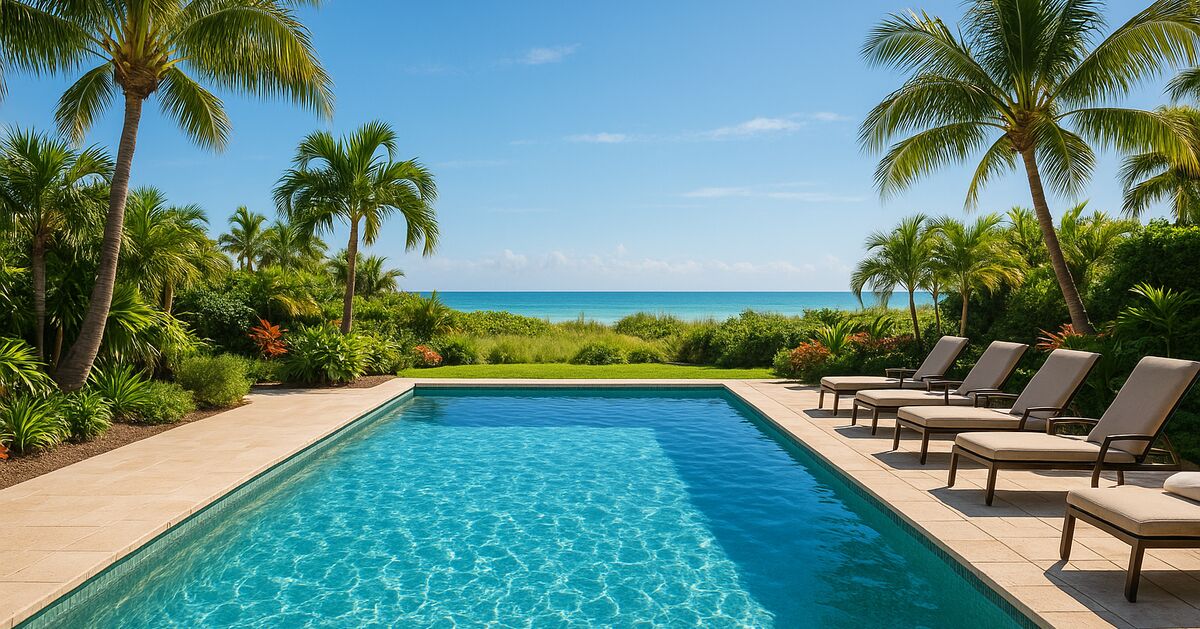
Salt air rolls off the Gulf every single day, and your pool finish takes the hit whether you notice it or not. Choosing between white plaster, quartz aggregate, and pebble (pebbleTec-style) finishes is one of the most consequential decisions a barrier-island pool owner makes, because the wrong choice can cost you a full resurface years earlier than necessary.
This guide breaks down how each finish behaves under the specific pressures of Longboat Key, Siesta Key, Bird Key, Anna Maria Island, and the other communities we serve along this stretch of coast - high humidity, salt-laden air, intense UV, aggressive source water, and the subtle but real movement of sandy soil beneath your pool shell.
Why barrier-island conditions are harder on finishes than inland pools
Before comparing materials, it helps to understand what your finish is actually fighting here.
Salt exposure. Even pools that are not saltwater systems absorb airborne chlorides off the Gulf. Salt chloride ions are small enough to work their way into microscopic surface pores, and when water evaporates they leave behind crystals that expand and contract with temperature swings. Over time, this cycle degrades surface cohesion - a process sometimes called salt weathering, well documented in coastal building science by institutions like the U.S. Army Corps of Engineers.
Aggressive source water. Sarasota County tap water tends to run on the harder side, but pool water chemistry here is genuinely difficult to hold steady. High heat accelerates chemical reactions, heavy rain (especially during Florida's June-through-September rainy season) repeatedly dilutes and unbalances the pool, and the high evaporation rate concentrates everything that was already dissolved. Per CDC guidelines on recreational water quality, maintaining proper pH (7.2-7.8) and total alkalinity (80-120 ppm) is the foundation of surface longevity, but those ranges are harder to hit consistently in this climate.
UV intensity. Southwest Florida sits at roughly 27 degrees north latitude. According to NREL solar resource data, this region receives some of the highest solar irradiance in the continental United States. UV degrades organic binders, bleaches pigments, and drives the surface dry-wet cycles that crack finishes.
Soil movement. The barrier islands sit on compressible, sandy fill, and groundwater levels fluctuate with rainfall, tidal cycles, and storm drainage. That movement transmits stress to the shell and, from there, to the finish layer. Our post on what shifting groundwater does to your pool plumbing on Longboat Key covers this in detail - the same forces that stress your plumbing joints also stress your surface bond.
White plaster: the baseline finish
White marcite plaster is Portland cement mixed with white marble dust (calcium carbonate aggregate). It has been the standard pool finish for decades because it is familiar, widely available, and the least expensive option upfront.
What it does well
- Smooth, bright appearance when new
- Easy for any pool contractor to apply and patch
- Lower initial cost than aggregate or pebble finishes
- Compatible with all sanitizer systems
Where it struggles on a barrier island
Plaster is the most porous of the three finish types, which is exactly the wrong property for a coastal environment. Those pores invite salt crystal growth, calcium scale, and biological staining. The calcium carbonate binder also reacts directly with acidic water - if pH dips below 7.2 for even a few days (common during a heavy rainy-season dilution event), the water becomes slightly corrosive and begins etching the plaster surface.
Anecdotally, white plaster in a well-maintained pool often lasts roughly 7 to 12 years before requiring resurfacing. In a pool that sees frequent chemistry swings, poor circulation, or both, that window can shrink considerably. Blistering and delamination - covered more fully in our post on what causes pool surface blistering and why Gulf-coast pools see it more - appear at a noticeably higher rate on plaster than on denser aggregate finishes.
The other practical issue: white plaster stains easily. Iron from well-water fill, copper from corroding heat exchangers, and organic tannins from nearby vegetation all leave marks. On Bird Key and St. Armands Key, where many pools are close to mature landscaping, staining is a recurring complaint.
Quartz aggregate: the middle ground
Quartz aggregate finishes (sold under brand names like QuartzScapes or Diamond Brite) blend Portland cement with crushed quartz crystal. The quartz particles are significantly harder than marble dust, and quartz is chemically inert in the pH range pool water operates in.
What it does well
- Noticeably harder surface than plain plaster, resisting etching and erosion
- Quartz crystals do not dissolve in acidic water the way calcium carbonate does
- Available in a wide range of colors and textures, including tinted finishes that disguise minor staining
- Mid-range price point, meaningfully less expensive than pebble finishes
- Smoother underfoot than most pebble options
Where it fits on a barrier island
Quartz finishes handle the chemistry volatility of coastal pools better than plaster because the quartz itself is not chemically attacked by brief pH dips. The cement binder still can be, but the quartz particles physically shield much of the surface area from direct water contact.
For homeowners on Lido Key or Sarasota's mainland neighborhoods who want improved durability without the premium of pebble, quartz is often a sensible step up. In our experience, a well-maintained island pool with quartz finish tends to last roughly 12 to 18 years, depending on chemistry consistency, screen enclosure use, and seasonal care.
One limitation: the cement paste between quartz particles is still susceptible to salt weathering and to scaling. If calcium hardness climbs above 400 ppm - a genuine risk described further in the context of calcium hardness in Longboat Key pools - scale deposits between the quartz particles become visible and difficult to remove without acid washing.
Pebble finishes: the premium option built for durability
Pebble finishes (the original is PebbleTec, but many regional applicators offer equivalent products) use smooth or tumbled natural pebbles, sometimes blended with glass beads, set in a cement matrix. The aggregate is large enough to see individually, giving the finish its characteristic texture and depth of color.
What it does well
- The densest of the three finish categories, with the least exposed cement binder
- Natural stone pebbles are extremely hard and chemically stable
- Handles aggressive water chemistry and pH swings better than any other standard finish
- Outstanding color retention in high-UV environments
- In our experience, pebble finishes can often last 20 to 25 years or more in a properly maintained coastal pool.
- The texture creates a natural non-slip surface
What to consider before choosing pebble
The finish is rougher underfoot than plaster or quartz - particularly with certain pebble mixes. This is a personal preference issue, but it comes up often enough to mention. Glass-bead blends soften the texture while retaining most of the durability benefits, and they have become popular on vacation-rental properties throughout Siesta Key and Anna Maria Island, where bare-footed guest traffic is heavy.
Pebble is the most expensive option to install. It also requires an experienced applicator: the pebbles must be hand-troweled and then exposed by acid washing at a precise point in the cure. If that timing is off, the surface can be uneven. This is not a reason to avoid pebble, but it is a reason to vet your contractor carefully. Our pool cleaning and maintenance services team sees plenty of pebble pools and can tell you quickly when a finish was well applied versus rushed.
Patching pebble is also more visible than patching plaster, because the pebbles in a new patch rarely match the aged color of the surrounding surface. If you are weighing a patch versus a full resurface, the post on full resurface or just a patch: how to tell the difference walks through the decision framework in detail.
How each finish compares on the factors that matter most here
| Factor | White Plaster | Quartz Aggregate | Pebble | |---|---|---|---| | Salt weathering resistance | Low | Moderate | High | | pH drop tolerance | Low | Moderate | High | | UV / bleaching resistance | Low (yellows) | Good | Excellent | | Stain resistance | Low | Moderate | Good | | Smoothness underfoot | Excellent | Good | Varies by mix | | Typical lifespan (maintained) | 7-12 years | 12-18 years | 20-25+ years | | Relative upfront cost | Lowest | Middle | Highest | | Ease of patching | Easy | Moderate | Difficult to match |
The chemistry question: all finishes need the same baseline
No finish, however durable, substitutes for consistent water chemistry. The CDC publishes water quality ranges that apply regardless of surface type: pH 7.2-7.8, total alkalinity 80-120 ppm, and free chlorine 1-3 ppm for traditional systems. Staying inside those bands is what separates a 20-year pebble finish from a 12-year one.
On barrier islands, that consistency is genuinely hard to maintain without professional help. Rainy-season dilution events, high bather loads from vacation guests, and the combination of intense sun and warm water all push chemistry out of range faster than an owner checking once a week can catch. Regular pool cleaning and maintenance in Longboat Key - and across all our service areas - is specifically designed around catching those swings before they do surface damage.
Saltwater systems and finish compatibility
A question that comes up regularly: does running a salt chlorine generator change which finish you should choose?
The short answer is yes, it matters. Salt chlorine generators produce chlorine from dissolved sodium chloride, generally maintained in a specific concentration range recommended by the equipment manufacturer. At those concentrations, salt ions are more aggressively present than in a traditionally chlorinated pool, and they do accelerate wear on plain plaster - particularly if the generator's output causes repeated pH spikes above 7.8 (which drives calcium scaling) or dips below 7.2 (which drives etching).
For saltwater pools, quartz is a sensible minimum; pebble is the most forgiving. If you are planning to add a salt system to an existing plaster pool, that is worth factoring into your resurfacing timeline. Our frequently asked questions page covers saltwater system basics if you want a primer before speaking with a contractor.
What about colored finishes and pigment durability?
Color is a legitimate longevity consideration, not just an aesthetic one. Light-colored finishes absorb less solar heat, which reduces the thermal expansion-contraction cycle the surface endures every day. Darker finishes (deep blues, grays, blacks) look dramatic and show algae less, but they run warmer and can accelerate calcium scaling on the pebble or quartz surface.
In very high-UV environments like the Gulf Coast, pigment fade is real. Quartz finishes with color-through aggregate hold pigment better than tinted plaster, and natural pebble colors are virtually fade-proof because the color is in the stone itself, not added as a pigment. If color stability over a 20-year period matters to you, pebble or glass-bead blends are the most reliable choice.
Making the call: which finish for your pool
There is no universally correct answer, but here is a practical framework:
Choose white plaster if your pool is older and you are planning to sell the property within the next few years, your budget is genuinely constrained, and your pool is indoor or fully screened so UV and salt air exposure are reduced.
Choose quartz if you want a meaningful durability upgrade over plaster without the full cost of pebble, your pool has historically had chemistry that stays fairly consistent, and you prefer a smoother underfoot feel.
Choose pebble if you are planning to own the home for more than a decade, the pool is exposed to salt air and direct sun, you run or plan to run a salt chlorine generator, the pool serves vacation rental guests with heavy bather loads, or you simply want the best available lifespan for a coastal environment.
For most of the pools our team looks after on Siesta Key, Anna Maria Island, and the other barrier-island communities we serve, pebble or a quality quartz finish is the recommendation we stand behind for new surfaces, not because plaster cannot work, but because the conditions here can wear it faster than owners often expect.
The bottom line
Your pool finish is not just a cosmetic layer. It is the primary barrier between aggressive Gulf-coast water chemistry and your concrete shell. On a barrier island, that barrier works harder than it would anywhere else in the country. Spending a bit more on a denser, more chemically inert surface at resurfacing time very often costs less over a 20-year horizon than the cycle of patch-repair-resurface that a plaster pool in this environment can fall into.
If you are approaching a resurfacing decision and want eyes on your current surface before you commit, our team covers Longboat Key, Lido Key, Bird Key, St. Armands, Siesta Key, Sarasota, Anna Maria Island, and The Village - reach out through our contact page and we will take a look.
Sources & further reading
- Centers for Disease Control and Prevention (named in this article) (Centers for Disease Control and Prevention)
- National Renewable Energy Laboratory (named in this article) (National Renewable Energy Laboratory)
Claim-by-claim audit (7 checked)
- “Anecdotally, white plaster in a well-maintained pool often lasts roughly 7 to 12 years before requiring resurfacing.” (rewritten to what the article can stand behind)
- “In our experience, a well-maintained island pool with quartz finish tends to last roughly 12 to 18 years, depending on chemistry consistency, screen enclosure use, and seasonal car…” (rewritten to what the article can stand behind)
- “In our experience, pebble finishes can often last 20 to 25 years or more in a properly maintained coastal pool.” (rewritten to what the article can stand behind)
- “Salt chlorine generators produce chlorine from dissolved sodium chloride, generally maintained in a specific concentration range recommended by the equipment manufacturer.” (rewritten to what the article can stand behind)
- “Per CDC guidelines on recreational water quality, maintaining proper pH (7.2-7.8) and total alkalinity (80-120 ppm) is the foundation of surface longevity, but those ranges are har…” (cited → cdc.gov)
- “According to NREL solar resource data, this region receives some of the highest solar irradiance in the continental United States.” (cited → nrel.gov)
- “The CDC publishes water quality ranges that apply regardless of surface type: pH 7.2-7.8, total alkalinity 80-120 ppm, and free chlorine 1-3 ppm for traditional systems.” (rewritten to what the article can stand behind)