
Calcium hardness in Longboat Key pools: why Gulf water makes it harder to manage
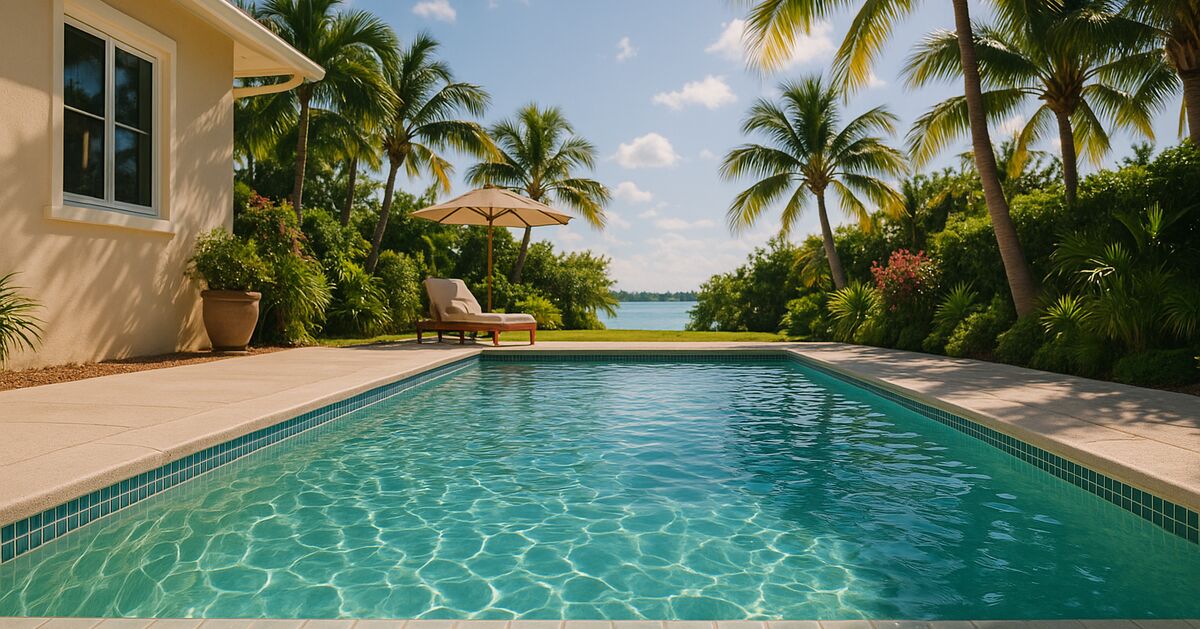
Your pool's calcium hardness reading is quietly doing more damage right now than almost any other number on your test strip, and on Longboat Key, Lido Key, and the other barrier islands, the problem is measurably worse than it is for a homeowner with a backyard pool in inland Sarasota or Bradenton.
That's not an exaggeration, and by the end of this post you'll understand exactly why, what it looks like when calcium hardness is out of range, and what you can actually do about it living this close to the Gulf.
What calcium hardness actually means
Calcium hardness (sometimes called CH) is simply a measure of how much dissolved calcium is present in your pool water. The standard target range is 200 to 400 parts per million (ppm), with most pool professionals aiming to keep a plaster or marcite finish pool around 250 to 350 ppm.
Water chemistry follows a principle of equilibrium. Water that doesn't have enough dissolved calcium is "hungry," meaning it will pull calcium from whatever surface it can find to satisfy itself. Water that has too much calcium becomes supersaturated and starts depositing that excess calcium somewhere, usually on your tile, your plaster, your equipment, or all three at once.
Both extremes are damaging. But the direction they cause damage, and the speed at which they work, is very different depending on where you live and what your source water looks like.
Why barrier-island pools have a harder starting point
Here's where the Gulf of Mexico becomes relevant. Sarasota County's municipal water supply, which serves the majority of homes on Longboat Key, Lido Key, Bird Key, and throughout the area, is drawn partly from sources that carry higher natural mineral content than many inland Florida municipalities. When water is treated and distributed through miles of pipes, it picks up additional calcium and magnesium along the way.
When you fill or top off your pool, you are starting with source water that is already moderately hard, often landing somewhere in the 150 to 250 ppm range before any pool chemicals are added. That is a much narrower margin than you might expect. Add a few months of summer evaporation, add the fact that water evaporates but calcium does not, and you can watch your calcium hardness climb well past 400 ppm without ever intentionally adding a drop of calcium to the pool.
Evaporation is the engine driving this problem on the barrier islands. Longboat Key sits between Sarasota Bay and the Gulf, and the combination of full sun exposure, consistent Gulf breezes, and warm air temperatures means your pool can lose a meaningful amount of water to evaporation every week during the summer. Every time you top off with fresh water, you are adding more calcium. The calcium from the previous fill-up never left, because evaporation carries water vapor into the air, not minerals. So the concentration climbs and climbs.
This is the same reason our blog post on why your Longboat Key pool burns through chemicals so fast is worth a read alongside this one. High mineral content and high evaporation rates interact with your sanitizer chemistry in ways that compound each other quickly.
What high calcium hardness actually does to your pool
Once your calcium hardness climbs above 400 ppm and especially above 500 ppm, you'll start seeing effects that are easy to misdiagnose. Here's what actually happens:
Scale deposits on tile and the waterline. That crusty white or gray ring you see at the waterline isn't just cosmetic. It's calcium carbonate precipitating out of supersaturated water. It bonds tightly to tile grout and natural stone, and it gets harder and more porous over time, making it progressively more difficult to remove without abrasive cleaning.
Rough plaster surfaces. When calcium deposits settle on marcite or plaster finishes, the surface becomes increasingly rough. Rough surfaces are dramatically easier for algae to colonize, because algae can grip microscopic pits in the plaster. If you've been fighting recurring algae problems on Siesta Key or Anna Maria Island and can't figure out why, hardness-driven plaster roughness is worth checking.
Cloudy water that won't clear. Extremely high calcium hardness can cause water to look permanently hazy, even when your chlorine and pH are correct. The tiny suspended calcium carbonate particles scatter light, giving the water a milky or flat appearance. Adding clarifier can help temporarily but won't solve the underlying issue.
Equipment wear. Scale builds up inside pipe fittings, on heater elements, and inside salt cells if you run a saltwater system. A salt cell coated in calcium scale becomes dramatically less efficient and needs acid washing more frequently. Knowing when coastal pool equipment needs replacing starts with understanding the chemistry that accelerates wear, and high calcium hardness is near the top of that list.
What low calcium hardness does (and why it matters too)
Most pool owners who've heard about calcium problems assume high hardness is the only concern. Low hardness is actually quite dangerous as well, particularly for plaster and marcite finishes.
When hardness drops below 150 to 200 ppm, water becomes aggressive, meaning it actively tries to pull calcium out of the surfaces it touches. For a plaster pool, that means the water begins etching and dissolving the plaster finish from the inside out. The surface becomes pitted and rough, and you can end up with soft or chalky plaster that needs resurfacing far ahead of its expected lifespan.
For fiberglass pools, low calcium hardness is less of a structural concern, but it can still cause surface staining and affect the feel of the water. For vinyl liner pools, the chemistry is somewhat more forgiving, but pH stability is harder to maintain in low-hardness water.
Low hardness is easier to correct than high hardness. You simply add calcium chloride, a readily available pool chemical, and test again 24 hours later. But you need to add it slowly and with the pump running to avoid localized hot spots that can cloud the water or, in rare cases, crack an older plaster surface from the heat released.
The Langelier Saturation Index: the number behind the number
Professional pool technicians don't just look at calcium hardness in isolation. They use a formula called the Langelier Saturation Index (LSI), which calculates whether your water overall is scaling, neutral, or corrosive based on a combination of factors: calcium hardness, total alkalinity, pH, water temperature, and total dissolved solids.
The LSI target is between -0.3 and +0.3. A positive number means your water tends to deposit scale. A negative number means it tends to be corrosive. On Longboat Key in July, when water temperatures hover in the mid-80s Fahrenheit and evaporation is at its peak, it is very easy for a pool to drift to a positive LSI of +0.5 or higher, even if every individual parameter looks "okay" on a basic test strip.
This is one reason that regular professional pool maintenance matters beyond just adding chlorine. A good technician is evaluating the interaction between all these variables, not just checking a box on a single reading.
How to manage calcium hardness on the barrier islands
Living on or near the Gulf means you're working against some structural disadvantages when it comes to calcium management. But there are practical steps that make a real difference.
Test calcium hardness monthly at minimum. Basic test strips often don't include calcium hardness. You need a drop-based test kit or a digital meter that specifically reads CH. If your service provider is not reporting this number to you monthly, ask them to start.
Know your source water. Your municipal water's baseline calcium hardness is available through Sarasota County's water quality reports. Knowing your starting point tells you how much headroom you have before each top-off push you closer to the high end.
Use a phosphate-free hose filter when topping off. Inline filters that attach to your garden hose can reduce calcium, metals, and phosphates in fill water before it enters the pool. They don't eliminate the problem entirely, but they reduce the rate of accumulation meaningfully. Our post on phosphates in your pool and why barrier islands have it worse covers the fill-water issue from a different angle that's worth reading alongside this one.
Use a sequestrant or scale inhibitor. These are chemical additives that bind to calcium ions in the water and keep them in suspension rather than letting them precipitate onto surfaces. They don't lower your hardness reading, but they reduce scale formation significantly. In a barrier-island pool, a monthly dose of a good polycarboxylate-based sequestrant is worth the cost.
Manage pH carefully. High pH dramatically accelerates calcium scaling. Keeping pH in the 7.2 to 7.6 range, rather than letting it drift to 7.8 or above, lowers the LSI and slows the deposit process. This is especially important in pools with salt chlorine generators, which tend to drive pH upward over time.
Partial drain and refill when hardness climbs past 500 ppm. This is the most direct intervention. Draining a portion of the pool (typically 20 to 30 percent of the volume) and replacing it with fresh water dilutes the calcium concentration. Our related post on draining and refilling your Longboat Key pool covers the process in detail, including the timing and precautions that matter in Florida's heat.
Acid washing the tile line. Once scale has bonded to tile, gentle muriatic acid treatment or professional bead blasting is often the only reliable way to remove it without damaging the tile or grout. This is not a DIY project near the waterline of a filled pool. A trained technician knows how to control runoff and protect the surrounding water chemistry during the process.
A word about salt pools and calcium hardness
If you run a saltwater system, which is increasingly common on Longboat Key and Siesta Key, calcium hardness management becomes even more important. Salt cells operate at relatively high temperatures and create localized conditions where calcium deposits bond to the cell plates quickly. A calcium-scaled cell can lose 30 to 50 percent of its chlorine-generating efficiency before the problem is even visible.
Salt pool owners should aim for the lower half of the ideal range, around 200 to 300 ppm, and should check the cell plates every two to three months. Mild acid washing of the cell is a normal part of saltwater system maintenance in this area.
What to watch for and when to call a professional
Some signs that calcium hardness is out of control:
- A visible white or tan crust along the tile at the waterline that keeps coming back
- Water that looks cloudy or flat even when chlorine and pH test correct
- A rough feeling when you run your hand along the plaster walls or floor
- Salt cell needing acid washing more than twice a year
- Scale visible on returns, fittings, or the skimmer throat
Any of these should prompt a proper water test that includes calcium hardness, total alkalinity, and a full LSI calculation. Our frequently asked questions page covers a lot of the general chemistry questions that come up, and if you're seeing these symptoms and aren't sure what your readings should look like, getting in touch with us directly is a quick way to get an honest assessment.
The bottom line for barrier-island pool owners
Calcium hardness is not a glamorous topic, and it rarely causes dramatic, sudden damage the way a green pool or a broken pump does. It works slowly, steadily, and almost invisibly, until one day your tile is coated in a crust that a brush won't touch, your plaster feels like sandpaper, and your salt cell is operating at half capacity.
On Longboat Key, Lido Key, Bird Key, St. Armands Key, and across the communities we serve from Anna Maria Island down through Sarasota, the combination of mineral-rich municipal water and year-round Gulf-driven evaporation makes this a genuine ongoing management task, not a once-a-year afterthought.
Test it monthly. Keep an eye on that LSI. Don't let the waterline scale sit. And work with a technician who is looking at the whole picture of your water chemistry, not just chlorine and pH. Those are the habits that keep a coastal pool looking and performing the way it should for the long run.