
How to know when coastal pool equipment needs replacing
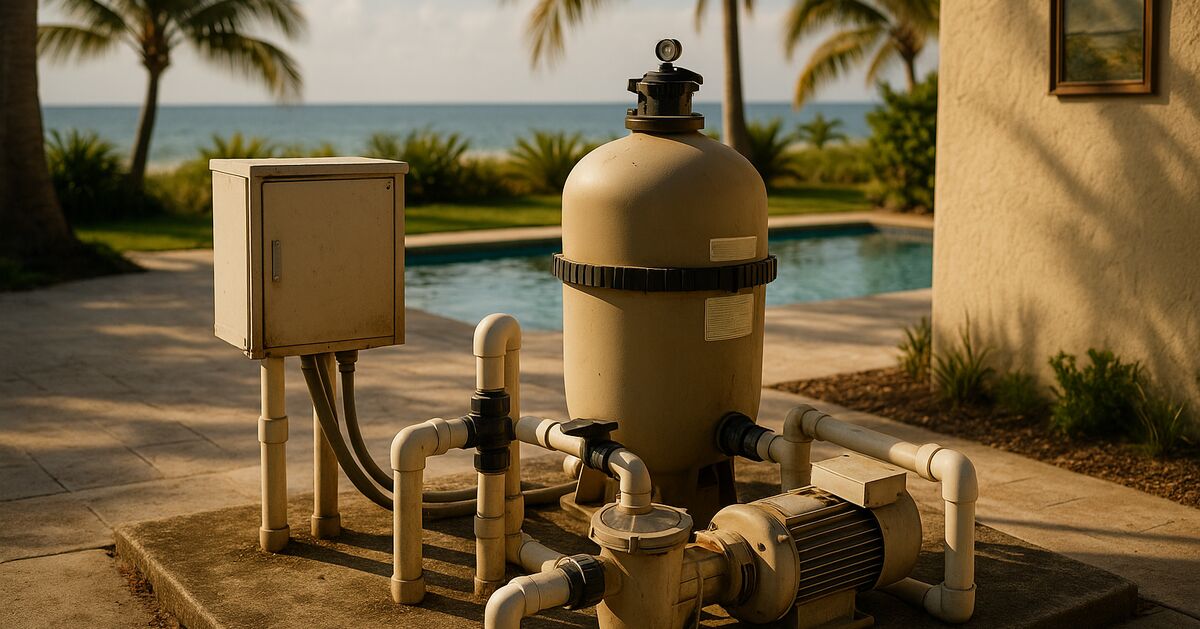
Salt air is not subtle. Walk past a pool pump that's been sitting on a Longboat Key patio for six or seven years and you'll see it: the housing is chalky, the hardware is rust-streaked, and the label is barely legible. That's not neglect. That's just what the Gulf Coast does to equipment that would last a decade or more in a drier, inland climate.
Knowing when to replace a piece of pool equipment, rather than patching it one more time, is one of the most practical things a barrier-island homeowner can learn. Replace too early and you're throwing away money. Wait too long and a failed pump or corroded heater causes bigger, more expensive damage downstream. This guide walks through every major piece of equipment, the coastal factors that shorten its life, and the specific signs that tell you it's time to stop repairing and start shopping.
Why the coast shortens equipment lifespan
Before diving into individual components, it helps to understand the three stressors that are unique to barrier-island pools.
Salt-laden air. This is the big one. Homes on Longboat Key, Lido Key, Bird Key, and Siesta Key sit within a few hundred feet of open Gulf or bay water. Salt particles in the air settle on every exposed metal surface: pump housings, motor windings, heat exchanger fins, conduit fittings, timer boxes. Salt is hygroscopic, meaning it pulls moisture out of the air and holds it against the metal. That's a perfect recipe for accelerated oxidation.
High humidity and heat. Sarasota-area summers routinely combine 90-degree temperatures with 90-percent humidity. That combination is brutal on rubber seals, plastic fittings, and the lubricants inside motors. Thermal cycling, where equipment heats up during the day and cools at night, causes expansion and contraction that slowly loosens connections and cracks housings.
Hard, minerally source water combined with splash-out. Gulf Coast tap water is relatively high in calcium and minerals. Every time water splashes onto the equipment pad, it leaves a mineral deposit behind when it evaporates. Over years, those deposits work into threads, valve seats, and sensor ports. Combine that with the salt air and you have a compound corrosion problem that's genuinely different from what pool equipment faces inland.
Our pool cleaning and maintenance services include an equipment inspection at every visit precisely because catching early corrosion is so much cheaper than dealing with a full failure.
Pool pumps: the heart of the system
Typical inland lifespan: 8 to 12 years. Realistic coastal lifespan: 5 to 9 years, sometimes less for single-speed pumps that run long hours.
A pump that's doing its job is quiet, moves water at a consistent rate, and starts without complaint. Here's what to watch for as it ages:
- Grinding or screeching noise. Bearings are the first mechanical component to fail. Once you hear that sound, the motor is probably weeks away from seizing.
- Visible rust bleeding from the motor casing. Surface rust on the exterior is cosmetic. Rust weeping from seams or vents means the interior windings are corroding, and motor failure is close.
- Tripping the breaker on startup. A pump that pulls too much current is usually a failing capacitor or a motor winding that's deteriorating. A capacitor swap is a reasonable repair; a failing winding is a replacement decision.
- Leaking at the shaft seal. A single shaft seal replacement is worth doing once. If it fails again within a season or two, the pump housing itself is usually warped or pitted from corrosion and a new seal won't hold reliably.
- Variable-speed drive errors. Variable-speed pumps have electronic controllers that are sensitive to voltage fluctuations and heat. If yours is throwing fault codes regularly and cleaning the controller doesn't help, the drive board is often more expensive to replace than a new pump costs.
If your pump is past the six-year mark on a barrier island and showing two or more of these signs, replacement is almost always the better economic choice over repair.
Filters: sand, cartridge, and DE
Filters are simpler mechanically, but the vessels and internal components still degrade on the coast.
Sand filters are the most durable in terms of the tank itself, but the internal laterals (the plastic spider arms at the bottom) become brittle over time. A cracked lateral sends sand into your pool return lines. If you're finding sand on the pool floor after backwashing, that's a lateral problem. Replacing laterals is a mid-level repair. But if the tank itself is showing spider cracks or the multiport valve is corroding at the body, replacement of the whole unit makes more sense.
Cartridge filters need new cartridges roughly every 1 to 3 years depending on bather load and how well the water chemistry is maintained. The housing on a cartridge filter generally outlasts the cartridges by a wide margin, but examine the o-ring groove and the pressure gauge port for corrosion every year. A cartridge filter that won't hold pressure despite a fresh o-ring usually has a compromised lid or band clamp.
DE filters are the most maintenance-intensive and the most sensitive to neglect. The grids inside can tear, and torn grids allow DE powder into the pool. If you're adding DE and still getting DE-cloudy water on the returns, inspect the grids before assuming anything else is wrong.
All three filter types share one diagnostic rule: if your pressure gauge reads 8 to 10 PSI above the clean baseline and the filter doesn't recover after a backwash or cleaning, something inside is broken or the tank capacity is genuinely undersized for the pool's bather load.
Heaters and heat pumps
Typical inland lifespan: Gas heaters 7 to 12 years; heat pumps 10 to 15 years. Realistic coastal lifespan: Gas heaters 5 to 9 years; heat pumps 8 to 12 years.
Heaters take the hardest beating from salt air because their heat exchangers, typically copper or cupro-nickel, are finned for maximum air exposure. That's the same design that maximizes salt-air contact.
Signs it's time to replace a heater or heat pump:
- Visible green or white corrosion on the heat exchanger fins. Light surface deposits can be carefully cleaned. But if the fins are crumbling or you can see pinhole corrosion in the exchanger tubes, leaks are coming.
- Water leaking from the bottom of the heater cabinet. This almost always means the heat exchanger itself is cracked or pitted. Exchanger replacement on an older unit often costs more than a new heater.
- "Hc" or "Lo" flow fault codes that persist after cleaning the filter. These can indicate a failing flow switch or a partially blocked exchanger. If the unit is older and the repair quote is above half the cost of a new unit, replacement wins.
- Poor heating efficiency. A heat pump that used to bring the pool up to temperature overnight now takes two days, and the refrigerant has been checked recently, is telling you the compressor is worn.
Automation systems and control boards
Automation systems, the boxes that let you control your pump, heater, lights, and valves from an app or a wall panel, age differently than mechanical equipment. The boards inside are electronic, and electronics on the coast suffer from the same humidity and salt-air corrosion that affects everything else.
A control board that's starting to behave erratically, dropping communication with the app, misfiring relay schedules, or showing error codes that clear themselves, may simply need the board cleaned of oxidation. But boards that have visible green verdigris on the traces, or that fail repeatedly after cleaning, need replacement. Most automation brand replacement boards are specific to the model, so getting a quote before the old unit fully fails is smart.
Salt chlorine generators (saltwater pools)
The cell in a salt chlorine generator is a wear item by design. Cells typically last 3 to 5 years before the electrode plates erode enough to reduce chlorine output. The tell is straightforward: the salt level reads normal, the flow is normal, but your free chlorine is chronically low and you're compensating by running the cell at 100 percent all the time.
On the coast, the cell controller board faces the same corrosion risks as any other electronics. If you own a saltwater pool on Siesta Key, Anna Maria Island, or anywhere along the barrier islands and your salt system is over four years old, get the cell inspected before rainy season starts. Low chlorine output going into Florida's summer is a direct path to an algae problem, and Gulf-coast algae prevention during rainy season depends heavily on having a reliable, fully functional sanitizer.
Pool lights
LED pool lights have transformed what used to be a maintenance headache. A quality LED fixture can last 15 to 20 years, but the niche (the housing in the pool wall) and the conduit that runs the wiring are the more common failure points on the coast.
If a light is flickering or simply won't turn on, work through the simple steps first: check the GFCI breaker, then check the connection at the junction box. Corrosion at the junction box is extremely common on barrier-island homes. If the junction box terminals are green and pitted, clean and retorque them before assuming the fixture is dead.
A fixture that floods with water (you can see it sloshing inside the lens) needs immediate attention, not for the light itself but because water in the conduit can reach the junction box and create a shock hazard.
How to prioritize when everything seems old
It's common for homeowners in The Village, on Bird Key, or on St. Armands Key to inherit an older system when they buy a property, and everything might be aging at once. Here's a simple priority order:
- Safety first. Anything electrical with water intrusion or visible corrosion at wiring points gets addressed before anything else.
- Water circulation second. Without a working pump and clean filter, nothing else matters. Keep circulation reliable.
- Sanitation third. The chlorine generator or any automated chemical dosing system needs to be reliable before summer.
- Comfort last. Heaters and lighting, while valuable, can wait a short time if resources are limited.
If you're not sure where your system stands, a full equipment inspection is the right starting point. Our team covers Longboat Key pool maintenance, Siesta Key pool maintenance, Anna Maria Island pool maintenance, and all of our service areas with thorough equipment checks as part of regular service.
The repair-or-replace rule of thumb
This is the rule most pool technicians use in the field: if a repair costs more than 50 percent of the replacement cost, and the equipment is past two-thirds of its expected coastal lifespan, replace it. The logic is simple. You're spending significant money on a component that is already aged and will likely have the next failure soon. Two repairs in two years often cost more than one proactive replacement.
The exception is structural items like the plumbing, the equipment pad, and the pool shell itself. Those are worth repairing as long as the repair is sound, because replacement is enormously more expensive.
Making the new equipment last longer
When you do replace equipment on a barrier-island property, a few habits extend the new unit's life meaningfully:
- Rinse equipment pads after heavy weather or blown-in salt spray. A quick rinse with fresh water removes the salt before it can dry and concentrate.
- Use a quality motor cover or equipment enclosure that allows airflow but blocks direct salt spray. This is especially important for homes on the west-facing Gulf side of Longboat Key or Lido Key.
- Lubricate o-rings with a silicone-based lubricant at every filter clean. Never use petroleum-based grease, which destroys rubber.
- Maintain water chemistry consistently. Corrosive or scale-forming water attacks internal components from the inside. Keeping pH, alkalinity, and calcium hardness balanced protects the equipment as much as it protects the pool surface. Our FAQ page covers the basics of what those numbers should look like.
When to call a professional
Some of these diagnostics are genuinely DIY-friendly: checking a GFCI, reading a pressure gauge, visually inspecting a cell. Others, particularly anything involving electrical components, high-voltage motors, or gas connections, should be handled by a qualified technician. If you're not certain, err toward calling for help. The cost of a service call is trivial compared to the cost of an electrical fault or a gas leak.
The team at Longboat Key Pool Service has been working on coastal equipment long enough to know the difference between a component that just needs cleaning and one that's genuinely at the end of its road. If you'd like an honest assessment of where your system stands, reach out and schedule an inspection. There's no obligation, and knowing the real condition of your equipment is always worth more than guessing.