
Algae prevention for Gulf-coast pools: a rainy-season
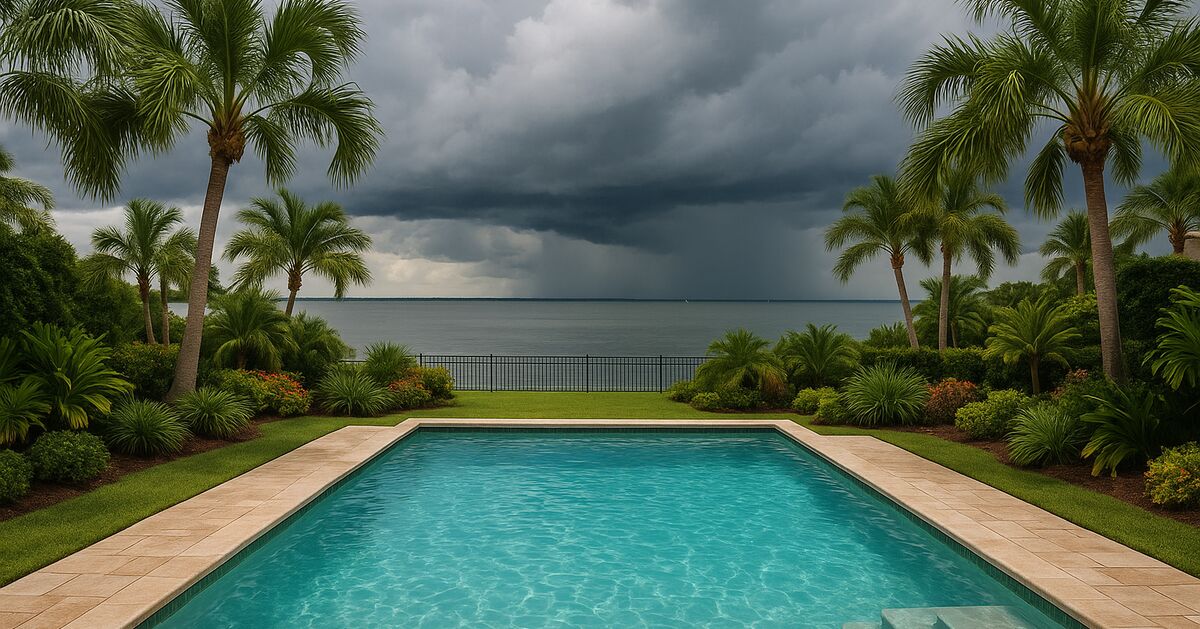
Florida's rainy season doesn't ask permission before it wrecks your pool chemistry. One afternoon thunderstorm can dump two inches of rain in forty minutes, dilute your sanitizer, spike your phosphates, and drop your pH, all before you've finished drying off from your last swim. If you own a pool on Longboat Key, Siesta Key, Anna Maria Island, or anywhere along this stretch of Gulf coast, you already know how fast a perfectly balanced pool can turn swampy green in July or August. The good news is that algae outbreaks during rainy season are almost entirely preventable. They just require a more proactive routine than the rest of the year.
This guide covers the specific steps that actually work here, on the Gulf coast, where the combination of heat, humidity, afternoon storms, and salt air creates conditions that are genuinely harder to manage than what you'd find in a backyard pool in Ohio.
Why rain is such a powerful algae trigger
Most people think of algae as a sunlight problem. Sunlight matters, but rainfall is the more immediate trigger during Florida's summer months. Here's what a single heavy rain event does to your pool:
- Dilutes free chlorine. Rainwater contains almost no chlorine. When inches of it fall into your pool in a short period, your chlorine level drops quickly, sometimes below the 1 ppm threshold where it stops being an effective sanitizer.
- Drops pH and total alkalinity. Rainwater is slightly acidic. Lower pH throws off the efficiency of whatever chlorine you do have, meaning the remaining sanitizer works less effectively even before it's been diluted.
- Floods the pool with phosphates and organic debris. Rain carries pollen, dirt, bird droppings, decomposing plant matter, and atmospheric phosphates straight into the water. Phosphates are fertilizer for algae. More phosphates means algae can establish and multiply faster.
- Raises cyanuric acid indirectly. When water level rises and you drain some off, you lose some stabilizer. But when you add fresh chlorine to compensate for dilution, you can overcorrect. The chemistry after a storm is genuinely messy.
- Warms the water. Summer rain in southwest Florida is warm rain. It does almost nothing to cool your pool, and warm water speeds up algae reproduction.
For a deeper dive into how these factors combine to create the most difficult stretch of the year for pool owners, see our post on why rainy season is the hardest time to keep your Gulf-coast pool algae-free.
The week-before-rainy-season checklist
The single highest-leverage thing you can do is start rainy season with your chemistry tightly dialed in. Think of it as building a cushion against the disruptions that are coming.
Target these levels before June:
- Free chlorine: 3 to 5 ppm (toward the higher end of the range)
- pH: 7.4 to 7.6
- Total alkalinity: 80 to 120 ppm
- Cyanuric acid (stabilizer): 30 to 50 ppm
- Phosphates: as low as possible, ideally under 200 ppb
- Calcium hardness: 200 to 400 ppm
If your phosphates are elevated going into rainy season, treat them now with a phosphate remover before the storms start. Trying to drop phosphates while simultaneously fighting a forming algae bloom is much harder than simply starting the season clean.
This is also the right time to inspect your circulation system. A pool with poor circulation has dead spots where algae anchor first. Check that your return jets are angled to create a circular current, that your pump is running long enough each day (a minimum of eight hours in summer, and ideally ten to twelve), and that your filter is clean and flowing at normal pressure.
For a comprehensive look at the chemistry fundamentals that apply year-round in Florida, the post on pool chemistry basics: what every Florida owner needs to know is worth bookmarking.
What to do immediately after a heavy rain event
This is where most pool owners fall short. They check the water after the storm, the pool looks fine, and they move on. The problem is that algae doesn't show up visibly for twenty-four to seventy-two hours after the conditions that caused it are already in place. By the time you see green, you're already behind.
After any rain event that adds a significant amount of water to your pool, here is what to do:
1. Test your water first. Don't guess. Grab a reliable test kit or take a water sample to be tested. You need actual numbers before you start adding chemicals. Over-correcting is a real risk and creates its own problems.
2. Shock the pool. After a significant rain, shock regardless of how the water looks. Use a calcium hypochlorite shock (not a stabilized chlorine product, since adding more cyanuric acid mid-summer is usually not what you want). Shock in the evening so the sun doesn't burn off the chlorine before it can circulate.
3. Adjust pH before or alongside shocking. Shock works best at pH between 7.2 and 7.6. If rain has pulled your pH below 7.2, add sodium carbonate to bring it up. If the storm runoff pushed pH above 7.6, add muriatic acid carefully.
4. Run your pump overnight. After shocking, let the pump run for at least eight to twelve hours to circulate the treated water through every part of the pool. This is not the night to set the pump to a short cycle.
5. Brush the pool. Brush all surfaces, including the steps, corners, behind ladders, and along the waterline tile. Algae spores settle on surfaces and attach before they become visible. Brushing disrupts that process and pushes spores into the water column where your sanitizer can reach them.
6. Add a phosphate remover. After a storm, especially one that carried a lot of organic debris, dose the pool with a quality phosphate remover to bring levels back down before they feed an algae bloom.
7. Skim and vacuum. Remove any leaves, organic matter, or debris that settled on the bottom as quickly as possible. Decomposing organic matter consumes chlorine and feeds algae.
Algaecide: when it helps and when it doesn't
Algaecide is a supporting player, not a lead actor. A properly chlorinated and balanced pool rarely needs algaecide to stay clear. But used as a preventive tool during rainy season, a weekly dose of a quality polyquat algaecide (not the cheap copper-based formulas, which can stain plaster and salt systems) adds a layer of protection during the weeks when rain events are frequent.
What algaecide will not do: it will not clear an existing bloom on its own, and it will not substitute for adequate chlorine. If you're already seeing green or cloudy water, the fix is shock and brushing and circulation, not algaecide alone.
If you're running a saltwater chlorinator, note that these systems can struggle to keep up during heavy rain periods because the salt cell only produces as much chlorine as it can given the current salt concentration and run time. If heavy dilution has dropped your salt level, the cell produces less chlorine right when you need more. Supplementing with a liquid or granular chlorine shock after major storms is smart even if you have a salt system. For more on managing this balance, see our post on saltwater pool maintenance: what island homeowners should know.
Circulation is your most underrated algae weapon
You can have perfect chemistry on paper and still grow algae if your circulation has dead spots. This is especially relevant on the Gulf coast because the pools on Longboat Key, Bird Key, and Lido Key are often larger and more architecturally complex than a standard rectangular backyard pool. Irregular shapes, raised spas, tanning ledges, beach entries, and attached water features all create zones where water moves more slowly.
Algae always colonizes the still water first. That's why you see it behind the ladder before anywhere else, or in the far corner away from the returns. The fix is directing return jets to maximize circulation across the full pool surface and running the pump long enough each day that all the water turns over at least once, ideally twice.
During rainy season, this often means extending your pump run time. If you're on a timer set for eight hours, consider bumping it to ten or twelve hours in June through September. The electricity cost is real, but it's small compared to a green-to-clean chemical treatment.
The plants and landscaping factor on Gulf-coast properties
This one is specific to properties in our area. Lush tropical landscaping is part of what makes homes on Anna Maria Island, Siesta Key, and along the Sarasota bayfront so beautiful. But that landscaping produces a steady rain of pollen, leaves, seed pods, and organic debris into pools, especially during storms. Some plants are worse than others. Palms, bougainvillea, and large-leafed tropical plants drop substantial organic matter.
Keeping a clear zone of a few feet between dense plantings and the pool edge helps, as does frequent skimming and emptying the skimmer baskets. During rainy season, plan to skim daily if your pool is near heavy landscaping, rather than every few days. Letting organic debris sit and decompose in the water is one of the fastest ways to crash your chlorine level and spike your phosphates at the same time.
How often should you be testing during rainy season?
During the dry season, testing once a week is generally adequate for a well-maintained pool with stable chemistry. During rainy season, the minimum is twice a week, and testing after every significant rain event makes sense. The chemistry swings simply happen faster than a weekly test schedule can catch.
If you're not comfortable testing and adjusting your own chemistry, or if you just don't have the time to stay on top of a twice-weekly schedule during the summer, professional weekly service becomes genuinely valuable. A trained eye on the water every week means problems get caught when they're inexpensive to fix, not after they've turned into a full algae bloom that requires days of treatment. You can see what our pool cleaning and maintenance services include, or check our frequently asked questions for specifics on what a weekly visit covers.
When to call for professional help
There are situations where DIY treatment is not the right answer. If your water has turned fully green or dark, if you're seeing black algae (which has a root system and is particularly hard to kill), or if you've shocked the pool twice and it's still not clearing, it's time for a professional assessment.
Black algae in particular is common in pools with older plaster surfaces and requires aggressive brushing with a steel brush and very high chlorine levels maintained over several days. Misidentifying it or treating it too gently just lets it come back stronger.
Our pool cleaning and maintenance service for Longboat Key is specifically designed around the conditions on the Gulf coast, including rainy-season management. The same goes for our teams covering Siesta Key and Anna Maria Island, where summer storm patterns and landscaping create their own specific challenges.
A simple rainy-season rhythm to stick to
To pull it all together, here's the routine that keeps most Gulf-coast pools clean through Florida's summer:
- Weekly (at minimum): Test water, adjust chemistry, skim, brush walls and floor, empty skimmer and pump baskets, check pump and filter pressure.
- After every significant rain event: Retest water, shock, adjust pH, run pump overnight, brush, dose with phosphate remover, skim debris.
- Monthly: Check filter, backwash sand or D.E. filter if pressure has risen, inspect all equipment for wear.
- Ongoing: Keep pump run time at ten-plus hours per day through the summer months.
This is more work than the off-season requires, no question. But it's far less work than recovering from a green pool in August. Prevention is always faster, cheaper, and less frustrating than remediation.
If you'd like to hand that routine over to a team that knows these island pools well, get in touch with us and we'll put together a schedule that fits your pool and your summer plans.