
Saltwater pool maintenance: what island homeowners should
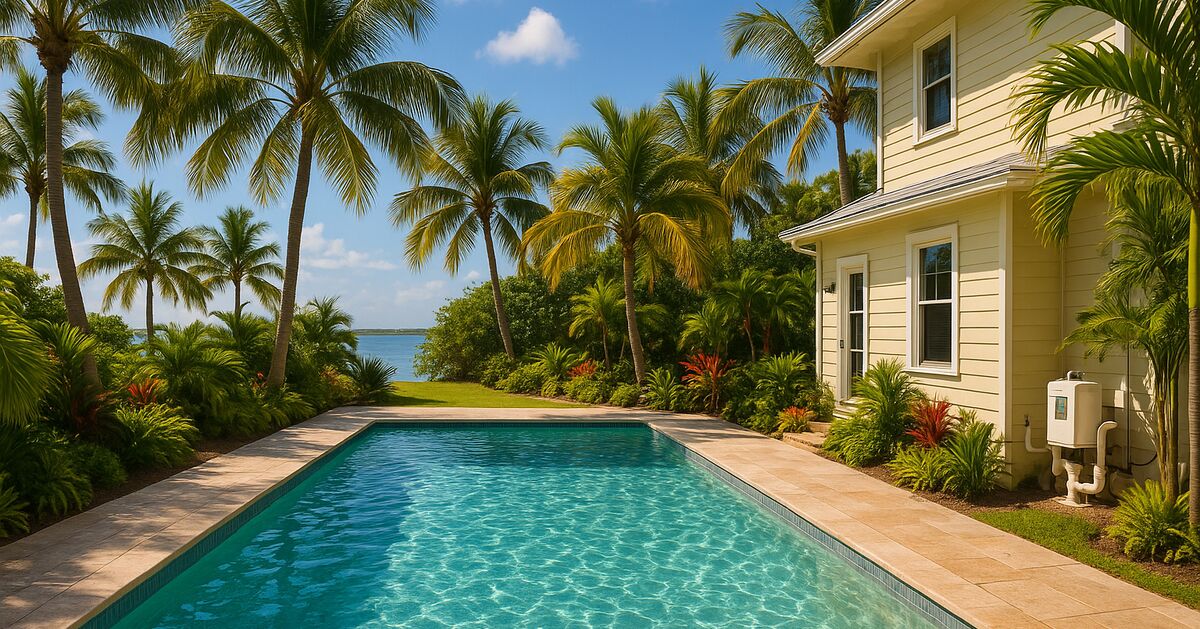
Saltwater pools look after themselves. That is the line you may have heard when you first considered the upgrade, and it is not entirely wrong - but it is not entirely right either. A salt chlorine generator does a beautiful job of producing chlorine continuously from dissolved salt, and that steady output really does make the water feel softer and smell less chemical. What it does not do is eliminate the need for maintenance. On a barrier island like Longboat Key, Lido Key, or Siesta Key, where the Gulf air is already laced with salt and the sun hammers pool water for ten or eleven months of the year, a saltwater pool still needs consistent, knowledgeable attention.
This post walks through exactly what that attention looks like: how a salt system actually works, what can go wrong and why, and what a practical maintenance routine should include for an island homeowner.
How a salt chlorine generator actually works
The generator - sometimes called a salt cell or SWG - is a device plumbed into your return line. As pool water flows through it, a low-voltage electrical charge passes between a set of titanium plates coated with a precious-metal catalyst. That process splits sodium chloride (the pool salt you add to the water) into chlorine gas and sodium hydroxide. The chlorine immediately dissolves and sanitizes the pool. Then it reverts to salt, and the cycle starts again.
It is genuinely elegant chemistry. The salt level in a properly maintained saltwater pool is roughly 3,000 to 3,500 parts per million. For comparison, seawater runs around 35,000 ppm, and your tears are somewhere around 9,000 ppm. So the water feels only mildly salty - pleasant, even - while still producing enough chlorine to keep the pool safe.
The catch is that the cell plates need to be clean and the water chemistry needs to stay in balance for the generator to do its job. When those conditions slip, the whole system suffers.
The chemistry is still your responsibility
One of the most common misunderstandings we see from homeowners across our service area is assuming that a salt system manages all the chemistry on its own. It manages chlorine production. Everything else is still up to you (or your pool service professional).
pH drifts upward in a saltwater pool faster than in a traditionally dosed pool. The electrolysis process releases sodium hydroxide as a byproduct, and sodium hydroxide raises pH. In the intense Florida sun, carbon dioxide also gasses off quickly, removing the natural acid that would otherwise buffer pH. If you let pH climb above 7.8, the chlorine your generator is producing becomes far less effective - and you can end up with a pool that tests fine for free chlorine but is actually undertreated because the chlorine is tied up in an ineffective form.
Cyanuric acid (stabilizer) matters more in a saltwater pool than many owners realize. Because the generator runs continuously under direct sun, chlorine can be consumed by UV degradation very quickly. A stabilizer level between 70 and 80 ppm protects the chlorine long enough to do its job. Too much stabilizer, though (above 100 ppm), and you run into chlorine lock, where the chemistry prevents chlorine from working even when test levels look acceptable.
Calcium hardness is critical in Florida's climate. Low calcium causes water to become corrosive, and it will pull calcium right out of your plaster or tile grout. High calcium causes scaling - the white, chalky deposits you sometimes see on the cell plates and waterline tile. On Siesta Key and Anna Maria Island, where many pools get heavy use and lots of splash-out, topping up with fill water is common. Your fill water brings its own mineral load, so hardness should be tested regularly.
Salt level itself needs checking. Salt does not evaporate the way water does, but it leaves the pool whenever water splashes out, overflows during heavy rain, or is drained for backwashing. Most salt systems have an onboard sensor that estimates salt concentration, but those sensors drift and should not be trusted without a separate manual test.
For a deeper look at how all these parameters interact, our guide on pool chemistry basics for Florida owners is a good place to start.
Cleaning the salt cell - the job most owners skip
The salt cell is the heart of the system, and calcium scale is its enemy. Even with calcium hardness properly managed, some scale accumulates on the plates over time. Most manufacturers recommend inspecting the cell every three months and cleaning it when you see visible buildup.
The cleaning process involves removing the cell from its housing and soaking it in a diluted muriatic acid solution (typically one part acid to ten parts water) for a few minutes. The acid dissolves the calcium deposits without damaging the titanium plates. You then rinse thoroughly and reinstall.
A few cautions. Muriatic acid is aggressive - eye protection, chemical-resistant gloves, and working outdoors are non-negotiable. Some cells have a self-cleaning or reverse-polarity mode that reduces (but does not eliminate) manual cleaning. And if you notice the plates are pitted, corroded, or the coating is flaking off, the cell is past cleaning and needs to be replaced. Cell lifespan typically runs three to seven years, depending on how well the water chemistry has been maintained and how hard the system has been run.
Generator output settings and seasonal adjustment
The generator's output percentage - usually adjustable from about 10 to 100 percent - controls how much of each cycle is spent producing chlorine. In summer on Longboat Key, with the pool in full sun and potentially in heavy use, you may need to run the generator at a high output percentage to keep free chlorine in the 2 to 4 ppm range. In winter, when bather load drops and the sun is lower, the same setting will likely over-produce and you will find free chlorine creeping up toward 6 or 7 ppm.
Over-chlorinated water is not just a chemistry problem. It bleaches swimwear, irritates eyes and skin, and can damage pool surfaces and equipment seals over time. Checking actual free chlorine weekly and adjusting the generator output accordingly is a simple step that protects both swimmers and equipment.
Our pool cleaning and maintenance services include exactly this kind of weekly adjustment - it takes only a minute or two with the right test kit, but it makes a real difference over a season.
What the island environment adds to the equation
Living on a barrier island between the Gulf of Mexico and a bay is wonderful. It is also a genuinely demanding environment for any pool system.
Salt air alone is not a major chemical threat to the pool water itself - the pool is already saltwater - but it is relentless on any metal components: pump housings, conduit fittings, control boards, junction boxes, and the exterior of the salt cell housing. We covered this in detail in our piece on how salt air wears out pool equipment faster on barrier islands, but the short version is: rinse exposed equipment with fresh water occasionally, check electrical connections annually for corrosion, and make sure any replacement components are rated for a coastal environment.
Heavy rain is another island-specific issue. A serious storm can dump several inches of rainfall into an open pool within hours, diluting salt concentration, driving pH down dramatically, and introducing organic load (leaves, debris, bird waste, runoff). After a significant rain event, check your chemistry before assuming the generator is handling things. For a full post-storm checklist, our guide on what to check on your pool after a storm covers the ground thoroughly.
Evaporation in summer is intense along the coast. Water levels drop, and when you top off with tap water you are adding fresh water that brings no salt. Over a season of repeated top-offs, salt concentration can drift down enough to affect generator performance. A good habit is to test salt level monthly rather than relying solely on the generator's onboard reading.
A realistic maintenance schedule for a saltwater pool
Here is what a well-managed saltwater pool on a Sarasota-area barrier island actually needs:
Weekly:
- Test free chlorine, pH, and alkalinity
- Adjust pH with muriatic acid or soda ash as needed
- Skim the surface, brush walls, and vacuum or confirm the automatic cleaner is working
- Check the salt generator's output setting against actual chlorine readings and adjust
- Inspect the cell's indicator light or display for any fault codes
Monthly:
- Test cyanuric acid, calcium hardness, salt level, and total dissolved solids
- Visually inspect the cell for scaling through the clear housing (if present)
- Check filter pressure and backwash or clean the filter if pressure has risen more than 8 to 10 psi above clean baseline
- Inspect pump and plumbing for any minor leaks around fittings
Every three months:
- Remove and inspect the salt cell
- Clean the cell if any scale is visible
- Inspect the cell's titanium plates for pitting or coating damage
- Check all electrical connections at the generator control board for corrosion
Annually:
- Have a professional inspect the generator, cell, pump, heater (if present), and all automated equipment
- Test the cell's output against its rated output to confirm it is still producing efficiently
- Lubricate O-rings on unions and the pump lid with a silicone-based lubricant
Homeowners on Anna Maria Island and Lido Key who are away for part of the year should also think carefully about what happens to a saltwater pool when it goes unattended. The generator does not prevent algae if chemistry drifts, and a neglected salt cell can scale badly in a matter of weeks during summer. Our team services pools across the island communities specifically because a saltwater pool with no one checking it regularly is not a self-managing pool - it is a pool waiting for a problem.
Common mistakes and how to avoid them
Relying only on the generator's display. The onboard salt sensor is a convenience, not a precision instrument. Always confirm salt level and chlorine output with a separate test.
Letting pH drift and ignoring it. High pH is the single most common reason a saltwater pool turns cloudy or develops algae even with the generator running at full output. Test pH at least weekly.
Skipping cell cleaning. A scaled cell produces less chlorine even when the display says it is running at 100 percent. Many service calls we get for "the generator isn't keeping up" turn out to be a cell that simply needed a cleaning.
Adding too much salt at once. Undissolved salt granules sitting on a plaster surface can cause localized etching. Always broadcast salt across the pool with the pump running, and never pile it in one spot.
Ignoring low stabilizer. Without adequate cyanuric acid, the chlorine the generator works hard to produce can be destroyed by UV within a few hours of a sunny Florida morning.
Getting the right help
Saltwater pools are genuinely lower maintenance than manually dosed pools in one specific way: you are not lugging chlorine tablets or shock treatments to the pool every week. But they are not maintenance-free, and the consequences of neglect can be expensive. A failed salt cell runs several hundred dollars to replace. A resurfacing job on a pool with badly managed calcium hardness runs several thousand.
The homeowners we work with across Longboat Key, Bird Key, St. Armands Key, and Siesta Key generally find that weekly professional service pays for itself by catching small problems before they grow. A trained eye on the equipment every week, chemical adjustments made in real time, and a cell that gets inspected and cleaned on schedule adds up to a pool that actually runs the way a saltwater pool is supposed to.
If you have questions about your specific setup - what generator model you have, whether your current chemistry readings make sense, or what a professional maintenance program would look like - our frequently asked questions page covers a lot of common ground, and our contact page is the fastest way to get a straight answer for your situation.
A saltwater pool is a genuinely great choice for island living. It just needs someone paying attention to it. That is as true on Anna Maria Island as it is anywhere along the Gulf coast.