
Pool chemistry basics: what every Florida owner needs to
Florida sun will bleach a swimsuit in a single afternoon. That same intensity does something just as dramatic to your pool water: it burns through chlorine, supercharges algae growth, and swings pH in ways that leave swimmers with stinging eyes and a pool that looks increasingly suspect. Getting the chemistry right is not complicated, but it does require knowing why each number matters, not just what range to shoot for.
Why Florida conditions make chemistry harder
Most pool chemistry guides are written for climates where summer means 80°F and partly cloudy. On Longboat Key, Lido Key, Siesta Key, or Anna Maria Island, summer means water temperatures regularly reaching 88 to 92°F, UV index values that regularly top 10, and afternoon rain that can dilute your chemicals within hours of adding them. The barrier island environment adds one more wrinkle: airborne salt from the Gulf settles into your water and can slowly affect total dissolved solids over time.
Higher water temperature does two things that work against you simultaneously. First, it speeds up the rate at which chlorine degrades. A pool sitting at 90°F can lose a measurable portion of its free chlorine in a matter of hours on a sunny day without any cyanuric acid stabilizer in the water. Second, warm water is a far more hospitable environment for algae and bacteria. That means you need more chlorine just as the conditions are conspiring to remove it faster. Understanding this dynamic is the foundation of everything else in this guide.
Free chlorine: the number most owners fixate on, and why that's only half the story
Free chlorine is the active sanitizer in your pool. The target range is 1.0 to 3.0 parts per million (ppm) for a traditionally chlorinated pool. Below 1.0 ppm, especially in warm Florida water, you have very little margin before algae takes hold or bacteria multiply to concerning levels. Above 3.0 ppm, the water becomes irritating to eyes and skin, and chlorine smells start becoming noticeable.
But free chlorine does not tell the whole story on its own. You also need to pay attention to combined chlorine, which is chlorine that has already reacted with contaminants like sweat, sunscreen, and body oils. Combined chlorine contributes that sharp, chemical smell people often associate with "too much chlorine" - the irony being that the smell usually means there is not enough active chlorine doing its job. The sum of free and combined chlorine is total chlorine. Most test kits measure both, and you want combined chlorine to stay below 0.2 ppm.
If combined chlorine creeps up, the solution is shock treatment: adding a large dose of chlorine to break apart those chloramine compounds. In Florida summers, a weekly shock is not unusual for a heavily used pool.
pH: the lever that controls everything else
pH sits between 7.2 and 7.8 for good reason. At the low end of that range (closer to 7.2), chlorine is most active and effective as a sanitizer. At the high end (closer to 7.8), chlorine becomes significantly less effective even at the same concentration. A pool at pH 8.0 with 3 ppm of free chlorine is actually less protected than a pool at pH 7.4 with 1.5 ppm.
Florida rainfall is the main driver of pH swings here on the Gulf Coast. Rain is slightly acidic, so a summer downpour can pull your pH down. On the other hand, aeration from fountains, water features, and splashing pushes pH upward. Algae growth also consumes carbon dioxide and can drive pH higher. The practical result is that pH needs to be tested and adjusted more frequently during the rainy season (roughly June through September) than at any other time of year.
To raise pH, you add sodium carbonate (soda ash). To lower it, you add muriatic acid or sodium bisulfate. Small, incremental adjustments are always better than large corrections. If you add too much acid at once, you can overshoot in the other direction and end up corroding metal fittings, etching plaster, or irritating swimmers.
Total alkalinity: pH's support system
Total alkalinity (TA) is a measure of your water's ability to resist pH changes. Think of it as a buffer. When TA is in the right range (80 to 120 ppm is the standard target), pH stays more stable and does not swing dramatically every time it rains or you add chemicals. When TA is too low, pH bounces all over the place - sometimes called "pH bounce" - and becomes very difficult to hold steady. When TA is too high, pH becomes stubborn and hard to bring down, and you can start to see cloudy water and scale formation.
Alkalinity and pH influence each other, which is why many pool owners find them tricky to manage. The general rule is to adjust total alkalinity first, then fine-tune pH afterward. Sodium bicarbonate (plain baking soda, essentially) raises total alkalinity without dramatically moving pH. Muriatic acid lowers both, so it requires a bit more care in how you dose it.
Cyanuric acid: Florida's most important and most misunderstood chemical
Cyanuric acid (CYA) is a stabilizer. It bonds loosely with chlorine molecules and protects them from UV degradation. Without it in Florida conditions, you are essentially watching your chlorine evaporate in real time. The recommended range is 30 to 50 ppm for a traditionally chlorinated pool.
Here is where many owners and even some less-attentive service providers go wrong: CYA accumulates over time because it does not leave the water the way chlorine does. It does not evaporate. It does not get consumed by bacteria. The only ways to reduce it are dilution (draining and refilling a portion of the pool) or using a CYA-reducing product. If CYA climbs above 80 or 100 ppm, chlorine becomes less effective even at higher concentrations. This is sometimes called "chlorine lock," and it means that your test kit might show adequate free chlorine while your pool is still vulnerable to algae because the chlorine is so heavily stabilized it cannot do its job efficiently.
If you use stabilized chlorine tablets (trichlor or dichlor), you are adding CYA every single time you add chlorine. Over the course of a Florida summer, this adds up. Checking CYA levels monthly is a smart habit. For a deeper look at how this interacts with different sanitizer systems, our post on saltwater vs. traditional chlorine for Sarasota island pools covers the tradeoffs in detail.
Calcium hardness: the quiet one that causes expensive problems
Calcium hardness is the measure of dissolved calcium in your water. The target range is 200 to 400 ppm. Too low, and water becomes "hungry" - it will leach calcium from your pool's plaster, grout, or concrete to satisfy itself, leading to pitting and surface damage that is expensive to repair. Too high, and calcium begins to precipitate out of solution, forming scale on your tile line, inside your pipes, and on your equipment.
Sarasota area tap water tends to be moderately hard, so new fills usually start in an acceptable range. The bigger issue tends to be evaporation. As water evaporates (and Florida pools evaporate quickly in summer), the dissolved minerals concentrate. Over months and years without partial drain-and-refills, calcium hardness can drift upward. This is one reason why monitoring all five of these numbers together, rather than just testing chlorine and pH, gives you a much more complete picture of your pool's health.
Total dissolved solids: the long game
Total dissolved solids (TDS) is a catchall measurement of everything dissolved in your water: minerals, chemicals, organic matter, and yes, accumulated salt if you have a saltwater pool or live near the Gulf. The general guidance is to keep TDS below 1500 ppm for a freshwater pool (saltwater pools run intentionally higher, around 2700 to 3200 ppm).
High TDS does not cause immediate problems the way a pH crash does, but over time it makes the water feel dull, makes it harder for other chemicals to do their jobs properly, and can contribute to corrosion on metal components. The only reliable fix is partial draining and refilling with fresh water. On barrier islands like Bird Key or St. Armands Key, where owners may top off their pools frequently due to splash-out and evaporation without ever doing a significant partial drain, TDS can creep up over the years without ever being on the radar.
Testing: how often and by what method
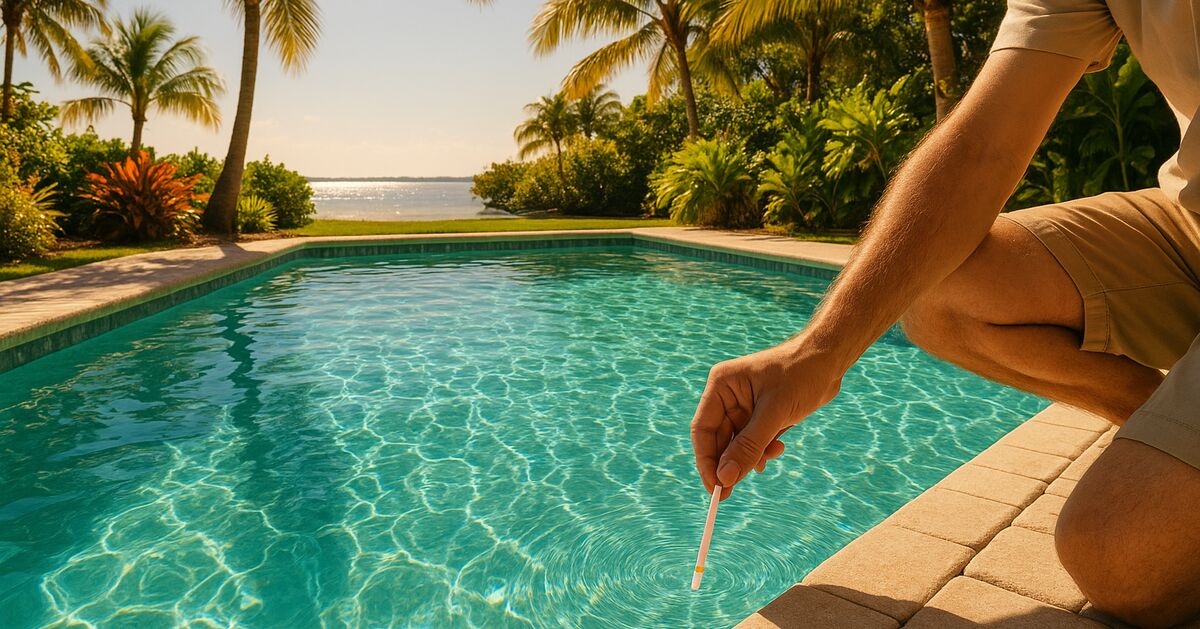
Home test strips are convenient and fine for a quick daily check on chlorine and pH. Liquid drop-test kits (the OTO or DPD type) are more accurate for free and combined chlorine. Neither of these measures calcium hardness, CYA, or total dissolved solids reliably.
A proper water analysis using a five-way or seven-way test - one that covers free chlorine, combined chlorine, pH, total alkalinity, calcium hardness, CYA, and ideally TDS - should happen at least once a month, and more frequently during summer. Many pool supply stores offer free water testing if you bring in a sample taken from elbow depth in the middle of the pool (not near a return jet or skimmer, which gives unrepresentative readings).
For homeowners who want a more hands-off approach, professional weekly service includes this kind of testing as a matter of course. If you are curious what that looks like in practice, our pool cleaning and maintenance services page outlines what a standard visit covers.
Common mistakes that send Florida pool chemistry sideways
- Adding chemicals without testing first. Guessing leads to overcorrection, which leads to more guessing.
- Shocking during the day. UV burns off unstabilized shock very quickly. Shocking at dusk or after dark gives the chlorine time to work.
- Letting stabilizer accumulate unchecked. Many owners only test for CYA once a year, if at all.
- Adding multiple chemicals at once. Some combinations are hazardous; others simply react with each other before they can work in the water. Space additions at least 15 to 20 minutes apart and always broadcast them around the pool rather than dumping in one spot.
- Ignoring the water line tile. Scale on tile is an early warning sign that calcium hardness or pH has been drifting. It is much easier to address early than after it has calcified.
- Skipping post-rain testing. A heavy summer downpour can shift your chemistry enough to matter. A quick test after significant rainfall is good practice throughout the rainy season.
If your pool has already gone past the point of routine chemistry adjustments, our guide on bringing a neglected barrier-island pool back to life walks through the recovery process step by step.
Putting it all together: a practical testing rhythm
For most Florida pool owners, a reasonable routine looks like this:
- Twice a week: Quick strip test for free chlorine and pH, especially during summer.
- Weekly: Check and adjust chlorine, pH, and total alkalinity. Add shock if the pool has seen heavy use or heavy rain.
- Monthly: Full five-parameter test including calcium hardness and CYA. Adjust stabilizer or plan a partial drain if CYA is trending high.
- Seasonally: Consider a professional full water analysis, especially when transitioning into or out of the busy winter season.
Owners on Anna Maria Island, Siesta Key, and throughout the Sarasota area who rent their properties or have high bather loads during tourist season should move toward the more frequent end of all these ranges.
When to call in a professional
Chemistry is manageable as a DIY project when you understand the fundamentals, test consistently, and make small adjustments. It becomes much harder to keep up with during the peak of summer, after a storm, or when you are not on the island full-time. A missed week during a heat wave can mean a green pool that requires aggressive remediation rather than routine maintenance.
Our frequently asked questions page covers some of the most common questions homeowners raise about service schedules and what to expect from professional pool care. And if you are curious about how often professional visits should happen in summer specifically, the post on how often a Longboat Key pool should be serviced in summer lays out the reasoning in plain terms.
Professional service is not just about convenience. A trained technician spots early signs of equipment wear, water line scale, subtle chemistry drift, and equipment corrosion before they become expensive problems. For waterfront homeowners throughout our service area, that kind of early-warning value adds up over time.
If you are ready to hand off the testing and adjusting to someone who does it every day, get in touch with us and we will talk through what makes sense for your pool and your schedule.