
Why rainy season is the hardest time to keep your
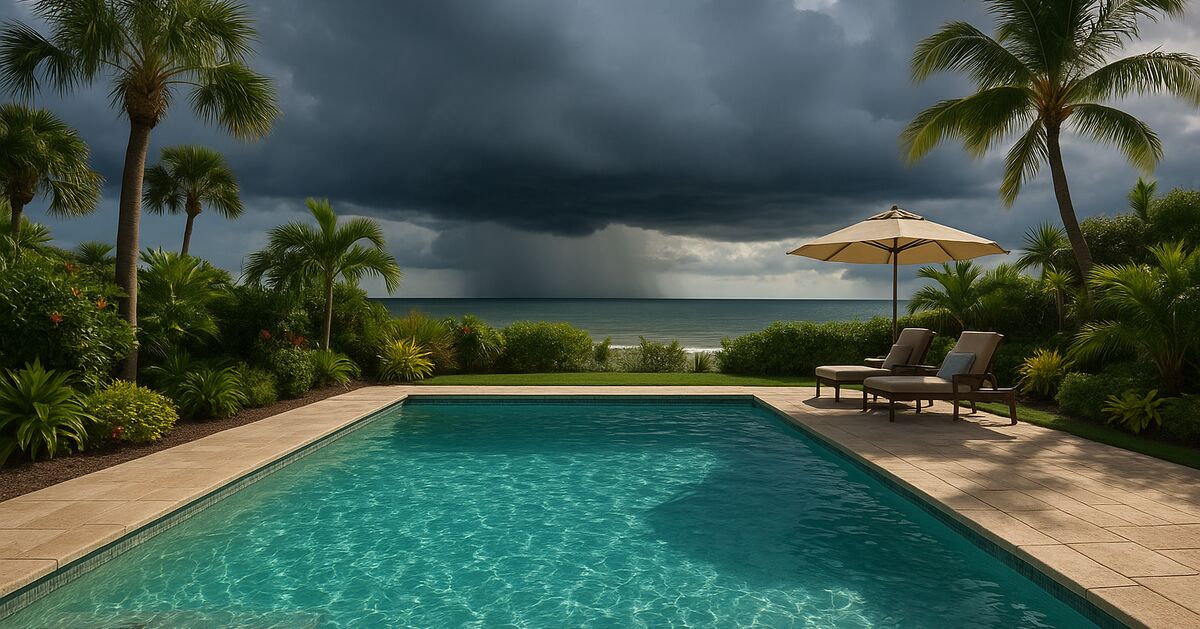
Florida's rainy season doesn't just water your lawn - it quietly dismantles everything you've built up in your pool chemistry, sometimes overnight.
From June through October, homeowners across Longboat Key, Siesta Key, Anna Maria Island, and the rest of the Sarasota coastline deal with the same frustrating pattern: the pool looks fine on Monday, and by Thursday it's cloudy green. Understanding why that happens - and not just what to do about it - is the difference between chasing algae all summer and actually staying ahead of it.
Why rainy season creates a perfect storm for algae
Algae isn't a mystery. It's a plant, and like any plant it needs three things to thrive: water, nutrients, and the right conditions. Your pool gives it all three during rainy season, often faster than you can correct.
Rain dilutes your sanitizer. A typical Florida afternoon storm can drop an inch or more of rain in under an hour. That water is essentially distilled - it carries no chlorine, no stabilizer, and no pH buffer. When it lands in your pool, it dilutes everything. Free chlorine levels that were sitting at a healthy 3 ppm can drop to 1 ppm or below in a single heavy storm. Algae spores, which are always present in the air and on swimmers, seize that window immediately.
Warm water accelerates everything. Gulf-coast pool water in July and August often sits between 86 and 92 degrees Fahrenheit. Warm water speeds up chemical consumption, meaning your chlorine burns off faster even on a calm, dry day. Add rain dilution on top of that burn rate and you can hit zero free chlorine within 24 hours of a storm.
Phosphates wash in with the rain. Rainwater picks up organic material as it flows across decks, landscaping, and screen enclosures before it lands in your pool. Leaves, pollen, bird droppings, and fertilizer residue all introduce phosphates - the primary food source for algae. On properties along the barrier islands, wind carries even more airborne organics off the Gulf. Once phosphates are elevated, algae has a buffet waiting for it the moment sanitizer drops.
Sunlight is relentless. Even with afternoon storms, Gulf-coast summers deliver intense UV index readings. UV degrades free chlorine quickly in an unstabilized pool. If your cyanuric acid (stabilizer) level isn't in the right range, you can lose the majority of your free chlorine in just a few hours of midday sun - rain or no rain.
These four factors working together explain why rainy season is genuinely harder than the rest of the year and why passive maintenance routines that worked fine in March start failing in July.
The chemical adjustments that actually prevent algae
Preventing algae is a chemistry problem before it's a physical one. Brushing and vacuuming matter, but if your water balance is off, no amount of scrubbing will stop the bloom. Here's what to focus on.
Maintain a higher free chlorine target. During rainy season, holding free chlorine at 3 to 5 ppm rather than the standard 1 to 3 ppm gives you a buffer when storms hit. The goal is that even after a heavy rain event dilutes the pool, you're still above the minimum effective level.
Check stabilizer (cyanuric acid) carefully. Stabilizer is a double-edged chemical. Too little (below about 30 ppm) and the sun destroys your chlorine within hours. Too much (above 80 to 90 ppm) and the chlorine becomes less effective - a condition sometimes called "chlorine lock." Rainy season is a particularly bad time for low stabilizer because you're adding water constantly, further diluting what's already there. If you're on a regular pool cleaning and maintenance schedule, your technician should be monitoring stabilizer throughout the season.
Watch your pH more closely than usual. Rain is slightly acidic, so frequent rain events push pool pH downward. When pH drops below 7.2, chlorine can become corrosive to surfaces and equipment, and swimmer comfort suffers. When pH climbs above 7.8, chlorine loses much of its killing power - sometimes up to 70 percent. Both extremes help algae survive. Test pH at least twice a week from June through September, and don't wait for your weekly service visit to correct a reading that's clearly out of range.
Use a phosphate remover proactively. Because rainy season actively loads your pool with phosphates, a monthly phosphate treatment makes sense in a way it might not at other times of year. Starving algae of its food source before sanitizer drops is a smart second line of defense.
Shock after significant rain events. Any storm that drops more than half an inch of rain is worth a follow-up shock treatment. Calcium hypochlorite shock works quickly and doesn't add stabilizer (important if yours is already on the higher end). Add shock in the evening to prevent rapid UV degradation, and run the pump through the night to distribute it fully.
For a deeper dive into why these numbers matter and how they interact, our guide on pool chemistry basics for Florida owners covers the fundamentals in plain language.
Physical maintenance steps that work alongside chemistry
Good chemistry is the foundation, but physical maintenance removes the organic matter that feeds algae and the surface irregularities where it hides.
Brush every surface, every week - more often if you've had a bloom. Algae clings to plaster, grout lines, and step edges before it becomes visible in the water. Brushing breaks it free and sends it into suspension where the filter and sanitizer can deal with it. Nylon brushes work for most plaster and tile surfaces. If you have a fiberglass pool, stay with softer nylon to avoid scuffing.
Clean your filter more frequently. Your filter is doing far more work during rainy season because it's catching higher volumes of organic debris. A cartridge filter that normally needs cleaning every four to six weeks may need attention every two weeks in peak summer. A sand filter may need backwashing more often. A clogged filter recirculates dirty water and gives algae another advantage.
Keep your skimmer baskets clear. This sounds obvious, but during storm season leaves and debris can fill a skimmer basket within hours of a storm. A blocked skimmer reduces flow, starves the pump, and allows organic matter to sit in the water and decay.
Trim back landscaping near the pool. Properties on Anna Maria Island, Bird Key, and the Sarasota mainland alike tend to have lush tropical landscaping close to the pool. During rainy season that vegetation grows fast and drops more material into the water. Keeping it trimmed back by a foot or two meaningfully reduces the organic load your pool has to handle.
Run your pump longer. During the cooler months, running the pump six to eight hours a day is typically sufficient. In rainy season, bump that to at least ten hours, and if you've had a storm or suspect early algae, run it continuously for 24 hours until the water clears. Circulation keeps sanitizer distributed and makes your filter work.
Recognizing early algae before it becomes a real problem
Catching algae in its very early stage - before it's visible to the naked eye - is possible if you know what to look for.
The first signs are usually subtle: water that looks slightly hazy or dull rather than sparkling, a faint greenish or yellowish tint when you look along the length of the pool (not straight down), or surfaces that feel faintly slick when you brush your hand across them. That slickness is a biofilm, and it's the first physical structure algae builds before it pigments.
If you notice any of these signs, test your water immediately. Almost certainly you'll find low free chlorine, elevated phosphates, or a pH that's drifted out of range - often all three at once. Correcting the chemistry at this stage, combined with a thorough brushing and a shock treatment, can stop the bloom before it fully takes hold.
If you wait until the water is visibly green, you're dealing with an active algae bloom that requires a more aggressive process: multiple shock treatments, extended pump run times, and often a flocculant or algaecide to clear the water fully. That process can take several days and significantly more product. Early intervention is always cheaper and faster. Our post on bringing a neglected pool back to life goes into more detail on the recovery side if you're already past the prevention stage.
What's different about barrier-island pools specifically
Pools on Longboat Key, Lido Key, Siesta Key, and Bird Key face conditions that are a step beyond what inland Sarasota pools deal with. The proximity to the Gulf matters in ways that aren't always obvious.
Salt air carries microscopic brine droplets that settle on every surface around your pool. When rain washes those deposits off screen enclosures, pavers, and coping into the water, it introduces minerals and organic particles that can affect water balance and boost phosphate loads. On a calm inland lot, you don't have this input.
Wind-driven spray off the Gulf also deposits organic material - microscopic algae, plankton, and airborne organics - directly onto pool surfaces and into the water. During the summer storm season, when Gulf weather is active, this can happen almost daily.
Condensation is heavier on the islands as well, adding to the cumulative moisture and organic load even on days without actual rain. For homeowners on Longboat Key or Siesta Key, this combination of factors is exactly why consistent, year-round professional attention pays off in a way it might not for a pool tucked behind a house in a more sheltered neighborhood.
If you're also managing a saltwater system on one of the barrier islands, the rainy season chemistry challenges are somewhat different. Our guide to saltwater pool maintenance for island homeowners covers what to watch for with salt cells and salt levels when heavy rain is diluting your pool repeatedly.
How a professional service schedule helps during rainy season
Weekly professional maintenance during rainy season isn't a luxury - it's the most practical way to stay ahead of the chemistry swings that cause algae blooms. A technician who visits every week can catch a pH drift or a low stabilizer reading before the next storm compounds it. They can spot a failing filter, a slow-running pump, or an early biofilm on steps that a homeowner walking past the pool twice a day might miss entirely.
The cost of a professional cleaning visit is a fraction of the cost of an algae remediation, which often requires multiple visits, extra chemicals, and sometimes acid washing of surfaces if the bloom is severe enough to stain. Viewed that way, consistent maintenance is simply the less expensive option, especially in the five months when conditions are most hostile.
If you're curious about what a professional maintenance visit covers and why it matters more in summer, our FAQ page answers the most common questions we hear from homeowners on the islands.
We serve pools across the Sarasota area including Anna Maria Island, Lido Key, and Bird Key - areas where the combination of Gulf weather, high humidity, and warm water makes proactive care the only reliable approach.
A simple rainy-season checklist to keep on your phone
- Test free chlorine and pH at least twice a week
- Shock after any rain event of half an inch or more
- Keep free chlorine target at 3 to 5 ppm through October
- Verify stabilizer is between 30 and 80 ppm
- Use a phosphate remover monthly
- Brush all surfaces and clean skimmer baskets after every storm
- Run the pump at least 10 hours per day, more after storms
- Clean filter cartridges every two weeks instead of every month
- Trim back landscaping near the pool edge
- Catch hazy water early before it turns fully green
The rainy season is predictable. The algae blooms don't have to be. If you'd like help getting your pool on a schedule that takes the guesswork out of summer, reach out to us and we'll talk through what makes sense for your pool and property.