
What causes pool surface blistering, and why Gulf-coast pools see it more
Pool blisters are one of those problems that homeowners tend to dismiss at first, right up until the entire surface starts to spall and a full resurfacing job lands in the budget. Understanding exactly what causes them, and why Gulf-coast pools from Longboat Key to Anna Maria Island see them at a higher rate than inland pools, can save you thousands of dollars and a lot of frustration.
What a pool surface blister actually is
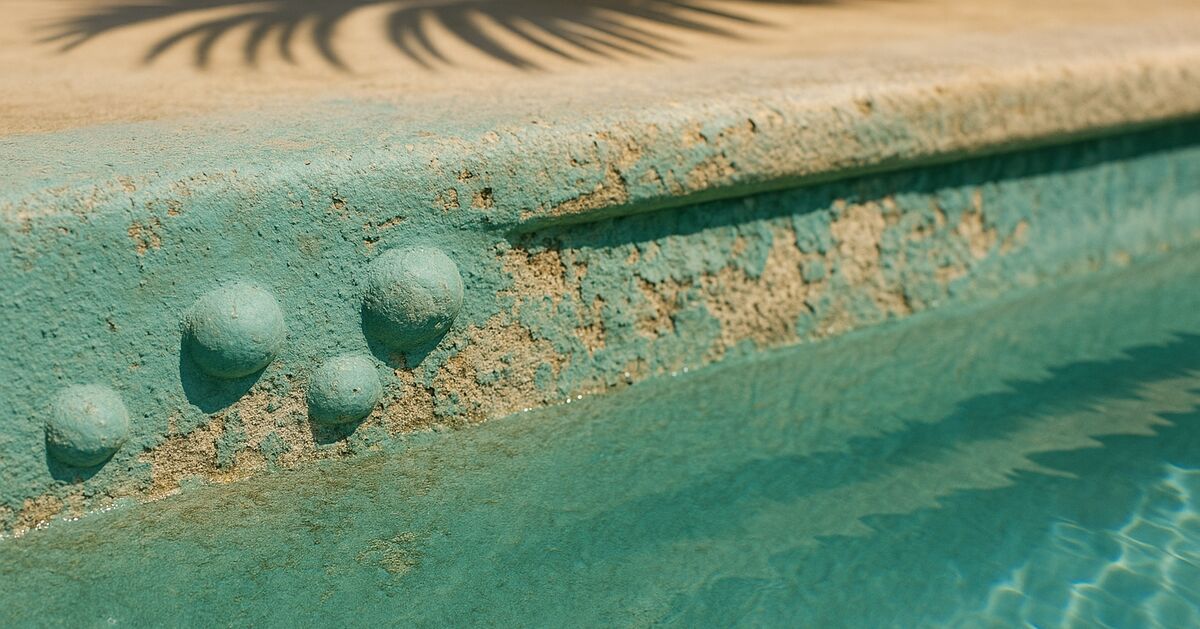
A blister (also called a "pop-off," a "delamination bubble," or a "spot," depending on who you ask) is a dome-shaped separation between the finish layer and the substrate underneath. On a plastered pool, the finish is typically a layer of white plaster, quartz aggregate, or pebble material applied over a gunite or shotcrete shell. When that bond breaks, trapped moisture or gas pushes the finish outward, forming a visible bump.
Run your fingers across a blistered surface and you can often feel a hollow, slightly springy spot even before it becomes visible to the eye. Press firmly and the bubble may crack, exposing a dark, wet cavity underneath. At that stage the damage is already structural, not just cosmetic, because water can now work its way behind the finish and accelerate further delamination.
The same process happens with tile and coatings, though the mechanics differ slightly. For the purposes of this post, we are focusing primarily on plastered and aggregate pool finishes, which is what the overwhelming majority of pools in the Sarasota and barrier-island area use.
The core causes of blistering
1. Osmotic blistering (the chemistry culprit)
Osmotic blistering is the form pool professionals encounter most often, and it is directly tied to water chemistry. Here is the plain-language explanation.
Plaster is not perfectly solid. It contains microscopic pores. When the water chemistry inside those pores differs significantly from the pool water on the other side of the surface, water molecules move through the plaster membrane in an attempt to equalize concentration, a process called osmosis. As water migrates into the pores and accumulates, pressure builds. If the pressure exceeds the bond strength of the plaster, the surface lifts and a blister forms.
What drives the pore chemistry in the wrong direction? A few things:
- High calcium hardness combined with high pH. When pool water is consistently oversaturated with calcium carbonate (a high Langelier Saturation Index), mineral-laden water is pushed into the plaster pores. The Calcium Hypochlorite (Cal-Hypo) shock treatments common in Florida add calcium to the water every time you use them.
- Aggressive (low LSI) water. On the opposite end, water that is too "hungry" (low calcium, low pH, low alkalinity) will pull minerals out of the plaster itself, weakening its structure and creating voids that later blister.
- Contamination in the mix or the bond coat. If the plaster was applied over a dusty or oily shell, or if the mix had too high a water-to-cement ratio at the time of application, weak spots are built in from day one.
The Langelier Saturation Index (LSI) is the standard tool the pool industry uses to measure whether water is in balance with the surface it contacts. The Pool & Hot Tub Alliance (PHTA) publishes guidance on LSI targets, and keeping pool water in that recommended range is one of the most direct ways to reduce osmotic blistering risk.
2. Hydrostatic pressure from below
Blistering does not only push outward from the pool water side. It can also push inward from groundwater pressure beneath and around the shell. When the water table rises, as it reliably does during Florida's rainy season from June through September, groundwater can press against the outside of the shell and force moisture through any micro-cracks in the gunite. That moisture gets trapped between the shell and the finish layer, and blistering follows.
This is a meaningful issue on barrier islands. As we have covered in detail in our post on what shifting groundwater does to your pool plumbing on Longboat Key, the water table on keys like Longboat and Lido sits very close to the surface. A heavy rainy season or a passing tropical system can raise it dramatically in a short period of time.
Pools that were partially or fully drained during a storm event, or pools left empty for maintenance during the wet season, are especially vulnerable because the hydrostatic pressure is no longer counterbalanced by the weight of pool water.
3. Application defects and curing problems
Even a perfectly designed pool can blister if the finish was applied incorrectly. Common application problems that lead to blistering include:
- Recoating over an inadequately prepared surface. Old plaster that was not acid-washed and fully cleaned before the new coat went down leaves a weak boundary layer.
- Finish applied in extreme heat or direct sun. In the Sarasota area, where summer temperatures routinely exceed 90 degrees Fahrenheit, a plaster crew that works in full afternoon sun risks having the surface flash-dry before it properly cures. That introduces shrinkage stress and micro-voids.
- Thin application. Standard white plaster is applied at roughly 3/8 to 1/2 inch thickness. Corners and transitions around steps and fittings are common spots where the coat gets thin, and those are often the first places blisters appear.
- Incorrect startup chemistry. The 28 days following a new plaster installation are called the "startup" or "cure" period. If aggressive chemicals, especially high-dose chlorine, are introduced too early, they attack the plaster before it has hardened fully.
Our detailed post on how to read a pool resurfacing quote on Longboat Key covers some of these application quality indicators and what to ask a contractor before signing anything.
4. Salt damage from saltwater pool systems
Saltwater chlorine generators have become standard on many pools in the Sarasota area, and for good reason: they reduce the handling of liquid chlorine and produce a softer-feeling water. But salt is a mineral, and over time it can work its way into a porous plaster surface and contribute to delamination, particularly in areas around jets and the salt cell itself where the concentration gradient is highest.
The interaction between salt and plaster is a topic the Pool & Hot Tub Alliance addresses in its guidelines for saltwater pool maintenance, which recommend keeping salinity levels at the low end of the generator manufacturer's specified range to minimize surface stress.
Why Gulf-coast pools see it more often
Proximity to the Gulf and ambient salt
Even pools that use a traditional chlorine system are not immune to salt exposure on the barrier islands. Salt air deposits fine particles on deck surfaces, equipment, and the waterline. Rain then washes those particles into the pool. Over years, pools on barrier islands like Siesta Key or Bird Key likely accumulate more airborne salt than pools further inland, given their proximity to the Gulf. Higher salt loads mean more mineral intrusion into the plaster pores.
Our pool cleaning and maintenance services include regular water testing that tracks total dissolved solids and salt levels even in non-saltwater pools, precisely because this creep happens silently.
The water table problem
As touched on above, the barrier islands of Sarasota County sit on sandy substrates where the freshwater table is shallow. Per guidance from the Florida Department of Environmental Protection, coastal barrier systems experience significant groundwater fluctuation linked to tidal cycles and seasonal rainfall. That means the hydrostatic pressure acting on the outside of a pool shell on Longboat Key or Lido Key is not a one-time event. It cycles up and down continuously.
Over years, that cycling fatigues the bond between the shell and the finish layer. A pool that looks fine in April may show the first blisters by October after a summer of high groundwater.
Heat and UV intensity
Southwest Florida's low latitude means it receives intense year-round sun, contributing to greater thermal stress on pool surfaces. Southwest Florida's high latitude and clear skies mean it receives an especially high amount of solar radiation, which contributes to greater thermal stress on pool surfaces.
That heat and UV exposure matters for pool surfaces in two ways. First, pool water in an exposed, uncovered pool can reach temperatures in the mid-to-upper 80s Fahrenheit for months at a time. Warm water is more chemically active and drives faster mineral saturation changes. Second, the finish itself, particularly on the pool deck and the upper waterline area, undergoes thermal expansion and contraction daily. That mechanical stress, compounded year after year, loosens the bond coat over time.
Rapid chemistry swings tied to weather
Gulf-coast pools experience chemistry swings that are hard to replicate inland. A heavy afternoon thunderstorm, common from June through September, can dump enough rainwater into an uncovered pool to meaningfully drop the pH, alkalinity, and calcium hardness in a single afternoon. If that water is not corrected promptly, the pool spends hours or days as an aggressive, low-LSI solution pulling minerals out of the plaster.
Owners on Longboat Key, Anna Maria Island, and across the barrier islands we serve have the additional challenge that many properties sit empty for part of the year, meaning these chemistry events can go uncorrected for days before anyone notices.
How to tell a blister from other surface damage
Not every bump, rough patch, or discolored spot on a pool finish is a blister. Here is a quick field guide:
- Blister: Dome-shaped, hollow when tapped, springy or cracked. Usually 1/4 inch to several inches in diameter.
- Calcium nodule: Hard, not hollow, often white or gray. Formed by calcium carbonate precipitation, not delamination. More common at jets and fittings.
- Spall: A chunk of finish that has already broken away, leaving a rough depression. Often what a blister becomes if ignored.
- Etching: A rough, dull texture across a broad area rather than isolated bumps. Caused by aggressive water chemistry but not a delamination blister.
If you are unsure what you are looking at, our frequently asked questions page covers common surface anomalies, or you can reach out directly for a visual assessment.
What to do if you find blisters
Small, isolated blisters (fewer than 5, small diameter)
A qualified pool professional can sometimes grind out individual blisters, clean the substrate, and patch with a compatible material. Whether this is worth doing depends on the age of the finish and the root cause. If the problem is chemistry-driven, patching without correcting the water balance just means the blisters come back.
Widespread blistering
If blisters appear across multiple surfaces, steps, or walls, the finish has likely lost its bond in a more systemic way. At that point a full resurfacing is typically the appropriate answer. Patching over widespread delamination is a temporary measure at best.
Prevention going forward
The most effective prevention is straightforward, though it requires consistency:
- Keep LSI in balance. Test weekly, not monthly, especially in summer. The PHTA recommends an LSI between -0.3 and +0.5 for plaster surfaces.
- Avoid aggressive shock treatments directly against the plaster. Pre-dissolve granular products in a bucket of water before adding them to the pool, or use liquid chlorine instead.
- Do not drain below the tile line without understanding your hydrostatic risk. On the barrier islands, consult a pool professional before dropping water levels significantly during the wet season.
- Start new plaster correctly. If you have recently resurfaced or are planning to, make sure the contractor follows a documented startup protocol for the first 28 days.
Our team provides pool cleaning and maintenance on Siesta Key, Longboat Key, and across the region with weekly water testing built into every service visit, which is the single most reliable way to catch a chemistry imbalance before it has a chance to damage your finish.
The bottom line
Pool surface blistering is a physical and chemical process with real, understandable causes. On the Gulf coast, the combination of a shallow water table, salt-laden air, intense solar radiation, and weather-driven chemistry swings creates a more demanding environment than most inland pools face. None of that means blistering is inevitable. It means the bar for consistent maintenance is higher here than it would be for a pool in central Florida or Georgia.
Catching it early, understanding whether the cause is osmotic, hydrostatic, or application-related, and keeping water chemistry consistently balanced are the three things that make the biggest difference. If you are not sure where your pool stands, our pool maintenance team is happy to take a look.
Sources & further reading
- Pool & Hot Tub Alliance (PHTA) industry standards and guidelines (Pool & Hot Tub Alliance)
- Florida Department of Environmental Protection - coastal and groundwater resources (Florida Department of Environmental Protection)
- EPA - drinking water and water chemistry fundamentals (U.S. Environmental Protection Agency)
Claim-by-claim audit (3 checked)
- “Southwest Florida's high latitude and clear skies mean it receives an especially high amount of solar radiation, which contributes to greater thermal stress on pool surfaces.” (rewritten to what the article can stand behind)
- “Southwest Florida's low latitude means it receives intense year-round sun, contributing to greater thermal stress on pool surfaces.” (rewritten to what the article can stand behind)
- “Over years, pools on barrier islands like Siesta Key or Bird Key likely accumulate more airborne salt than pools further inland, given their proximity to the Gulf.” (rewritten to what the article can stand behind)