
What shifting groundwater does to your pool plumbing on Longboat Key
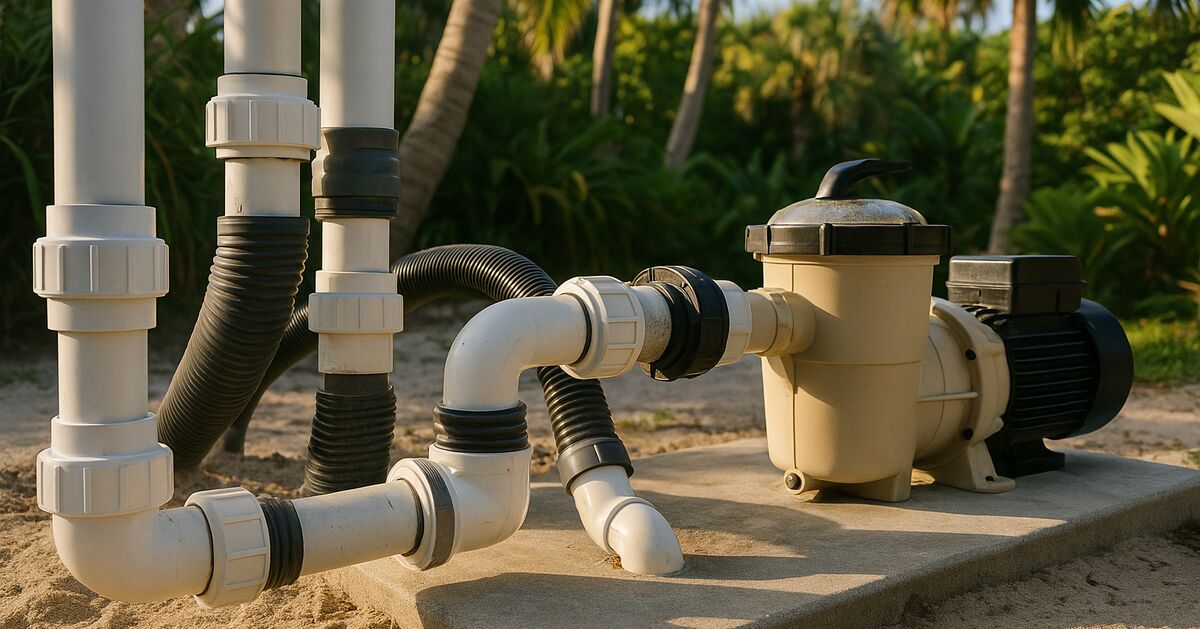
Your pool plumbing runs through ground that is never entirely still. On Longboat Key and the surrounding barrier islands, the water table sits just a few feet below the surface on a good day, and even closer after a heavy rainy season or a slow-moving tropical storm. That ground moves, swells, and settles with every significant rainfall, every drought stretch, and every surge of Gulf water that soaks beneath the sand. Most homeowners never think about what that constant motion means for the pipes, fittings, and joints hidden underneath and around their pool, until the water bill jumps or a wet patch shows up where it shouldn't.
This post is about getting ahead of that moment. The damage groundwater movement causes to pool plumbing tends to be gradual, which is actually both good news and bad news. Good news because early signs are readable if you know what to look for. Bad news because those signs are easy to dismiss until the repair scope has grown significantly.
Why barrier-island groundwater is especially problematic
The barrier islands from Anna Maria Island down through Longboat Key, Lido Key, Bird Key, St. Armands Key, and Siesta Key share a common geological reality: they are thin strips of sand and shell material perched above a shallow, highly reactive water table. Unlike inland areas of Sarasota or Bradenton where soil composition is more varied and deeper, barrier-island soil offers very little structural resistance to movement.
When heavy rain falls during Florida's summer rainy season, the water table can rise several feet in a matter of days. During a dry stretch in late spring or winter, it drops, sometimes unevenly. That rise-and-fall cycle creates what engineers call differential movement, meaning one section of ground around your pool shifts at a slightly different rate than another section. The pool shell itself, being a rigid structure, resists this. The plumbing, being made up of joints and transitions between rigid PVC pipe sections and flexible fittings, absorbs the stress at its weakest points.
Saltwater intrusion adds another layer of complexity. Near the Gulf shoreline, especially along the western edges of Longboat Key or on waterfront lots on Bird Key, brackish groundwater can saturate the soil around plumbing runs. This accelerates corrosion on any metal components, degrades rubber gaskets and O-rings faster than fresh-soil conditions would, and softens the adhesive bonds on PVC solvent-weld joints over years of exposure.
The plumbing components most likely to fail first
Understanding which parts fail first helps you know where to look during a walk-around inspection.
Unions and flex connectors near the equipment pad. The equipment pad, where your pump, filter, and heater live, is often poured on a concrete slab. The underground plumbing runs from the pool shell to this slab. Where pipe transitions from buried underground to above-grade equipment, there is almost always a union fitting or a short section of flexible PVC hose designed to accommodate minor movement. These are the first points to show stress cracks or drips when ground shift occurs, because they are doing exactly the job they were designed to do: flexing so the rigid pipe doesn't crack. When the flexing exceeds the fitting's design tolerance, it leaks.
Return line fittings inside the pool wall. Return jets are set into the pool shell wall with a fitting that passes through the gunite or fiberglass. Behind that fitting is a threaded or glued connection to the return pipe. When the ground beneath and behind the pool wall shifts, it applies lateral and rotational stress to that connection. The fitting can crack, the threads can strip, or the wall penetration can develop a hairline fracture around the fitting. Water loss through return fittings is common and often mistaken for evaporation or splash-out.
Skimmer throat and plumbing connections. The skimmer is a plastic or ABS box set into the pool wall near the waterline. It connects to suction-side plumbing below the deck. Because skimmers sit at the intersection of the pool shell, the coping, and the deck, they experience stress from multiple directions when the ground shifts. Separation at the skimmer throat, where the box meets the pool wall, is one of the most common leak points on barrier-island pools, and groundwater movement is a major contributing factor.
Main drain fittings and sump. The main drain sits at the deepest point of the pool. Its plumbing runs horizontally through the pool floor and then down and away from the shell. Ground settlement directly beneath the pool floor, which happens when soil compaction changes due to water table fluctuation, can cause the main drain fitting to shift slightly relative to the shell. A hairline crack at the base of the main drain fitting can lose a surprising amount of water each day.
Below-deck lateral pipe runs. Most residential pools have plumbing that runs beneath the deck between the shell and the equipment pad. This pipe is buried at a shallow depth in sandy barrier-island soil. When that soil alternately saturates and dries, it can cause the pipe to rack, meaning it bends laterally in place. Solvent-welded PVC joints are strong but not infinitely so. A rack stress that might be harmless once becomes cumulative damage over several years of seasonal water table cycles.
Early signs homeowners can catch themselves
You do not need special tools to notice most of the early warning signs. You need a habit of looking.
- Track your water level consistently. Fill the pool to mid-skimmer and mark the tile line with a pencil or a piece of tape. Check it 24 to 48 hours later on a day without rain and without significant bather activity. Evaporation in the Florida sun accounts for roughly a quarter-inch to a half-inch per day in summer. If you are losing more than that on a regular basis, you likely have a leak somewhere in the shell or plumbing. The bucket test can help you rule out evaporation, and it costs nothing.
- Watch for soft or sunken spots on the deck. A deck section that feels slightly soft underfoot, or that has developed a new crack along a grout line or control joint, is telling you the ground beneath it has moved. If that soft spot happens to be above or near a buried plumbing run, that is worth investigating before it worsens.
- Check the area around the equipment pad after rain. Standing water that lingers near the pad after everything else has dried is a flag. So is a persistent damp patch in the grass or mulch between the pool and the equipment pad where the underground plumbing runs.
- Listen at the equipment pad. When the pump is running, put your hand near unions and flex connectors and feel for spray or drips. Look for white calcium mineral deposits around fittings, which often indicate a slow leak that has been weeping and drying repeatedly.
- Inspect skimmer and return fittings visually. Look at the point where each return fitting meets the pool wall, and where the skimmer box meets the coping. A visible gap, a crack in the plaster or tile surrounding the fitting, or discoloration in the grout nearby can all indicate water is finding its way behind the wall.
- Notice unexplained chemistry swings. Groundwater infiltrating a pool through a crack or compromised fitting dilutes the water. If your chemical readings keep swinging low despite consistent dosing, and you have not had unusual rain or heavy bather load, water exchange from outside the pool may be part of the story. Our piece on why your pool burns through chemicals so fast covers some of the chemistry side of this equation.
What a professional leak detection actually involves
When early signs suggest a plumbing problem, a professional can confirm and localize it far more precisely than a visual inspection alone. Pressure testing is the standard starting point. Each line, the skimmer line, the main drain line, and each return line, can be isolated and pressurized with air or water. If a line will not hold pressure, it has a breach somewhere. This tells you which line is compromised without digging up anything.
Dye testing is useful for shell and fitting leaks. A small amount of colored dye released near a suspected fitting will be drawn visibly toward any crack or gap if water is escaping through it. It is a low-cost, non-invasive technique that can localize a leak to a specific point in minutes.
For buried line leaks that pressure testing has confirmed, acoustic listening equipment can often pinpoint the location along the pipe run without requiring a full excavation. The leak creates a detectable sound signature in the pipe that a trained technician can follow to its source. This matters enormously on barrier-island properties where extensive deck removal and excavation is disruptive and expensive.
For context on what can go wrong with pool shell integrity and surfaces, especially in saltwater-exposed environments, the post on pool resurfacing quotes and what the fine print means covers related territory worth reading before any significant repair conversation.
Why timing your repairs around the water table matters
Here is something most homeowners do not consider: the timing of a plumbing repair can affect how well it holds long-term. If your plumber repairs or replaces a fitting or a pipe section during a period when the water table is unusually high, the ground around the repair will be saturated. Some adhesives and patching compounds cure best in drier conditions. More importantly, if groundwater is actively pressing against the pool shell from outside, the hydrostatic pressure can complicate repairs to floor fittings and main drain connections.
Scheduling repairs during the dry season, roughly November through May on Florida's Gulf coast, gives the repair the best chance to cure and settle before the next rainy season cycle stresses it again. This is one of the practical reasons our pool cleaning and maintenance services include routine inspections throughout the year rather than just reactive visits when something has already gone wrong. Catching a marginal fitting in February is a very different repair scope than catching it in August when the ground is saturated and the equipment is running hard.
The equipment pad and its relationship to ground movement
Your equipment pad is worth a brief mention separate from the plumbing itself. Concrete pads on barrier-island properties can settle, tip, or crack as the sandy soil beneath them shifts with water table changes. A tilted pad puts mechanical stress on the plumbing connections at the pump and filter because those connections were designed for level equipment. It also allows standing water to pool around equipment bases, accelerating corrosion on motor housings and creating conditions that shorten equipment life.
Look at your equipment pad from the side and from the back. It should be level. If it has tilted noticeably, or if there is a visible gap between the pad and the pool deck or coping nearby, that is a conversation to have with a pool professional sooner rather than later. The pool cleaning and maintenance teams serving Longboat Key and the surrounding islands see this kind of settlement regularly and can advise whether it needs correction or just monitoring.
A word about older plumbing on resale properties
If you purchased your Longboat Key, Lido Key, or Siesta Key home in the last few years, particularly if it was a seasonal or rental property before your purchase, the pool plumbing may have decades of barrier-island water table cycles behind it. Older PVC (pre-2000s installations) used slightly different formulations and may be more brittle today than it was when installed. Solvent-weld joints from that era may have dried and become micro-porous over many years.
A thorough inspection of an older pool's plumbing is one of the best investments a new owner can make, ideally before making expensive cosmetic improvements to the pool. The post on pre-purchase pool inspections on Siesta Key and Bird Key goes into detail about what those inspections cover and why they matter for properties with pool plumbing of unknown history.
How to build a simple monitoring habit
The most effective thing a homeowner can do is build a short, monthly habit of looking at the right things.
- Check water level against a fixed reference mark once a week when the pool is in active use.
- Walk the deck perimeter after each significant rain and press on suspect spots.
- Glance at equipment pad unions and flex connectors monthly while the pump is running.
- Have a professional look at skimmer throat seals and return fittings during each scheduled service visit, especially heading into and out of rainy season.
The barrier islands from Anna Maria Island south through Siesta Key all share the same shallow, reactive water table that makes this monitoring worthwhile. The homeowners who avoid expensive plumbing repairs are almost never the ones who reacted faster to a major leak. They are the ones who caught the small drip, the soft deck spot, or the slow chemistry swing while the fix was still minor.
If anything in this post sounds familiar, or if you have noticed any of the early signs described here, get in touch with our team for a professional assessment. Our pool maintenance services include the kind of trained eye that catches these problems while they are still affordable to fix.