
Full resurface or just a patch? How to tell the difference
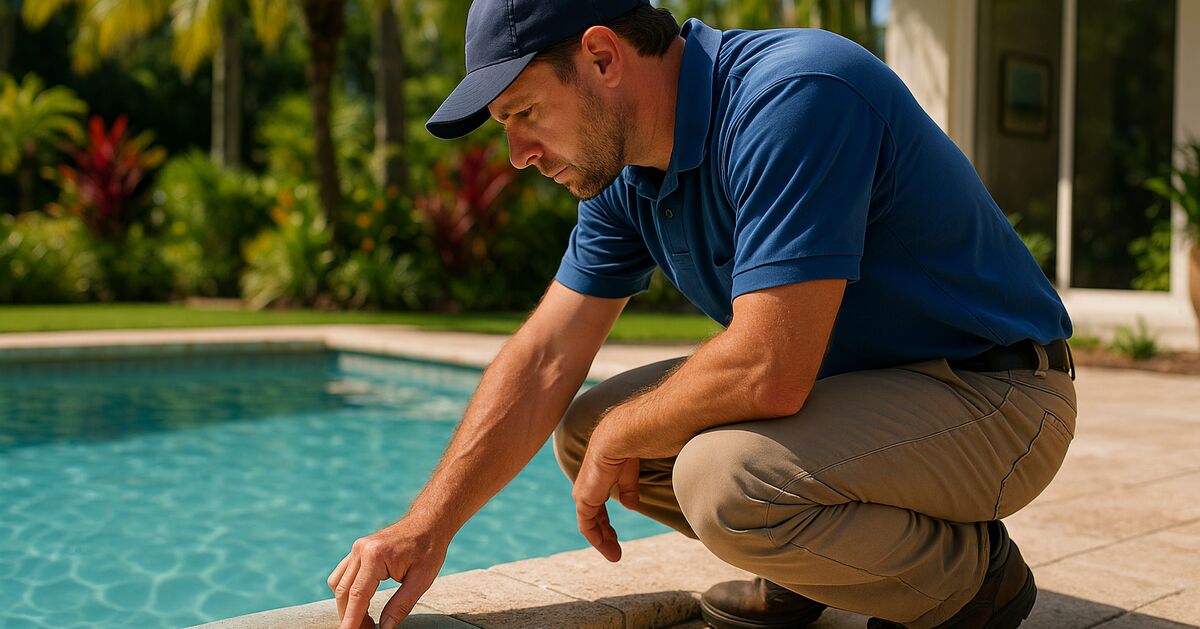
The crack you noticed last Tuesday might be a $300 patch, or it might be the first sign that your entire finish is failing from the inside out. On a barrier island where salt air, high humidity, and warm groundwater are constants, those two scenarios look almost identical from the pool deck but lead to completely different repair bills.
Knowing which situation you are actually in, before anyone drains your pool or mixes a single bucket of plaster, is the most valuable decision you will make about your pool this year. This guide walks through the signs, the tests, and the reasoning that separates a straightforward patch from a full resurface, with specific attention to what the saline Gulf Coast environment does to accelerate surface failure.
Why the environment changes the math
Pool finishes in the Sarasota area, across Longboat Key, Lido Key, Bird Key, Siesta Key, and out to Anna Maria Island, face a combination of stressors that inland pools simply do not encounter at the same intensity. Salt aerosols carried off the Gulf deposit chloride ions on and around every exposed surface. Groundwater tables here are shallow and shift seasonally, creating subtle hydrostatic pressure against the shell. Water temperatures stay high for eight to nine months of the year, which accelerates every chemical reaction taking place inside the plaster or pebble finish. And because many of these homes spend part of the year empty, chemistry imbalances go undetected for longer than they would in a full-time residence.
The result is that surface failure on a barrier island tends to be more widespread and more deeply rooted than an equivalent-looking failure on an inland pool. A crack that would be a straightforward cosmetic patch in Orlando may, on a Longboat Key pool, indicate that the bond coat beneath the finish has been undermined by chloride penetration or hydrostatic movement. Our earlier post on what shifting groundwater does to your pool plumbing on Longboat Key covers the plumbing side of that phenomenon in detail, but the same forces act on the finish layer itself.
That context matters because patches applied to a failing substrate rarely bond properly and rarely last more than a season or two. You end up paying for the patch, then paying for the full resurface a year later anyway, plus the cost of another drain and refill.
The four things to look at first
Before any professional gives you a recommendation, they will examine the pool with these four factors in mind. You can do a preliminary assessment yourself.
1. Coverage: how much of the surface is affected?
Walk the entire perimeter of your pool and look at the waterline and the areas just below it, the floor in the deep end (look from above on a calm day), the steps and benches, and the main drain surround. Note every spot where you see:
- Rough or sandpaper-like texture where the finish was once smooth
- Discoloration that does not respond to brushing or a round of acid treatment
- Exposed aggregate (the small pebbles visible through a worn pebble-tec surface)
- Actual cracks, whether hairline or wider
- Areas where the surface sounds hollow when you tap it with a coin (this indicates delamination)
If the affected areas are isolated, meaning two or three spots that together cover less than roughly two to three square feet, and the rest of the surface looks consistent in color and texture, a patch is at least worth considering. If the roughness or discoloration is generalized across multiple walls and the floor, a full resurface is almost certainly the more economical long-term answer.
2. Age and original finish type
Plaster finishes have a typical service life of roughly seven to twelve years in a well-maintained pool. Pebble and quartz aggregate finishes generally last longer, often fifteen to twenty-five years, but that range shrinks considerably in high-salinity coastal environments where the bond between aggregate and matrix is under constant chemical stress. Per the Pool & Hot Tub Alliance's guidance on finish longevity, aggressive water chemistry (low pH, low calcium hardness, or high salt levels) is among the leading causes of premature finish failure.
If your finish is already at or past its expected lifespan, patching tends to be a short-term solution. The surrounding finish is aging at the same rate as the failed spots, and new patch material bonded to old, tired plaster rarely holds for more than a year or two. Our detailed breakdown of how to read a pool resurfacing quote on Longboat Key covers what the materials and warranty language in those quotes actually mean, which is worth reading before you sign anything.
3. The delamination test
Delamination is the single most important indicator that a patch will not hold. It occurs when the finish layer separates from the gunite or shotcrete shell beneath it, creating a void or a bubble between the two. Water infiltrates that void, freezes in colder climates or expands under heat in warm ones, and the separation grows.
The test is simple: use a coin (a quarter works fine) and tap firmly across the suspect areas. A solid, well-bonded finish produces a consistent hard sound. A delaminated area produces a distinctly hollow or dull thud, almost like tapping a thin ceramic pot. Mark every hollow spot with a piece of underwater marking tape or a dry-erase marker on the coping above it.
If delamination is limited to one small zone, patch repair is potentially viable. If hollow areas are scattered across multiple surfaces, the bond coat has failed broadly and no patch material will stay adhered for long.
4. The nature of the cracks
Not all cracks carry the same message. Hairline surface cracks (sometimes called crazing or checking) are often purely cosmetic and confined to the finish layer. They are common in older plaster and can sometimes be addressed with a targeted patch or an acid wash followed by a water chemistry correction. Structural cracks, which are wider, actively growing, or accompanied by a visible ledge (one side of the crack is slightly higher than the other), indicate movement in the shell itself and require a different level of repair entirely.
In a coastal setting, a structural crack also warrants a pressure test on your plumbing, because the same ground movement that stressed the shell may have stressed underground pipes as well.
When patching is genuinely the right answer
Patches make sound economic and practical sense in a specific, narrow set of circumstances:
- The damage is isolated to one or two small areas covering no more than a few square feet total
- The surrounding finish is in good condition, consistent in color, and well-bonded (no hollow sounds)
- The finish is relatively young, with several years of reasonable service life remaining
- The cause of the failure has been identified and corrected (a chemical imbalance, a single impact, a localized construction flaw)
- The patch can be color-matched well enough to be acceptable to the owner
That last point is often underestimated. Patch material, even when mixed carefully to match the existing finish, often doesn't look identical once the pool is refilled and the water chemistry does its work over the first few months. On a white plaster pool the difference may be subtle. On a colored plaster or pebble finish, mismatched patches are visible and permanent. If appearance matters to you, factor that into the decision.
When a full resurface is the honest answer
A full resurface is the appropriate scope of work when any of the following is true:
- Delamination is present in multiple locations across different surfaces
- The finish is at or past its expected service life and showing generalized wear
- The affected area, even if it looks like "a few spots," adds up to more than a small fraction of the total surface
- The color or texture of the existing finish has degraded uniformly, making it impossible to patch to a consistent appearance
- A previous patch has already failed, indicating the substrate is not accepting new material
- There is evidence of ongoing chemical aggression (chronically low calcium hardness, high cyanuric acid, or a history of low pH) that has been corroding the finish from the water side
In a saline Gulf Coast environment, the corrosive workload on a finish is higher than average, and pool owners along the barrier islands often find that their finish reaches the end of its useful life a few years earlier than the manufacturer's nominal warranty would suggest. If you have noticed steady deterioration over two or three seasons rather than a sudden localized failure, that pattern is a reliable indicator that the finish is failing as a whole.
What salt specifically does to pool finishes
Chloride ions, which are the chemically active component of salt, are small enough to migrate through pool plaster and into the concrete shell beneath it. Once there, they can attack the iron reinforcement (rebar) in the shell, causing rust expansion that pushes outward and contributes to both delamination and cracking. This is the same mechanism that corrodes concrete bridges in coastal areas and is well-documented in civil engineering literature and in guidelines from organizations like the American Concrete Institute.
For pool owners, the practical implication is that surface damage in a saline environment is more likely to have a subsurface component than equivalent-looking damage on an inland pool. What you see from the pool deck, a crack or a rough patch, may be only the outward expression of a larger degradation process underneath. This is one reason why the visual and tap tests above matter so much: they help distinguish surface-only issues from those with a deeper structural dimension.
Our post on what causes pool surface blistering and why Gulf-coast pools see it more goes further into the chemistry of how salt-laden air and water interact with plaster at the molecular level, which is useful background if you want to understand the mechanism rather than just the symptoms.
Chemistry's role in the patch-or-resurface decision
A pool with chronically out-of-balance water is a pool where patches will fail prematurely, almost regardless of how well they are applied. Before any surface repair work is scheduled, it is worth having your water tested thoroughly, not just a quick strip check but a full panel that includes calcium hardness, total dissolved solids, cyanuric acid, and pH alongside the basics.
Low calcium hardness is a particular concern on the barrier islands. Water that is undersaturated in calcium actively pulls calcium carbonate out of plaster to satisfy its chemical equilibrium, a process called etching. Our pool cleaning and maintenance services include regular water testing precisely because catching a calcium hardness problem early is far cheaper than the resurfacing it accelerates. The Langelier Saturation Index, a formula used by pool professionals to gauge whether water is balanced, corrosive, or scaling, is the standard tool used across the pool industry for this assessment.
If your water has been running corrosive for an extended period, patching into an actively etching environment is unlikely to produce a lasting result.
Getting a second opinion before you commit
Because the cost difference between a well-executed patch and a full resurface can range from a few hundred dollars to several thousand, it is entirely reasonable to get more than one assessment before committing. A reputable pool professional should be able to explain exactly why they are recommending one scope versus the other, pointing to the specific signs they observed. If the recommendation for a full resurface comes without a clear explanation of the delamination or wear patterns found, ask for that explanation.
Owners across our service area, from Sarasota and Siesta Key to Longboat Key and Anna Maria Island, benefit from having a professional who knows what coastal exposure does to finishes over time. That local experience matters in interpreting the findings correctly.
You can review our full service area and what we cover on our locations page, and if you have questions about your specific pool's finish, our contact page is the fastest way to get a straight answer from someone who has looked at hundreds of Gulf Coast pools over the years.
A few practical steps before you call anyone
If you want to arrive at the conversation with a contractor well-prepared, do these things first:
- Walk the pool on a bright morning when light hits the water surface at a low angle. Surface texture irregularities show up far more clearly in raking light than in midday overhead sun.
- Do the coin tap test across all surfaces and make a rough sketch of where the hollow areas are.
- Note any cracks and measure their approximate width and length.
- Look at the waterline tile for salt-mineral deposits or grout erosion, because tile condition often correlates with overall finish condition. Our post on the hidden cost of skipping waterline tile cleaning on a saltwater-exposed pool explains why those deposits are more than cosmetic.
- Pull together any records you have on the pool's age, original finish type, and recent water chemistry history.
That information will make any professional assessment faster and more accurate, and it puts you in a much stronger position to evaluate the recommendation you receive.
The bottom line
Surface repair on a Gulf Coast pool is not simply a question of how big the damaged area looks from the pool deck. It is a question of what is happening at the bond layer beneath, how aggressively the environment has been working on the finish, and whether the remaining finish has enough structural integrity to accept and hold a patch. In a saline-heavy environment, the honest answer to those questions is more often "full resurface" than it would be for an equivalent-looking pool fifty miles inland. That is not a sales pitch. It is a function of chemistry, physics, and the specific conditions that come with living near the Gulf.
Getting that diagnosis right before any work begins is the difference between a repair that lasts and money spent twice.
Sources & further reading
- Pool & Hot Tub Alliance - Industry standards and finish longevity guidance (Pool & Hot Tub Alliance)
- American Concrete Institute - Guide to Durable Concrete (chloride exposure) (American Concrete Institute)
- EPA - Drinking Water Treatment and Corrosion Control guidance (U.S. Environmental Protection Agency)
- Centers for Disease Control and Prevention (named in this article) (Centers for Disease Control and Prevention)
Claim-by-claim audit (8 checked)
- “Plaster finishes have a typical service life of roughly seven to twelve years in a well-maintained pool.” (cited → phta.org)
- “Pebble and quartz aggregate finishes generally last longer, often fifteen to twenty-five years, but that range shrinks considerably in high-salinity coastal environments where the …” (cited → phta.org)
- “Per the Pool & Hot Tub Alliance's guidance on finish longevity, aggressive water chemistry (low pH, low calcium hardness, or high salt levels) is among the leading causes of premat…” (cited → phta.org)
- “Chloride ions, which are the chemically active component of salt, are small enough to migrate through pool plaster and into the concrete shell beneath it. Once there, they can atta…” (cited → concrete.org)
- “This is the same mechanism that corrodes concrete bridges in coastal areas and is well-documented in civil engineering literature and in guidelines from organizations like the Amer…” (cited → concrete.org)
- “The Langelier Saturation Index, a formula used by pool professionals to gauge whether water is balanced, corrosive, or scaling, is the standard tool used across the pool industry f…” (rewritten to what the article can stand behind)
- “Low calcium hardness is a particular concern on the barrier islands. Water that is undersaturated in calcium actively pulls calcium carbonate out of plaster to satisfy its chemical…” (reasoning shown in the article)
- “Owners along the barrier islands may find that their finish reaches the end of its useful life earlier than the manufacturer's nominal warranty suggests, given the added salt and h…” (rewritten to what the article can stand behind)