
The hidden cost of skipping waterline tile cleaning on a saltwater-exposed pool
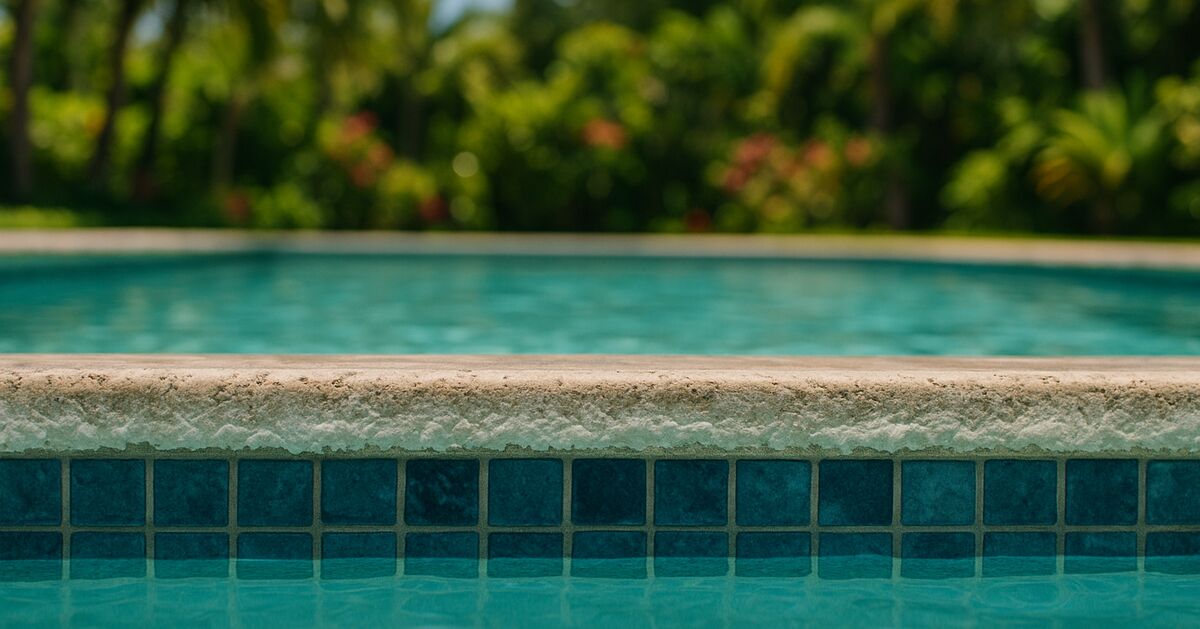
That chalky white band creeping up your pool tile is not just cosmetic. On a saltwater-exposed pool anywhere along our stretch of coast, from Longboat Key down to Siesta Key and out to Anna Maria Island, skipping waterline tile cleaning is one of the most reliably expensive decisions a pool owner can make. The damage builds slowly and invisibly, which is exactly why it catches so many people off guard.
Why the waterline is the most punished part of your pool
Every pool has a waterline, the zone where the water surface meets the tile or plaster. That zone is subject to a constant cycle: water laps up, retreats, evaporates, and laps again. Each cycle leaves behind a tiny deposit. On a freshwater pool in a low-humidity climate, those deposits are annoying. On a saltwater-exposed pool a few blocks from the Gulf, they are aggressive.
Here on the barrier islands, the environment layers several stressors on top of each other all at once:
- Airborne salt and mineral aerosol from Gulf breezes deposits fine particles directly onto the tile, especially above the waterline where it dries and concentrates.
- High evaporation rates during our long warm season pull water away quickly, leaving calcium, magnesium, and salt residue behind in a thick, repeating band.
- Pool chemistry fluctuations are more pronounced here because heat, heavy rain, bather load from vacation rentals, and wind all conspire to swing pH and calcium hardness rapidly. Each swing contributes to scaling.
- Saltwater pool systems themselves, increasingly popular across Longboat Key and Bird Key, produce chlorine through electrolysis of dissolved salt. That process tends to raise pH over time, and elevated pH is the single fastest driver of calcium scale on tile.
The result is a waterline that scales up faster than it would almost anywhere else in the country, and then holds onto that scale with remarkable stubbornness.
What is actually building up on the tile?
Most of what you see as a white or grey film at the waterline is calcium carbonate scale. Your pool water carries dissolved calcium, and when conditions are right (too-high pH, too-high calcium hardness, too-high water temperature, or just too much evaporation), that calcium precipitates out and bonds to the nearest hard surface, which is usually your tile grout lines and the tile face itself.
On top of the calcium layer, a barrier-island pool also accumulates:
- Sunscreen and body oils, which bind to scale and create a greasy, yellowish film.
- Algae biofilm, which anchors itself to the rough texture that scale creates and becomes increasingly hard to brush away.
- Metal staining, particularly from copper and iron in source water or from corroding equipment. We covered the specifics of how to read those colors in our post on pool tile and waterline stains: what each color is telling you.
- Airborne organic debris from the palms, sea grape, and mangroves common to our neighborhoods, which oils the surface and traps particulates.
None of these layers are inert. Each one creates a slightly rougher surface that attracts and anchors the next layer faster.
The cascade of damage that follows
Here is where the real cost starts to accumulate, and why "I'll get to it eventually" rarely ends cheaply.
Stage one: surface etching. Calcium scale is not just sitting on top of your tile glaze. The acids produced by algae biofilm and the minor pH swings that occur naturally begin to etch into the glaze itself. Once the glaze is etched, the tile is permanently more porous, which means scale and staining adhere faster in the future. A tile that took two years to scale badly will now scale badly in six months.
Stage two: grout deterioration. Pool grout between tiles is far more vulnerable than the tile itself. Calcium scale works into grout lines, and the freeze-thaw cycle is not your concern here, but the expansion and contraction caused by Florida's daily temperature swings and the mechanical action of cleaning tools absolutely is. Grout that has been left to scale for a season or two begins to crack and crumble. Once grout is compromised, water infiltrates behind the tiles.
Stage three: tile delamination. Water behind the tiles is a serious problem. It works on the tile adhesive, especially in a salt-air environment where the adhesive is already under stress. Tiles begin to loosen, then pop off entirely. Replacing individual tiles sounds straightforward until you discover that the original tile style is discontinued (extremely common on older pools), the substrate behind the delaminated area is damaged, or the delamination has spread to neighboring tiles invisibly. What starts as one loose tile quickly becomes a 20-tile repair project, and on pools with a decorative glass mosaic waterline band, replacement tile can be surprisingly expensive.
Stage four: plaster or finish damage. If your pool has a plaster, pebble, or quartz finish (rather than full tile) in the body of the pool, heavy waterline scale does not stop at the tile. The same calcium precipitation that coats the tile also coats the finish just below the waterline. That zone of the finish becomes rough, stained, and eventually pitted. Resurfacing a pool is a major expense. If you have been wondering what that process involves, our guide on how to read a pool resurfacing quote on Longboat Key walks through the materials, warranties, and line-item costs in plain language.
Why a pressure washer is not the answer
Many homeowners try to tackle heavy waterline buildup themselves with a pressure washer or an abrasive pad. On light, fresh deposits this can work. On scale that has been building for a season or more, it usually causes as much damage as it prevents.
Pressure washing at close range on tile grout can blast out material that was still structurally intact. Abrasive pads, particularly anything rated for household scrubbing, scratch the tile glaze. Once scratched, the surface scales dramatically faster, so you end up in a cycle where you are scrubbing harder and harder, doing more damage each time, while the problem returns more quickly.
Professional waterline cleaning on a scaled pool typically uses a combination of pumice stone (applied carefully by hand at the correct angle), diluted acid washing for severe cases, and specialty descaling chemicals that chelate calcium without attacking the grout or finish. The goal is to remove the scale without removing the glaze or grout surface beneath it. That distinction matters enormously for the long-term health of the tile.
How often does waterline tile actually need cleaning?
On a well-maintained pool with balanced chemistry, a thorough waterline scrub at every weekly service visit prevents serious buildup from ever forming. The technician brushes the line during each visit so that deposits never have time to harden and bond.
On a pool where chemistry is allowed to swing (common on vacation rental properties in Siesta Key and Lido Key that see heavy bather loads between service visits), scale can become noticeable within two to three weeks during summer. On a pool that is only opened for the season with no interim visits, a full season of unchecked buildup can require a professional acid wash to reverse, which carries its own risks for the finish if not done carefully.
As a general rule for our area:
- Weekly service should include a waterline brush as a standard step, not an optional add-on.
- Monthly is the minimum for any pool that is actively used, even with good chemistry.
- A dedicated deep clean is warranted at the start of each season, particularly after a pool has been closed or minimally serviced during an owner's absence. Our pool cleaning and maintenance services include this as part of regular seasonal care.
The saltwater system factor
If you have a salt chlorine generator, pay extra attention here. As mentioned above, these systems tend to drift pH upward because the electrolytic process produces sodium hydroxide as a byproduct. High pH dramatically reduces the effectiveness of your chlorine (which creates a secondary problem) and dramatically increases the rate of calcium precipitation.
Owners of saltwater pools on Longboat Key and Bird Key often notice faster waterline scaling than neighbors with traditional chlorine pools, and the reason is almost always pH drift that went uncorrected between service visits. Keeping pH in the 7.4 to 7.6 range and calcium hardness between 200 and 400 ppm is the primary chemical defense against scale. Our team covers the chemistry side in detail through our frequently asked questions page if you want to go deeper on those numbers.
What about pools without a screen enclosure?
Unscreened pools on the barrier islands accumulate organic material and airborne salt at a higher rate than screened pools. Leaves, pollen, and salt aerosol land directly in the water and on the tile, which accelerates every process described above. We wrote specifically about how enclosure status changes your maintenance needs in our post on why your pool screen enclosure matters for water chemistry. If your pool is unscreened, waterline cleaning needs to happen more frequently, not less.
What to expect from a professional cleaning visit
When a technician addresses waterline tile during a regular service visit, here is what the process actually looks like:
- Visual inspection first. The technician identifies the type and thickness of deposit, any areas of grout concern, and any tiles that appear loose before any tool touches the surface.
- Wet brushing with a pool brush. Fresh or light deposits brush off easily. This is done before any chemical or abrasive tool.
- Pumice stone for mineral scale. Held at a shallow angle and kept wet at all times, a pumice stone removes calcium scale without scratching tile glaze when used correctly. Dry pumice on dry tile scratches. Wet pumice on wet tile descales.
- Spot treatment for stubborn deposits. A diluted tile-safe acid gel is applied to areas where scale has fully hardened, allowed to dwell briefly, then rinsed off and re-brushed.
- Post-clean chemistry check. Because descaling work temporarily affects water chemistry, a good technician checks and adjusts pH, alkalinity, and calcium hardness after the tile work is done.
This is a routine part of professional pool care, not a specialty upsell. If your current service provider is not touching the waterline at every visit, that is worth asking about.
The bottom line on cost
A weekly or bi-weekly maintenance plan that includes waterline brushing costs a fraction of what a single tile repair or acid wash costs. Tile repair on barrier-island pools typically requires sourcing specialty materials, dealing with the substrate in a salt-air environment, and often leads to a partial retiling of the waterline band when a perfect match is unavailable. None of that is cheap.
Preventing scale costs essentially nothing extra when it is built into a regular service schedule. Reversing it once it has damaged grout, etched tile glaze, or compromised adhesion behind the tile costs significantly more, every time.
If you are not sure what condition your waterline tile is currently in, or if you have noticed that chalky band starting to form, the right move is a professional assessment before the damage progresses. Our team serves homeowners across Longboat Key, Lido Key, Siesta Key, Anna Maria Island, Bird Key, St. Armands Key, and the broader Sarasota area. You can see our full list of service locations or get in touch to schedule a visit.
The tile at your waterline is telling you something. The longer you wait to listen, the more it costs to respond.