
Pool tile and waterline stains: what each color is telling you
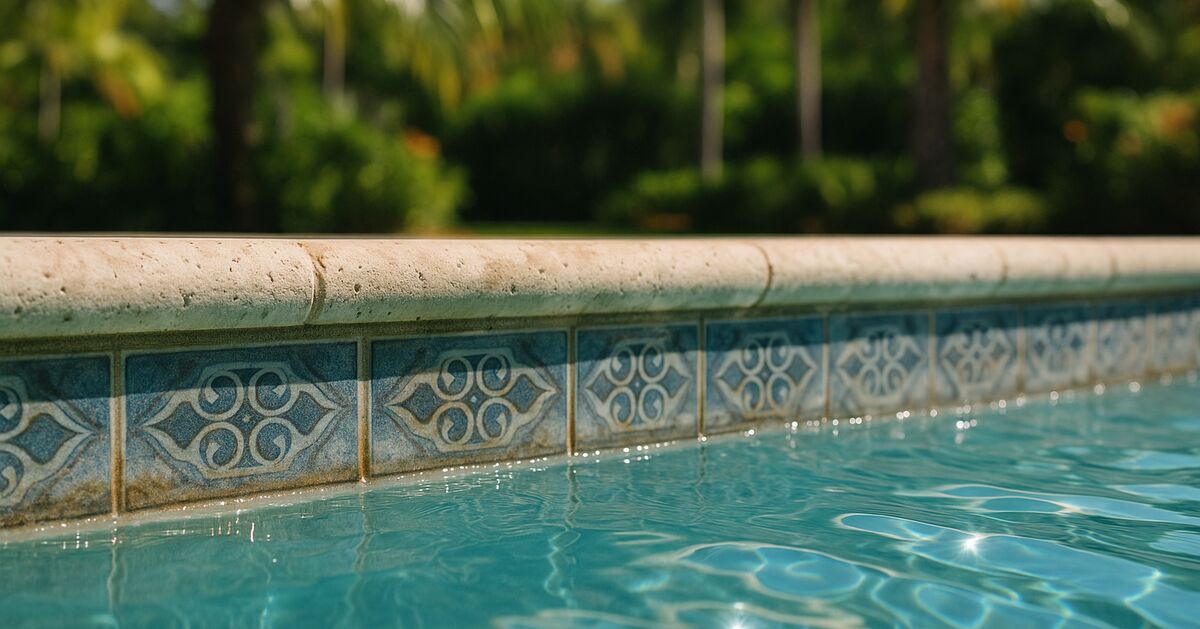
Your pool tile is one of the most honest diagnostic tools you own. Before a water test number even comes back from the lab, the colors creeping along your waterline are already telling a story about what's wrong - and how urgently you need to fix it.
On the barrier islands, that story is almost always more complicated than it is for an inland pool in Sarasota or Bradenton. Salt air, high mineral loads in the source water, intense UV, heavy summer rain, and the unique splash-and-evaporation cycle that comes with waterfront living all stack up to create staining patterns that can confuse even experienced pool owners. This guide will walk you through the most common colors and deposits, explain what's actually happening at a chemical level, and help you figure out whether you need a simple fix or a conversation with a pro.
Why waterline staining happens in the first place
The waterline is where physics punishes chemistry. Water constantly evaporates from the surface of your pool, and everything dissolved in that water - minerals, metals, organic debris, sunscreen residue, body oils - gets left behind right at the tile line. Think of it like the ring inside a tea kettle. Every inch of evaporation concentrates those deposits a little more, and on a warm Gulf-coast day in July, an unscreened pool can lose an inch or more of water to evaporation before you notice.
On Longboat Key pool cleaning and maintenance, Lido Key, and Siesta Key, source water already arrives with elevated calcium and mineral content. Add seasonal topping-off during dry months, and you're essentially running a slow mineral concentrator. The tile is simply where you see the result.
Understanding the specific color and texture of a stain is the fastest way to identify the cause. Let's go through the most common ones.
White or gray crusty deposits
This is the most common stain type on barrier-island pools, and the culprit is almost always calcium - either calcium carbonate or calcium silicate, and they are not treated the same way.
Calcium carbonate looks chalky and white. It forms a fairly soft crust that often flakes if you scratch it. This deposit forms when your pH creeps too high (above 7.8), your total alkalinity is elevated, or your calcium hardness is very high - all while water temperatures are warm. In Florida heat, this is basically the default setting for an unmanaged pool. Calcium carbonate is the more forgiving of the two: it responds to mild acid washing, pumice stones, or a properly balanced water chemistry correction. The tile cleaning itself is the easy part; rebalancing the water so it stops happening is the real job.
Calcium silicate is harder, usually grayish-white rather than bright white, and it does not flake. If you run your fingernail across a deposit and it doesn't budge, suspect silicate. This form develops over a longer period, usually from sustained high pH combined with silica-rich water or certain types of plaster, and it requires more aggressive professional tile cleaning. Catching it early matters - calcium silicate left alone for a season or two can permanently etch grout and soften tile surfaces.
If you've noticed your calcium-related staining has accelerated, it may be worth reading about calcium hardness and why Gulf water makes it harder to manage - the mineral content of the water you're using to top off your pool plays a bigger role than most people realize.
Yellow or tan staining
Yellow or mustard-colored staining at the waterline - or spread across the floor and walls - is a tricky one because two very different problems can produce it.
Pollen and organic matter produce a yellow-tan smear that is usually soft, wipes off with brushing, and tends to appear heavily after heavy tree bloom seasons or after a windy day. On Anna Maria Island and Bird Key, where properties often sit near older, heavily landscaped lots, pollen loads can be significant. If brushing removes it and it comes back quickly after wind events, the source is almost certainly organic. A quick shock treatment and improved skimming habits usually control it.
Iron staining also shows up as yellow to brown, but it behaves very differently. Iron deposits don't brush off cleanly - they stain the tile or plaster surface itself, leaving a faint discoloration even after scrubbing. Iron typically enters pools through source water (well water especially) or through corroding equipment. If you have an aging heater with a deteriorating heat exchanger, iron can leach directly into the water. A metal sequestrant and pH correction are the standard treatment; if the equipment is the source, you're treating symptoms until the hardware is replaced.
Rust-colored or reddish-brown streaks
Rusty streaks running vertically down the tile, or a reddish bloom near a return jet or light fixture, almost always point to metal contamination - iron or manganese, or both.
Iron in its oxidized form leaves orange-brown marks. Manganese tends toward dark brown or even purplish-brown when it oxidizes. Both can enter through source water, but on older properties, a more common culprit is corroding pool equipment or metal fittings. Pool light fixtures with deteriorating stainless hardware, older copper heat exchangers, and even brass fittings in aging pump systems can all shed metal ions into the water.
High chlorine levels accelerate metal oxidation, which is why rust staining sometimes appears or gets worse after a shock treatment. The chlorine oxidizes dissolved iron in the water and it precipitates out onto whatever surface is nearby. If you're seeing rust bloom after shocking, that's a diagnostic clue worth noting: your water contains dissolved iron that's hiding in plain sight until you add an oxidizer.
A sequestrant will bind the metal ions and help prevent further staining while you address the source. Do not drain and refill as a first response - if your source water contains iron, you'll just reintroduce it. Draining and refilling a pool on the barrier islands involves more planning than most homeowners expect, and for metal-stained pools, a refill without a treatment plan often restarts the cycle.
Green or blue-green staining
Green staining at the waterline is not always algae, and correctly identifying which one you're dealing with changes your response entirely.
Copper staining produces a distinctive blue-green or teal discoloration that often appears near fittings, return jets, or along the full waterline after a period of low pH. Copper is most commonly introduced through copper-core algaecides (a common and often over-applied product in DIY pool care), through copper heat exchangers, or through certain ionizer systems. Low pH is the accelerant: when your water is acidic, it becomes corrosive and actually dissolves trace copper from fittings and equipment, putting it into solution until it oxidizes and stains.
If you see blue-green staining and you've been using a copper-based algaecide or your pH has been running low, copper is the prime suspect. A sequestrant and pH correction are the starting points. Repeated heavy copper-algaecide use without proper pH management is one of the more common causes of persistent green tile staining we see across our service areas.
Algae, by contrast, tends to produce a softer, smearier green that often covers larger surface areas, feels slick to the touch, and responds (at least initially) to brushing and chlorine. If the green on your tile wipes off when you brush it and reappears within days, algae is much more likely than metal staining.
Black or dark brown staining
Dark staining is among the most serious to find on pool tile or at the waterline, and it deserves prompt attention.
Black algae is the classic culprit. It's not truly algae in the simple sense - it's a cyanobacteria that forms a protective layer over itself, which is why it resists normal chlorine treatment and keeps coming back even after brushing. It appears as small, dark spots that feel rough or raised, and it embeds into grout lines and plaster rather than sitting on the surface. Black algae is a persistent problem on the Gulf coast during and after rainy season, when bather load and organic contamination are both elevated.
Manganese staining also produces dark brown to black discoloration, and it's easily confused with black algae. The key difference: manganese staining is flat and smooth, not raised or rough. It also tends to appear across broader areas rather than in the distinct dark spots that characterize black algae colonies. Manganese is more common in pools that have used potassium permanganate treatments or in areas with high manganese in the source water.
Organic decomposition from leaves, debris, and tannins can also produce dark staining, particularly on plaster surfaces beneath a heavy debris load. Pools on properties with large overhanging trees - common in many Sarasota neighborhoods and on parts of Anna Maria Island - see this regularly after wind events or heavy leaf fall.
Pink or reddish-pink staining
A pink or pinkish-red stain on tile, grout, or the plastic components of fittings and light fixtures is almost always a biofilm caused by a bacterium called Serratia marcescens. It is not an algae and it does not respond to typical algae treatment.
This biofilm thrives in low-chlorine, moist environments and often colonizes grout lines, around tile edges, and on plastic fittings. It's especially common in pools where the sanitizer level has been allowed to drop for even a short period, or in pools with heavily shaded areas that limit UV exposure. Sustained proper chlorine levels (1-3 ppm) generally prevent it, but once established, it requires direct scrubbing with a chlorine-based cleaner and a period of elevated sanitizer levels to fully eliminate.
What the pattern and location of staining can tell you
The location of a stain is often as informative as its color.
- Staining only at the waterline generally points to evaporation and concentration - mineral or calcium issues are the most likely cause.
- Staining around a specific fitting or jet suggests a localized metal source, often a corroding component.
- Staining on the floor near the drain can indicate debris accumulation, organic decomposition, or localized algae growth in a low-circulation dead spot.
- Staining across the entire plaster surface, floor and walls is more often a whole-water-chemistry issue - pH, metals, or sustained algae.
- Staining that appears suddenly after a storm or heavy rain on barrier islands often reflects dilution of sanitizer and introduction of organic matter - a combination that favors rapid algae and biofilm growth. Our pool services page covers what a routine maintenance visit includes to catch these post-storm shifts early.
The barrier-island difference
For homeowners on St. Armands Key, Bird Key, and Longboat Key, a few local factors make staining both more common and more variable than it would be at an inland address.
Salt air itself doesn't directly stain tile, but it accelerates the corrosion of pool equipment, which puts metal ions into circulation faster than you'd see in a protected inland environment. The combination of high UV, warm water temperatures, and the higher-than-average calcium content of local municipal water creates an environment where carbonate scaling forms quickly. And the mix of heavy summer rainfall (diluting and destabilizing chemistry) followed by intense heat and evaporation (concentrating what's left) means water chemistry swings more often and more sharply than it does in less extreme climates.
That's the underlying reason our frequently asked questions consistently include questions about staining - it's genuinely one of the most visible and confusing maintenance challenges for barrier-island pool owners.
When to call a professional
DIY tile cleaning can address light calcium scale with a pumice stone or a mild acid wash gel, and simple chemistry correction can stop mild organic staining from progressing. But there are a few situations where it's worth bringing in a pro rather than experimenting:
- Staining that returns quickly after cleaning, which suggests the water chemistry cause hasn't been identified or corrected
- Any staining that appears to be embedded in or etching the tile or plaster surface
- Dark staining that might be black algae, which requires a specific treatment protocol to fully eliminate
- Metal staining that persists after sequestrant treatment, which may indicate an active equipment source of contamination
- Widespread staining after a period of inattention, where multiple chemistry problems may have developed simultaneously
If you're unsure what you're looking at or how far the problem has progressed, get in touch for a professional assessment. A trained eye can usually identify the stain type, likely cause, and correct treatment in a single visit, which is almost always faster and cheaper than working through the options by trial and error.
Your pool tile isn't just decoration. It's a running record of everything your water chemistry has been doing. Learning to read it is one of the most practical skills a pool owner on the barrier islands can develop.