
Why your pool screen enclosure matters for water chemistry - and what to do without one
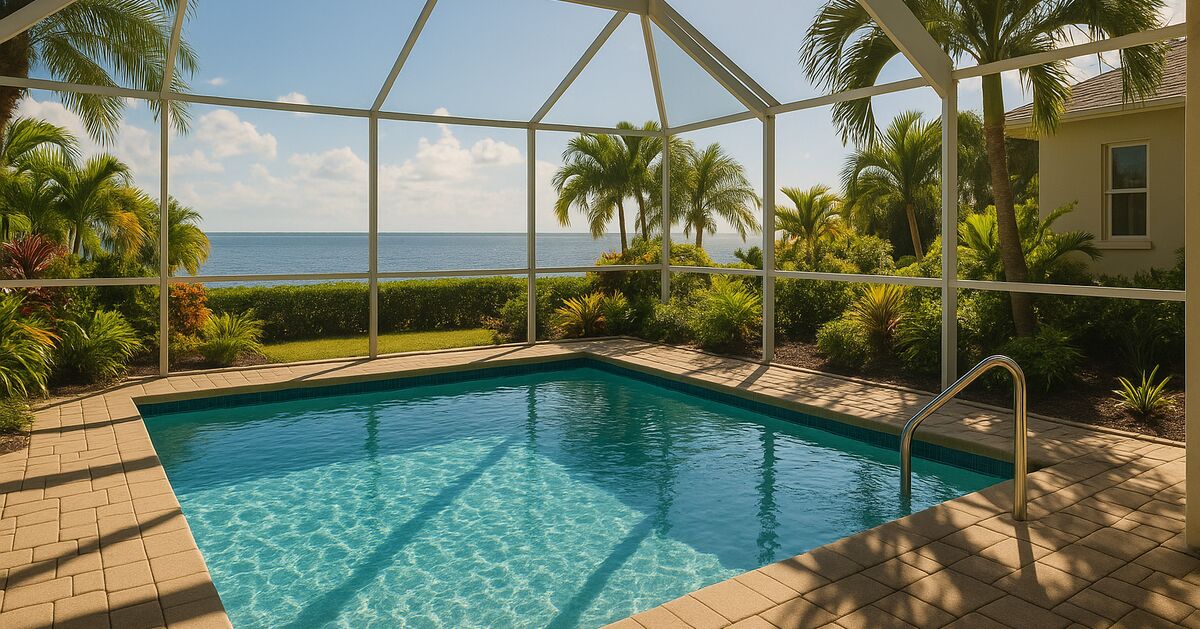
A screen enclosure is one of those things Longboat Key pool owners tend to take for granted until they no longer have one. Maybe a storm tore a panel, maybe the previous owner never installed one, or maybe you're weighing whether the cost is really worth it. The answer, from a pure water-chemistry standpoint, is almost always yes - and the reasons go a lot deeper than keeping the no-see-ums out.
What a screen enclosure actually does to your water
The obvious job of a pool enclosure is to act as a physical barrier. But think about everything that a barrier stops from entering your water on a typical Longboat Key afternoon.
Organic debris. Sea grape leaves, palm fronds, grass clippings, pine needles, flower petals, seed pods, bird droppings. Every single piece of organic material that falls into an unscreened pool starts breaking down immediately in Florida's heat. As it decomposes, it consumes chlorine, feeds algae with phosphates and nitrates, and drives up your combined chlorine (chloramines). A pool without a screen enclosure is fighting a constant biological battle that a screened pool barely notices.
Airborne pollen and dust. Sarasota County sits in a subtropical zone that produces significant pollen loads, especially in spring and early summer. Fine pollen dissolves partially in pool water and contributes to phosphate loading - one of the stealthiest chemistry problems on barrier-island pools. If you've read our post on phosphates in barrier-island pools, you already know how quickly elevated phosphates can destabilize an otherwise balanced pool.
Salt spray and windborne particles. Homes on Longboat Key, Lido Key, and Bird Key are often within a few hundred feet of open water. Gulf breezes carry fine salt aerosols, mineral particles, and microscopic organic matter. Every particle that lands in your pool alters the mineral balance just a little. Over weeks and months, that adds up in ways your test kit will confirm even if you can't see the source.
Direct sunlight intensity. A screen mesh blocks a meaningful percentage of UV radiation. Chlorine degrades rapidly under direct Florida sun - far faster than most owners expect. A screened pool gets slightly diffused light, which slows chlorine burn-off and means you spend less money on sanitizer to maintain a safe residual. The difference is not dramatic on a single day, but across a Florida summer it becomes very real.
The chemistry consequences of going unscreened
Let's be specific about what happens when all that debris and organic load hits an unscreened pool. None of this is theory.
Chlorine demand spikes constantly. When organic material enters the water, your sanitizer rushes to oxidize it. Each spike of demand chews through the free chlorine residual you carefully built up. If demand outpaces supply, you drop below the safe threshold and bacteria and algae get a foothold. Unscreened pools in Anna Maria Island neighborhoods and along the open stretches of Siesta Key frequently need significantly more chlorine per week than comparable screened pools nearby. This is a direct operating cost difference.
Phosphate levels climb faster. Organic debris is the primary phosphate source in most residential pools. Phosphates themselves don't cause algae, but they feed it, making it harder to control once it appears and making it bounce back faster after a treatment. Without a screen to intercept that debris, you are constantly reloading the fuel supply.
pH wants to drift upward. Heavy organic loading, combined with the naturally alkaline source water in this part of Florida, pushes pH upward over time. High pH makes chlorine dramatically less effective - at pH 8.0, free chlorine is only about 20 percent as active as it is at the ideal 7.4 to 7.6 range. You may be dosing chlorine faithfully and wondering why it never seems like enough. Drifting pH in a debris-loaded, unscreened pool is frequently the culprit.
Total dissolved solids (TDS) accumulate faster. Every substance that enters the water and dissolves raises TDS. High TDS dulls water clarity, makes it harder for chemicals to work efficiently, and is one of the factors that eventually pushes a pool toward a partial drain. You can read more about the drain-and-refill decision in our guide to draining and refilling your Longboat Key pool.
Calcium scaling risk increases. The Gulf Coast already sends hard source water into your pool. When evaporation runs at full speed in an unscreened pool under direct sun, you concentrate dissolved minerals, including calcium, faster than you would in a shaded or screened environment. We covered the nuances of this problem in detail in our post on calcium hardness in Longboat Key pools.
So your pool doesn't have a screen enclosure. Here's your practical plan.
Having an unscreened pool is not a disaster. Plenty of Longboat Key and Sarasota homeowners maintain beautiful, healthy pools without one. It just requires a more disciplined maintenance approach. Here is what that looks like in practice.
Test and adjust water chemistry more frequently
A screened pool can often stay in balance for a week between professional visits. An unscreened pool in the same neighborhood, exposed to the same conditions, may need attention every few days during summer and after windy stretches. At minimum, test your water two to three times per week during rainy season and whenever a significant weather event has passed. pH and free chlorine are your first priority. If either is out of range, everything else becomes less predictable.
Brush and skim obsessively
This sounds basic, but it matters more than almost any chemical step. The faster you remove organic debris from the water surface and walls, the less time it has to consume chlorine and release phosphates. Skim the surface at least daily. Brush the walls and floor twice a week to prevent biofilm from establishing itself in corners and along the waterline. A pool that is mechanically clean is much easier to keep chemically balanced.
Run your circulation longer
Filtration is your pool's immune system. An unscreened pool picks up more particulate matter and needs longer filter run times to stay clear. In summer, plan for at least eight to ten hours of daily filtration. During particularly dirty stretches, run the pump for twelve hours or more. The electricity cost is real, but it is far less than a green-pool remediation.
Elevate your phosphate management
With no screen to block incoming organic debris, phosphate loading in an unscreened pool is relentless. Have your phosphate levels tested regularly and use a phosphate remover on a scheduled basis, not just as a reaction to a problem. Keeping phosphates below 100 parts per billion makes algae prevention dramatically more effective. If you are unsure what your current levels are, ask your pool professional to test at the next service visit.
Use a stabilized chlorine product thoughtfully
Cyanuric acid (CYA) is a chlorine stabilizer that slows UV degradation. For an unscreened pool under full Florida sun, maintaining CYA in the 30 to 50 ppm range is important. Too little, and the sun destroys your chlorine before it can do its job. Too much (above 80 ppm is generally considered a problem), and the stabilizer itself ties up the chlorine and reduces its effectiveness. Unscreened pools often accumulate CYA faster through trichlor tablet use, so keep an eye on it.
Consider a liquid chlorine program
Trichlor tablets are convenient, but they add CYA to the water every time they dissolve. An unscreened pool that needs higher and more frequent chlorine doses can accumulate CYA quickly - sometimes reaching levels that require a partial drain to correct. Switching to liquid chlorine (sodium hypochlorite) for your primary sanitizing, with granular calcium hypochlorite for shock treatments, lets you control chlorine levels without continuously loading CYA. This is a conversation worth having with your pool service professional.
Use a solar cover between swims
A solar blanket or liquid solar cover is not a substitute for a screen enclosure, but it does meaningfully reduce evaporation, slow UV degradation of chlorine, and keep some debris out of the water during periods when the pool is not being used. A solid solar cover is impractical for pools in constant use, but for vacation homes or properties with seasonal patterns, it is one of the better return-on-investment moves available.
Phosphate removal after heavy pollen or rain events
Spring pollen season and summer rain events are both high-impact moments for unscreened pools. After a heavy pollen drop, do a targeted phosphate treatment. After a significant rainstorm, check and re-balance pH and alkalinity before doing anything else, since rainfall is mildly acidic and can suppress pH, which then causes alkalinity to yo-yo. See our resource on why Longboat Key pools burn through chemicals so fast for more on why weather events hit your chemistry harder than you might expect.
When to consider adding (or repairing) an enclosure
If your pool currently has no enclosure and you are spending significantly more on chemicals, labor, and remediation than your neighbors with screened pools, the math may favor installation. Screen enclosures in Florida have come down in cost over the years and the chemistry savings, combined with reduced cleaning time, can offset a portion of the investment over a reasonable period.
If you already have an enclosure but a storm has damaged it, do not wait on repairs. Even a torn or missing panel lets in meaningful amounts of debris, and during storm season on Longboat Key and the surrounding keys, that exposure can turn a well-balanced pool into a problem pool in just a few days. Temporary screen patches and tarps are a short-term measure, but getting a professional repair done before the next storm rolls in is the right call.
How professional service differs for screened vs. unscreened pools
Honest answer: a skilled pool professional will service both types of pools well, but the visit looks somewhat different. For an unscreened pool, expect more time spent on surface skimming and brushing, more attention to phosphate and pH trends, and potentially more frequent recommended visits during summer. This is not upselling. It reflects the genuine reality of what unscreened Gulf-coast pools require to stay healthy.
Our team serves screened and unscreened pools across Longboat Key, Lido Key, Siesta Key, Anna Maria Island, Bird Key, and Sarasota, and we see the chemistry differences firsthand every week. If you have questions about what your specific pool needs, our frequently asked questions page covers a lot of common ground, or you can reach out directly through our contact page for a conversation about your situation.
The bottom line is simple: a screen enclosure is a piece of infrastructure that does quiet, constant work protecting your water balance, your sanitizer budget, and your equipment. If you have one, keep it in good repair. If you don't, commit to a more disciplined maintenance routine and lean on your pool professional to help you stay ahead of the chemistry instead of chasing it.