
Why is my pool water cloudy? A barrier-island owner's guide
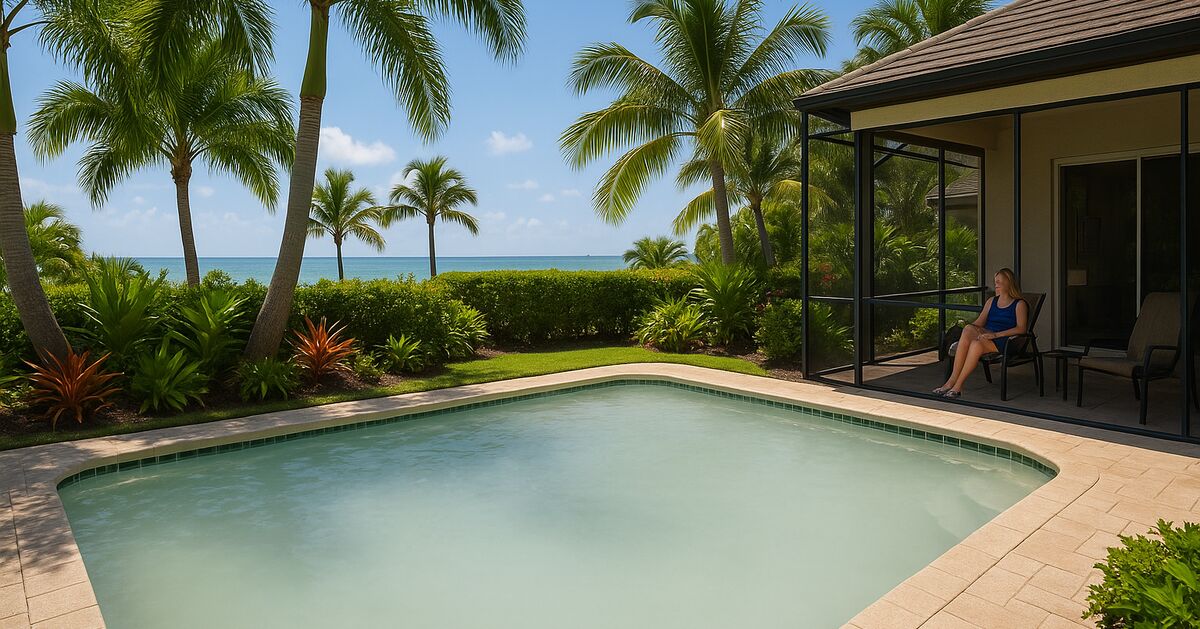
Your pool looked fine yesterday, and this morning it looks like diluted milk. That is one of the most common calls we get from homeowners on Longboat Key, Siesta Key, and Anna Maria Island, and it almost always has a clear explanation once you know what to look for.
Cloudy water is not a single problem. It is a symptom, and the fix depends entirely on the cause. Treat the wrong cause and you will waste money on chemicals, stress your equipment, and still be staring at a murky pool a week from now. This guide walks through every common culprit in a barrier-island setting, explains the "why" behind each one, and tells you what to actually do about it.
Why the Gulf-coast environment makes cloudiness worse
Most pool care advice is written for inland pools in moderate climates. Our situation on the barrier islands is genuinely different, and it matters.
- Intense UV load. The sun here destroys free chlorine faster than nearly anywhere else in the continental US. A pool that was balanced at 8 a.m. can be under-chlorinated by early afternoon in July.
- Salt air and wind. Living near the Gulf means your pool is constantly receiving airborne contaminants: salt particles, pollen, fine sand, and organic debris. Every gust off the water deposits something into the pool.
- Heavy rain dilution. Florida's rainy season delivers intense, sudden downpours that can dilute and unbalance pool chemistry within hours. We see cloudiness spikes every summer that trace directly back to a single afternoon storm.
- High bather load during season. Between November and April, pools on Bird Key, Lido Key, and St. Armands Key often see more swimmers in a single week than a northern pool sees all summer. Every swimmer introduces body oils, sunscreen, sweat, and bacteria.
- Warm water temperatures. Warmer water holds less dissolved oxygen and speeds up chemical reactions, meaning imbalances escalate faster and algae grows more readily.
Understanding this local context is the foundation of good pool care. If you want to dig deeper into how we approach maintenance across the islands, our pool cleaning and maintenance services page explains the routine we use to stay ahead of these conditions.
Cause 1: Low free chlorine or chlorine demand
This is the single most common cause of cloudy water we see. Free chlorine (FC) is the active sanitizer in your pool. When it drops below about 1 ppm, bacteria and microscopic organic particles accumulate faster than the water can clear itself.
On a sunny Sarasota afternoon, UV radiation can cut your free chlorine in half in two to three hours. If your pool is not stabilized properly with cyanuric acid (CYA), that process is even faster.
What to check: Test your free chlorine level with a reliable kit or test strips. If it is below 1 ppm, that is likely your culprit. Also test combined chlorine (chloramines). If combined chlorine is above 0.5 ppm, the water contains too many used-up chlorine molecules that are no longer sanitizing but are still consuming your new additions.
The fix: Shock the pool. Use a non-chlorine shock for a quick oxidizer boost, or a cal-hypo shock if you need to rebuild free chlorine levels rapidly. Do this in the evening so UV does not burn off the treatment before it can work. Run your pump overnight after shocking.
Also verify your CYA level. For an outdoor Florida pool, CYA between 30 and 50 ppm gives chlorine the protection it needs from UV without neutralizing it so heavily that it cannot sanitize.
Cause 2: pH and total alkalinity out of range
Chemistry is interconnected, and pH is the control lever for everything else. When pH climbs above 7.8, chlorine becomes dramatically less effective even if the concentration looks fine on paper. At pH 8.0, roughly 80 percent of your chlorine is in the hypochlorite ion form, which does almost nothing useful. Your water can show a "normal" chlorine reading yet still cloud up because the active fraction is tiny.
High pH also encourages calcium carbonate to come out of solution and form fine precipitates that scatter light and make water appear hazy. This is called scaling, and it is the pool equivalent of limescale on your shower tiles.
Total alkalinity (TA) is the buffer that prevents pH from swinging wildly. Low TA causes pH to bounce around. High TA (above 120 ppm) tends to push pH upward and makes it very hard to bring back down.
What to check: Test pH (target 7.4 to 7.6) and total alkalinity (target 80 to 120 ppm) with a proper test kit, not just strips.
The fix: If pH is high, use muriatic acid or a dry acid product, added slowly to the deep end with the pump running. Bring TA down first if it is above 120 ppm, because TA has a strong influence on where pH settles. These are the adjustments that most homeowners underestimate in their importance.
Cause 3: High calcium hardness and scale precipitation
Sarasota-area tap water is already relatively hard, and when that water evaporates from your pool (which happens quickly in Gulf-coast heat), calcium concentration increases. When the calcium hardness climbs above about 400 ppm, and especially when combined with high pH and high TA, calcium precipitates out of the water as tiny crystals. Those crystals are what you are seeing when the water looks milky or hazy with no obvious chemistry problem.
What to check: Test calcium hardness. Target range is 200 to 400 ppm for most plaster pools, slightly lower for vinyl liner pools.
The fix: There is no easy chemical way to reduce calcium hardness other than diluting the water by partially draining and refilling. In a case of severe hardness, a partial drain is often the right move. A sequestrant product can help keep calcium in solution temporarily, but it is a band-aid rather than a cure.
Cause 4: Poor filtration and circulation
Even perfectly balanced water will turn cloudy if the filter cannot remove fine particles. A clogged or old filter medium, a pump that is undersized for the pool volume, or a poorly designed return jet layout can all lead to water that simply does not turn over fast enough to stay clear.
Sand filters should be backwashed regularly, but they also need a media replacement every five to seven years because the sharp edges of sand grains gradually wear smooth and lose their ability to trap fine particles. Cartridge filters need to be cleaned and eventually replaced. DE filters need fresh diatomaceous earth after every backwash.
On many of the older estate pools we service on Longboat Key and Bird Key, we find filters that are technically "running" but are so far past their effective life that they are essentially just moving water around. A cloudy pool with otherwise acceptable chemistry is a strong sign of filtration failure.
What to check: How long has it been since your filter media was serviced or replaced? Is the pump running the minimum recommended hours per day? In summer in Florida, most pools need eight to ten hours of circulation daily. Is your pressure gauge reading higher than normal? That often signals a dirty or clogged filter.
The fix: Backwash or clean your filter. If it has not been deep-cleaned or had media replaced in several years, that may be the whole story. If you are unsure about the state of your equipment, our frequently asked questions page covers filter maintenance timelines and what to expect from a professional service visit.
Cause 5: Storm and rain runoff
This one catches people off guard. A heavy rainstorm does not just add water volume - it adds phosphates, nitrogen, dirt, debris, and organic matter. It dilutes your chemistry. And it can wash sunscreen, lawn chemicals, and everything else off your pool deck directly into the water.
We see cloudiness spikes after every significant rain event across all our service areas, from Anna Maria Island down through Siesta Key and into Sarasota proper. A pool that looked great before a storm can be visibly cloudy within 24 hours.
What to check: After any significant rainfall, test your entire chemistry panel: pH, TA, FC, CYA, and calcium hardness. Do not assume that because you balanced it last week, it is still balanced today.
The fix: Rebalance chemistry in the order that matters: TA first, then pH, then chlorine. Shock if the organic load from the storm was heavy. Skim the surface and vacuum debris before it breaks down and adds more organic demand to the water. For a full guide to managing your pool through storm season, our post on algae prevention for Gulf-coast pools: a rainy-season action plan covers the broader picture.
Cause 6: Phosphates and organic bather load
Phosphates are nutrients. They feed algae, and they also contribute to water clarity problems because they encourage microbial growth that clouds the water even before a visible green or black algae bloom develops. Sources include fertilizer runoff from neighboring lawns, leaves and organic debris, certain pool chemicals, and even tap water in some municipal supplies.
Bather load matters too. Body oils, sunscreen (especially the mineral sunscreen products that have become popular), and organic waste all demand chlorine and can overwhelm a pool's chemistry faster than many homeowners expect.
What to check: A phosphate test kit or test strip can confirm whether levels are elevated. Above 500 ppb is worth addressing.
The fix: Phosphate remover products are effective and work quickly. For high bather load days, consider adding a mid-week oxidizer treatment or boosting your chlorine slightly in advance. Enforcing a shower-before-swimming rule makes a genuine difference, especially for vacation rentals.
How to diagnose your specific cloudy pool
Rather than throwing products at the problem, follow this sequence:
- Test your water completely, not just chlorine.
- Look at your filter pressure gauge and run time logs.
- Think back to the last 48 hours: heavy rain, lots of swimmers, no pump run time?
- Start with circulation: make sure the pump has been running at least eight hours.
- Adjust chemistry in the correct order: TA, then pH, then shock.
- Clean or backwash the filter after shocking so the filter can capture the oxidized particles.
- Re-test after 24 hours.
If the water has not improved meaningfully within 48 to 72 hours of this process, the problem is likely something that needs a trained eye: a failing filter, a dead spot in circulation, an underlying algae bloom beginning, or a chemistry issue that simple testing kits do not reveal.
When to call a professional
Some cloudiness situations do resolve with a methodical DIY approach. Others spiral if handled incorrectly. Signs that it is time to call in help:
- The water has been cloudy for more than three days despite adjustments.
- You can see a green or yellow tint developing alongside the cloudiness.
- Your pool has gone from cloudy to opaque and you cannot see the bottom.
- You have treated the water multiple times and the problem keeps returning.
- You are not sure what caused it and do not want to experiment with expensive chemicals.
Persistent cloudiness that includes a green tint is typically an algae problem in its early stages. That is a different situation requiring a different intervention - our post on why rainy season is the hardest time to keep your Gulf-coast pool algae-free explains how algae establishes itself and how to stop it before it takes over.
For homeowners on Longboat Key, Lido Key, Siesta Key, and across our service area, professional pool cleaning and maintenance is often the most efficient path because our technicians see these exact conditions every week. We know what the local water supply brings in, how the Gulf-coast climate shifts chemistry, and what problems are seasonal versus structural.
Keeping it clear long-term
The best cloudy-pool fix is prevention. Here is what that looks like in practice:
- Test twice a week in summer, once a week in winter. Chemistry drifts faster in heat.
- Run your pump long enough. Eight to ten hours minimum in summer, six to eight in cooler months.
- Keep the filter clean. A clean filter is the difference between catching particles before you see them and watching the water haze over.
- Skim and brush regularly. Organic debris that sits on the pool surface or settles on the walls becomes a chemistry demand problem.
- Shock after heavy rain or heavy use. Do not wait to see a problem. Treat proactively.
- Use a stabilized chlorine product outdoors. Unstabilized chlorine in Florida sun is a losing battle.
If you would rather hand all of this off to a team that knows the barrier islands inside and out, we cover Longboat Key, Lido Key, Bird Key, St. Armands Key, Siesta Key, Sarasota, Anna Maria Island, and The Village. You can learn more about what we do and how we work on our about page, or get in touch with us to talk through your pool's specific situation.
Clear water is not luck. It is consistent, informed attention to a handful of variables that all interact with each other. Once you understand what each one does and why, keeping your pool clear becomes genuinely manageable even in a Gulf-coast summer.