
Getting your pool ready before you leave for the season
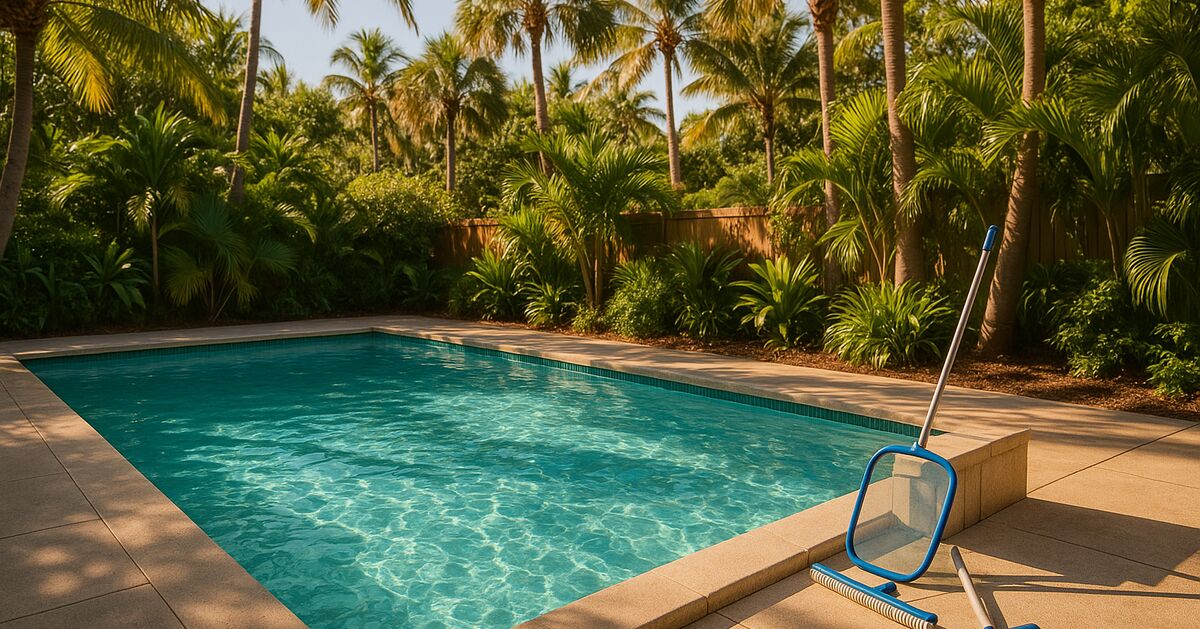
Your pool doesn't take a vacation just because you do. Leave it without proper preparation and you'll come back to green water, a corroded pump, a cracked fitting, or worse. Done right, a seasonal close-out takes a few hours and can save you hundreds of dollars in repair and chemical bills when you return in the fall or winter.
This guide walks through everything a Longboat Key, Siesta Key, or Anna Maria Island homeowner should do before locking up for the season. It's the same process our technicians follow, and we want you to understand the reasoning behind each step, not just a checklist to rush through.
Why closing a Florida pool is different from closing one in Ohio
In the northern states, "closing a pool" usually means draining it down, blowing out the lines, and popping in a freeze plug. Florida is another world entirely.
Our climate never truly freezes, which means you almost certainly won't drain your pool below the tile line. But that creates its own set of challenges. Warm, humid air doesn't go away just because you left. Algae spores float in from the Gulf, UV rays beat down on your water's sanitizer, and salt air on barrier islands like Lido Key, Bird Key, and St. Armands Key keeps working on exposed metal and fittings all summer long.
The goal of a Florida seasonal close-out is not to shut the pool down. It's to put it in a stable, low-maintenance state that can hold for weeks or months without someone on-site babysitting it every day.
Step 1: Get the chemistry dialed in before you do anything else
This is the single most important step, and the one most homeowners rush or skip. If you leave your pool with unbalanced water, every other precaution you take is undermined.
Here's what you want to confirm before you go:
- Free chlorine: 2.0 to 4.0 ppm for a standard chlorine pool, or 2.0 to 3.0 ppm for a saltwater pool
- pH: 7.4 to 7.6 (low pH corrodes equipment and plaster; high pH causes scaling and clouds the water)
- Total alkalinity: 80 to 120 ppm (this acts as a buffer that keeps pH from swinging wildly)
- Calcium hardness: 200 to 400 ppm (too low and your water starts pulling calcium from the plaster itself)
- Cyanuric acid (stabilizer): 30 to 50 ppm (this shields chlorine from UV breakdown, which matters enormously in a Florida summer)
If you want the full reasoning behind each of these numbers, our post on pool chemistry basics: what every Florida owner needs to know goes into the detail.
Once everything is balanced, add a quality phosphate remover and an algaecide rated for extended periods. Phosphates are algae food, and they blow in from landscaping, rain, and Gulf breezes. Cutting them off before you leave is cheap insurance.
Step 2: Shock the pool properly
A leaving shock is not the same as a routine weekly shock. You want to bring free chlorine up to a breakpoint that temporarily overwhelms any early-stage algae, bacteria, or organic contaminants that have been building up. For most residential pools in our area, that means adding a non-chlorine oxidizing shock or a calcium hypochlorite shock in the evening, letting the pump run overnight, and testing again in the morning before you proceed.
Do not leave the day after you shock without testing first. If something unexpected is growing in your water, better to catch it now than in November.
Step 3: Clean everything, and we mean everything
Balance and shock do a lot, but they can't replace physical cleaning. Before you leave:
- Brush all surfaces. Walls, steps, and the waterline tile. Algae and biofilm cling to grout lines, and brushing suspends them so the sanitizer can do its job.
- Vacuum to waste. If there's any debris on the floor, vacuum it out through the waste line rather than through the filter, so you don't redistribute particles.
- Skim thoroughly. Organic debris in the water feeds algae and burns through your chlorine.
- Clean the filter. Whether you have a cartridge, sand, or DE filter, it should be clean when you leave. A dirty filter restricts flow, and restricted flow means your circulation system isn't turning the water over the way it needs to.
- Empty the skimmer baskets and pump basket. Leaves and debris left sitting in a basket over a hot Gulf Coast summer become a slimy mess by the time you return.
- Wipe down the equipment pad. Salt air deposits sit on motor housings, unions, and fittings. A quick wipe-down and a light coat of corrosion-resistant spray on exposed metal goes a long way.
Step 4: Check and service your equipment
This is the step that separates a good close-out from a great one. Before you leave, take twenty minutes to look at every piece of equipment on the pad.
- Pump: Listen to it run. Any grinding, rattling, or unusual vibration is worth addressing now, not after six months of unattended operation.
- Filter: Note your clean pressure. When you return, you'll have a baseline to compare against.
- Salt cell (if applicable): Inspect the cell for calcium scaling. A scaled cell runs inefficiently and can burn out prematurely. Clean it with a diluted muriatic acid solution if needed.
- Timer and automation system: Set the pump to run at least 8 to 10 hours per day while you're gone. Some owners reduce this to save electricity, but dropping below 6 to 8 hours in Florida summer heat is a gamble with algae.
- O-rings, unions, and valve handles: Look for cracking or brittleness. The UV exposure and salt air on our barrier islands accelerate rubber degradation. A cracked O-ring that leaks slowly all summer can let air into the system and cause the pump to lose prime.
If you have already been reading our content on equipment care, you know that salt air on Longboat Key and the surrounding barrier islands is particularly aggressive on pumps, motors, and automation hardware. Catching small issues before you leave means a professional can address them in a scheduled visit rather than an emergency call.
Step 5: Set up ongoing maintenance while you're away
This is not optional. It is the single biggest mistake seasonal homeowners make.
A pool left completely unattended for three to six months in Southwest Florida heat is almost guaranteed to turn green. Even perfectly balanced water with a strong algaecide dose will drift as rain dilutes chemical levels, as UV burns off stabilizer, and as heat accelerates chlorine consumption. No chemical treatment you apply today is designed to hold for months without any follow-up.
There are a few ways to handle this:
Option A: Weekly or bi-weekly professional service. A pool service visits regularly to test and adjust chemicals, skim, brush, and empty baskets. When you come home, the pool is ready to swim in. This is what most of our customers choose. Our pool cleaning and maintenance services are specifically designed for seasonal homeowners who need reliable eyes on the property while they're away.
Option B: Smart monitoring with professional backup. Some homeowners install a wireless chemical monitor (brands like Ondilo or pHin float in the pool and send readings to your phone). This gives you visibility into your water from anywhere, but you still need someone physically on-site to add chemicals and clean debris. A monitor cannot skim a skimmer basket.
Option C: Have a trusted neighbor check in. This works only if that neighbor is genuinely comfortable testing and adjusting pool chemistry and is willing to call a professional when something looks wrong. Most of the time, it doesn't work as well as planned.
To understand what a professional maintenance visit actually covers and how frequency should scale with your pool's situation, our post on how often a Longboat Key pool should be serviced in summer lays that out in detail.
Step 6: Address the water level and auto-fill
Normal evaporation in a Florida summer can drop a pool several inches per month, even more if you have a spa with a waterfall or a fountain running. If your water level drops below the skimmer mouth, the pump will suck air and lose prime, which can overheat and damage the motor.
If you have an auto-fill device, make sure it is working properly before you leave and set it to a level that keeps water at the mid-skimmer line. If you do not have an auto-fill, make sure your maintenance provider knows to check the water level at every visit.
Step 7: Secure the area and think about safety
Before leaving a property for an extended period, it's worth doing a quick safety walkthrough:
- Test the gate latch and self-closing mechanism on your pool fence. Latches loosen over time, especially in salty air.
- Remove any floats, toys, or accessories from the water. UV breaks down plastics, and waterlogged inflatables foul your skimmer baskets.
- Check that any exterior outlets near the pool have properly sealed covers.
- If you have a pool heater, follow the manufacturer's guidance for extended non-use. In most cases this simply means leaving it in standby mode rather than fully disconnecting it, but confirm with your equipment documentation.
Common mistakes to avoid
Even well-intentioned homeowners make these errors. Keep them in mind:
- Over-relying on algaecide alone. Algaecide slows algae growth. It does not replace sanitizer, and it cannot overcome badly imbalanced chemistry.
- Leaving the pool in direct full-sun without adequate stabilizer. Cyanuric acid (stabilizer) is what keeps your chlorine from burning off within hours in a Florida summer. If your CYA is low when you leave, even a high chlorine reading won't last.
- Cutting the pump run time too far. Electricity costs are real, but a green pool cleanup is far more expensive. Keep circulation up.
- Skipping the equipment check. Small problems become big ones over a long unattended stretch.
- Not telling your service provider you're leaving. If you already have a pool service, confirm with them the date you're departing, what access they have to the property, and who to contact in an emergency.
If you return home to find your pool has turned green despite your best efforts, that is not the end of the world. It is a recoverable situation, but it requires prompt, systematic treatment rather than just dumping in extra chlorine and hoping for the best. Our FAQ page has guidance on what to do when water goes green.
Putting it all together
A good seasonal close-out follows a simple sequence: balance the chemistry, shock, clean everything, check the equipment, arrange professional ongoing maintenance, and confirm your water level situation. Every step depends on the one before it. Shock without brushing leaves organics on the walls. Clean without balancing gives algae a chance to rebound. Equipment checks without maintenance arrangements mean problems that develop in June don't get caught until October.
The homeowners on Longboat Key, Siesta Key, Bird Key, and Anna Maria Island who come back to sparkling pools in the fall are almost never the ones who just crossed their fingers. They're the ones who took a couple of hours before leaving to do the job properly.
If you'd like help with any part of this process, whether it's a pre-departure service visit, an equipment inspection, or a full maintenance plan for the months you'll be away, get in touch with our team. We serve homeowners across Longboat Key, Lido Key, St. Armands Key, Siesta Key, Sarasota, Bird Key, Anna Maria Island, and The Village, and we're happy to walk you through exactly what your pool needs before the gate closes for the season.
For more detail on the equipment side of things, our about page explains how our team approaches maintenance on Gulf Coast pools, where salt air and heat create conditions that demand a little more attention than pools just a few miles inland.