
Balancing pool chemistry in Florida heat: a simple guide
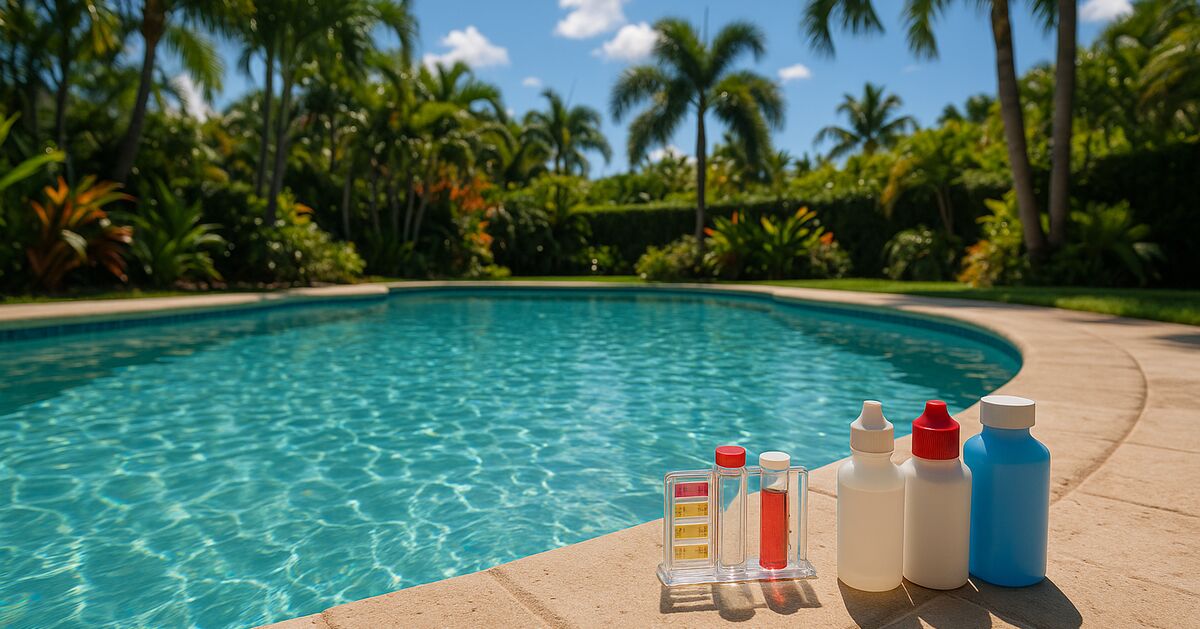
Florida sun is not kind to pool water. On a bright July afternoon on Longboat Key or Siesta Key, your pool can burn through a week's worth of chlorine in just a few days, and the chemistry can swing from "swim-ready" to "murky green" before you've had a chance to notice. Understanding why that happens, and what to do about it, is the difference between a pool you're proud of and one you're embarrassed by.
This guide covers the core chemistry you need to know, the specific ways Florida's climate pushes everything out of balance, and the practical steps you can take to stay ahead of it. No chemistry degree required.
Why Florida heat changes everything
Most pool chemistry guides are written with a national audience in mind, so they assume moderate temperatures, moderate sun, and pools that sit under shade trees half the day. That is not Sarasota. From April through October, water temperatures on barrier islands like Lido Key and Bird Key regularly climb into the upper 80s. Intense UV radiation burns off unstabilized chlorine at an alarming rate. High bather loads from family visits and vacation rentals add organic waste faster than cooler climates see in a full season.
The result is a pool that is chemically active and unstable. Every variable you'd normally check weekly may need attention twice a week or more. Our guide on how often a Longboat Key pool should be serviced in summer goes deeper on service frequency, but for now understand this: in Florida, chemistry is a moving target, and respecting that reality is step one.
The four numbers that matter most
Pool chemistry involves a lot of parameters, but four are responsible for the vast majority of problems homeowners face.
1. pH (target: 7.4 to 7.6)
pH is the measure of how acidic or basic your water is. The ideal range for a swimming pool is 7.4 to 7.6, which happens to be close to the pH of human eyes and skin. Staying in that range means swimmers are comfortable and your sanitizer works at peak efficiency.
Here is the critical piece: chlorine effectiveness is almost entirely pH-dependent. At a pH of 7.5, roughly 50% of your free chlorine is in its active, sanitizing form (hypochlorous acid). Nudge the pH up to 8.0 and that active fraction drops to around 20%, meaning you effectively lose most of your sanitizer even if the chlorine reading looks fine on a test strip. Florida's heat and frequent swimmer traffic push pH upward naturally, so testing frequently and adding a pH reducer (sodium bisulfate or muriatic acid) as needed is a non-negotiable habit.
On the flip side, pH that runs too low is corrosive. It eats away at plaster, grout, and metal fittings, and it irritates skin and eyes. Balance is everything.
2. Free chlorine (target: 2 to 4 ppm)
Chlorine is your primary sanitizer. It kills bacteria, oxidizes organic waste, and keeps algae from taking hold. In cooler climates, maintaining 1 to 3 ppm might be acceptable. In Sarasota-area pools, many professionals target the higher end of 2 to 4 ppm because of UV degradation and heat.
The most common mistake Florida homeowners make is relying on a weekly tablet feeder and assuming it will keep up. Slow-dissolving trichlor tablets are a fine baseline, but in summer they rarely replace chlorine as fast as the sun destroys it. Supplemental liquid chlorine additions, especially after heavy use or a stretch of intense weather, are often necessary.
3. Cyanuric acid / stabilizer (target: 30 to 50 ppm)
Cyanuric acid (CYA) is the sunscreen for your chlorine. Without it, UV rays destroy free chlorine within a couple of hours of direct sun exposure. With it, chlorine lasts significantly longer in outdoor pools.
The catch is that CYA accumulates over time. Trichlor tablets and dichlor granules both contain CYA, so every dose raises your stabilizer level slightly. Once CYA climbs above 80 to 100 ppm, it begins to "lock" the chlorine, reducing its ability to sanitize effectively. This condition is sometimes called "chlorine lock," and the only real remedy is diluting the pool water by partially draining and refilling it. Testing CYA every four to six weeks is a smart habit for any Florida pool owner.
4. Total alkalinity (target: 80 to 120 ppm)
Think of total alkalinity (TA) as pH's shock absorber. When TA is in the right range, pH stays relatively stable even when swimmers, rain, or chemicals push it around. When TA is too low, pH bounces wildly and becomes nearly impossible to control. When TA is too high, pH becomes stuck in an elevated range and resists correction.
Keeping TA in the 80 to 120 ppm range gives your pH a stable foundation, which in turn makes every other chemical adjustment easier and longer-lasting.
Calcium hardness: the silent wrecker
Calcium hardness (target: 200 to 400 ppm for plaster pools, 150 to 250 ppm for vinyl or fiberglass) is often overlooked but causes serious long-term damage when ignored.
Water that is too soft (low calcium) is "hungry" and will pull calcium out of plaster surfaces, causing pitting and etching. Water that is too hard deposits scale on tile, plumbing, and equipment. In Sarasota and on the barrier islands, the local source water tends toward moderate hardness, but evaporation in summer concentrates everything in the pool. As water evaporates and you top the pool off, calcium levels climb steadily over a season. Testing calcium hardness every four to six weeks and knowing when to dilute is part of responsible pool ownership here.
How Florida weather compounds the problem
Beyond raw heat, there are a few weather-specific factors that are especially relevant for pools near the Gulf Coast.
Heavy rain: A summer thunderstorm that drops two or three inches of rain in an hour (common throughout our area from June through September) dilutes your chemical levels and can also introduce phosphates and organic material that feed algae. After significant rain, always test and rebalance before the next swim.
Wind and salt air: Properties on Longboat Key, Lido Key, and Anna Maria Island sit close enough to the Gulf that airborne salt can affect surface equipment over time. It is less of a chemistry issue and more of an equipment wear issue, but it underscores the importance of regular inspection of your pump, heater, and fittings.
Extended hot dry spells: When it hasn't rained in weeks and temperatures are in the mid-90s, evaporation is intense. You may be adding water frequently, which dilutes some chemicals while concentrating others (notably calcium and CYA since they don't evaporate with the water). Testing more often during dry spells is important.
Our detailed post on balancing pool chemistry after storms covers the post-storm checklist specifically, and it pairs well with this guide.
Saltwater pools: same chemistry, different source
Many homeowners on Siesta Key, Bird Key, and in Sarasota proper have switched to saltwater chlorine generators, sometimes assuming they eliminate the need to manage chemistry. They don't. A saltwater system simply converts dissolved salt into chlorine through electrolysis. The pool still contains chlorine, and all the same chemistry principles apply: pH, TA, CYA, and calcium hardness all need regular attention.
What changes is that you're no longer adding chlorine manually as often, and the water often feels softer and silkier. But the generator's output can vary with water temperature, salt levels, and cell condition. In summer, many generators run at maximum capacity and still struggle to keep up. Our comparison of saltwater vs. traditional chlorine pools covers the trade-offs in detail if you're weighing a conversion.
A practical testing and maintenance routine
Here is what a realistic Florida pool maintenance routine looks like for a homeowner managing their own chemistry:
- Twice weekly in summer (May through October): Test free chlorine and pH. Adjust as needed.
- Weekly: Check and adjust TA if pH is swinging around a lot. Inspect the pump basket, skimmer basket, and water level.
- Every four to six weeks: Test CYA and calcium hardness. These change slowly, so monthly is enough.
- After heavy rain or a large party: Test everything and add a maintenance dose of chlorine if levels are low.
- Shock monthly (or as needed): Super-chlorinating the pool to 10 ppm or above burns off chloramines (combined chlorine that smells bad and is irritating) and resets the sanitizer level. Use a non-stabilized shock (calcium hypochlorite) to avoid constantly adding more CYA to an already high stabilizer level.
If this routine feels like a part-time job, you're not imagining things. That is genuinely what it takes to keep a pool chemically balanced through a Florida summer. It is one of the main reasons so many homeowners on the barrier islands choose professional pool cleaning and maintenance services rather than managing it themselves.
When to call in a professional
There are situations where DIY chemistry management hits a wall:
- Persistent algae that returns within days of treatment often signals an underlying chemistry imbalance (usually high CYA or low circulation) that can be hard to diagnose without professional testing.
- Cloudy water that doesn't clear after shocking and filtering is sometimes a calcium hardness or TA issue, not a sanitation issue.
- Staining on plaster or tile can result from metal in the water (iron or copper), high pH, or high calcium, and treating the wrong cause makes things worse.
- Equipment issues that reduce water circulation directly undermine chemical effectiveness.
If you've got a pool that has gone seriously off track, our post on bringing a neglected pool back to life walks through the recovery process step by step.
Local knowledge matters
Pools on Longboat Key, Lido Key, Bird Key, and the other barrier islands face conditions that a generic pool service guide simply doesn't account for. The combination of heat, intense UV, salt air, sandy soil, and heavy summer rainfall creates a chemistry environment that demands more attention and more precise adjustments than most parts of the country.
Our team at Longboat Key Pool Service works in this environment every day, across communities from Anna Maria Island south through Sarasota, and we've built our service protocols around what Florida pools actually need, not what a national manufacturer's label suggests.
If you're not sure whether your pool's chemistry is where it should be, or if you're tired of chasing imbalances on your own, we'd be glad to help. You can reach out to us directly to talk through your situation, or browse our service area locations to confirm we cover your neighborhood.
A well-balanced pool is genuinely a joy. It's clear, it's comfortable, and it protects your equipment investment for years to come. Getting the chemistry right is the foundation of all of that, and in Florida heat, it's worth treating seriously.