
Why your Longboat Key pool is losing water - evaporation
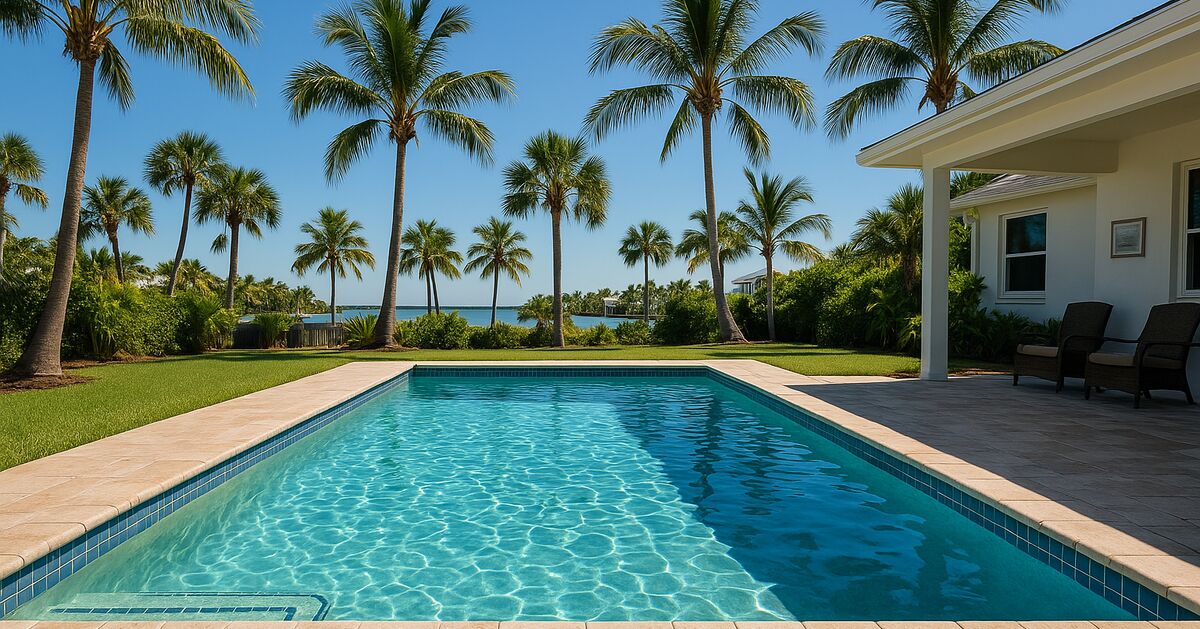
Your pool looked full on Monday and now, by Friday, you can see a ring of bare tile halfway up the skimmer throat. Something is eating your water, and you want to know what.
On Longboat Key and the surrounding barrier islands, pool water loss is one of the most common calls we get, and it is also one of the most misdiagnosed. Homeowners panic about leaks when evaporation is the real culprit. Or they shrug off what looks like normal evaporation while a slow structural crack quietly drives up their water bill. Getting the diagnosis right matters, because the fixes are completely different and the costs vary by a wide margin.
This guide walks you through the three main causes of pool water loss on the Gulf Coast, how to tell them apart with a simple bucket test, and what to do once you know which problem you are dealing with.
How much water loss is actually normal here?
Before you worry, you need a realistic baseline. In a mild, humid climate, an uncovered pool might lose half an inch to three-quarters of an inch of water per week to evaporation alone. On Longboat Key, Lido Key, and Siesta Key, that number climbs noticeably higher for most of the year.
Here is why our local conditions push evaporation up:
- Heat. Surface water temperature in an outdoor pool can hit 90°F or above through the summer months. Warmer water evaporates faster.
- Wind. Being on a barrier island means persistent Gulf breezes. Wind strips the boundary layer of humid air right off the pool surface, replacing it with drier air and accelerating evaporation.
- Low relative humidity during winter dry season. Counter-intuitively, the cooler, drier months from November through April can produce significant evaporation because the air can absorb so much moisture even though temperatures are lower.
- Pool surface area. A large, freeform pool with a spa, beach entry, and negative edge has far more exposed water surface than a standard rectangular pool of the same volume.
- Waterfalls and fountains. Every feature that breaks the water surface and sprays droplets into moving air multiplies evaporation dramatically.
Put all of that together and a one-inch loss per week is not unusual for an uncovered pool on the key during a windy stretch in summer. Two inches is starting to be a concern. Three inches or more in a single week with normal weather is worth investigating seriously.
The bucket test: your first and most important step
Before you call a leak detection company or tear anything apart, do the bucket test. It has been around for decades and it works.
What you need: A five-gallon bucket, a brick or heavy stone, and a marker or piece of tape.
How to do it:
- Fill the bucket with pool water to within an inch of the rim.
- Place the bucket on the first or second step of your pool so it is partially submerged, with the water level inside the bucket matching the pool's water level as closely as possible.
- Mark the water level inside the bucket and on the outside of the pool (use tape or a grease pencil on the skimmer throat).
- Turn off any auto-fill valve so the pool does not top itself up during the test.
- Run the pool exactly as you normally would, including the pump and any water features, for 24 to 48 hours.
- Compare the drop inside the bucket to the drop in the pool.
Reading the results:
- Pool drops the same amount as the bucket - You are looking at evaporation. The bucket, sitting in the same sun and wind, lost the same proportion as the pool. No leak.
- Pool drops significantly more than the bucket - You likely have a leak. The bucket accounts for weather and evaporation; the extra loss is unaccounted water going somewhere else.
- Pool drops more only when the pump is running - This points strongly toward a plumbing or equipment leak rather than a structural shell issue.
The bucket test is not 100 percent perfect. A very slow leak might not show a dramatic difference over 24 hours. But it is a solid, free first step that separates the majority of evaporation-only cases from the ones that deserve a professional leak inspection.
When it really is a leak: what to look for
If the bucket test points toward a leak, take a walk around your pool and equipment pad before calling anyone. There is a lot you can observe yourself.
Around the pool shell:
- Look for wet spots in the surrounding deck or landscaping that stay damp even on dry days.
- Check the waterline tile for any cracks, gaps in grout, or sections that sound hollow when you tap them.
- Look along the steps and ledges for hairline cracks. Concrete and gunite pools develop surface cracks over time; a crack that is wet on both sides or has efflorescence (a white mineral stain) around it is more suspicious than a dry surface crack.
- Check around any lights, return jets, or skimmer baskets for movement or gaps in the fitting.
Around the plumbing and equipment:
- Inspect every visible pipe fitting, union, and valve at your equipment pad. A slow drip from a union fitting can waste hundreds of gallons a week and is easy to miss.
- Check the pump lid o-ring for cracking. A pump that sucks air rather than leaking water outward can still cause pressure loss that affects the whole system.
- Look at the backwash line if you have a sand or DE filter. A valve that does not seat properly will push water out the backwash port continuously.
- Check the heater connections. If you have a gas or heat pump heater, the unions on either side of the heat exchanger are a common leak point.
Homeowners near Longboat Key pool service areas often find that the culprit is a corroded fitting at the equipment pad rather than a crack in the shell. Saltwater-pool hardware and metal fittings near the coast degrade faster than they would inland, and even a pinhole in a glued PVC fitting can lose a surprising amount of water overnight.
For a deeper look at how coastal conditions accelerate wear on pool plumbing and hardware, the post on pool equipment lifespan near the coast covers exactly what to expect and when to plan for replacements.
Equipment problems that mimic a leak
Sometimes the water is not going into the ground at all. It is going somewhere in plain sight, but the cause is a piece of equipment behaving badly.
Auto-fill valve stuck open: Many pools on the key have an autofill (sometimes called a Levelor or a float valve). When it sticks in the open position, it keeps topping the pool up, masking a real evaporation or leak problem. When it sticks in the wrong position at night after you turn off the fill water, you may think the pool dropped overnight when it actually just never refilled. Test your autofill by turning it off completely for your bucket test period.
Backwash valve leaking to waste: As mentioned above, a multiport valve that does not seat fully on the filter position will bleed water out the waste line 24 hours a day. This can look like a slow but steady water loss that defies the bucket test results.
Salt chlorinator cell cracking: A cracked cell housing can drip water at the equipment pad. It is not always obvious because the water often follows the pipe and drips somewhere unexpected.
Heater heat exchanger failure: A failed heat exchanger can push water into the gas combustion chamber. You will sometimes see rust staining at the bottom of the heater cabinet as a clue. This one needs a professional to diagnose and repair.
If you have already gone through a round of equipment investigation and are still seeing unexplained loss, it may be worth reading about when coastal pool equipment needs replacing. The corrosive salt air environment between Anna Maria Island and Siesta Key ages equipment faster than manufacturers' published lifespans assume.
Does a pool cover help?
Yes, significantly. A standard solar cover (bubble cover) cuts evaporation by up to 70 percent when left on during the hours the pool is not in use. For a pool on Lido Key or Bird Key where Gulf breezes are constant, a cover can make a noticeable difference on your water bill and on the amount of chemical you use, since evaporation also concentrates the water chemistry.
Automatic covers that roll on and off with a switch are a bigger investment but are genuinely used because they are convenient. Manual solar covers are inexpensive but often end up sitting on the deck because they are a hassle to handle solo. Whatever type you choose, even leaving a cover on overnight, when evaporation rates spike because the air cools faster than the water, makes a real dent.
What about rainfall? Does it ever add water?
Yes, and this is something barrier-island homeowners sometimes forget. A heavy afternoon thunderstorm in July can add half an inch or more to your pool in an hour. If you are tracking water levels and a storm rolled through, adjust your expectations accordingly. Conversely, our dry-season months from January through May produce very little rainfall, so evaporation loss is not offset by natural top-up the way it is in summer.
Rainwater also dilutes your pool chemistry, which is a separate problem. If you have been tracking a slow water loss but just had a significant rain event, retest after the pool has had time to settle and after you have re-checked your chemistry. Diluted water and the debris that heavy rain blows in can make your water look cloudy and behave differently, which sometimes leads homeowners to mistake a chemistry problem for a leak. The cloudy pool water guide for barrier-island owners is a useful companion read if your water looks off after rain.
When to call a professional leak detection service
If the bucket test clearly shows the pool is losing more than evaporation accounts for, and you cannot find an obvious equipment or fitting leak at the pad, it is time for a professional leak detection inspection. A qualified technician will:
- Pressure-test the plumbing lines to isolate which run is losing pressure
- Use dye testing at skimmers, returns, lights, and fittings to find the exact point of entry
- Use listening equipment to detect water movement underground where visible inspection is impossible
Do not put this off for weeks trying to figure it out yourself. A pool shell crack that is losing two inches a week is also washing soil away from under the deck and shell. Over months, that can destabilize the deck, undermine the shell support, and turn a relatively small repair into a major one.
Our pool cleaning and maintenance services include a regular water-level check on every visit. If we notice a trend that does not match expected evaporation for the current weather, we flag it for the homeowner early, before it becomes an expensive problem.
Keeping an eye on things between visits
Even if you have a weekly service, developing a habit of glancing at your pool's water level mid-week takes about ten seconds and can catch a developing problem early. Mark a reference point on your skimmer throat or a tile with a waterproof marker so you have something to compare against. If the level drops more than about an inch below that mark between weekly service visits during a calm weather stretch, note it and mention it to your technician.
Homeowners across our service area, from Sarasota and Anna Maria Island to Siesta Key, deal with this question regularly. The good news is that in the majority of cases, the water loss turns out to be normal evaporation amplified by our coastal conditions, and a simple conversation and a bucket test resolve the worry completely.
If you are not sure what you are looking at, or if the bucket test pointed toward a real problem, get in touch with us. We are happy to take a look and give you a straight answer about what is going on with your pool.