
Pool equipment lifespan near the coast: when to upgrade
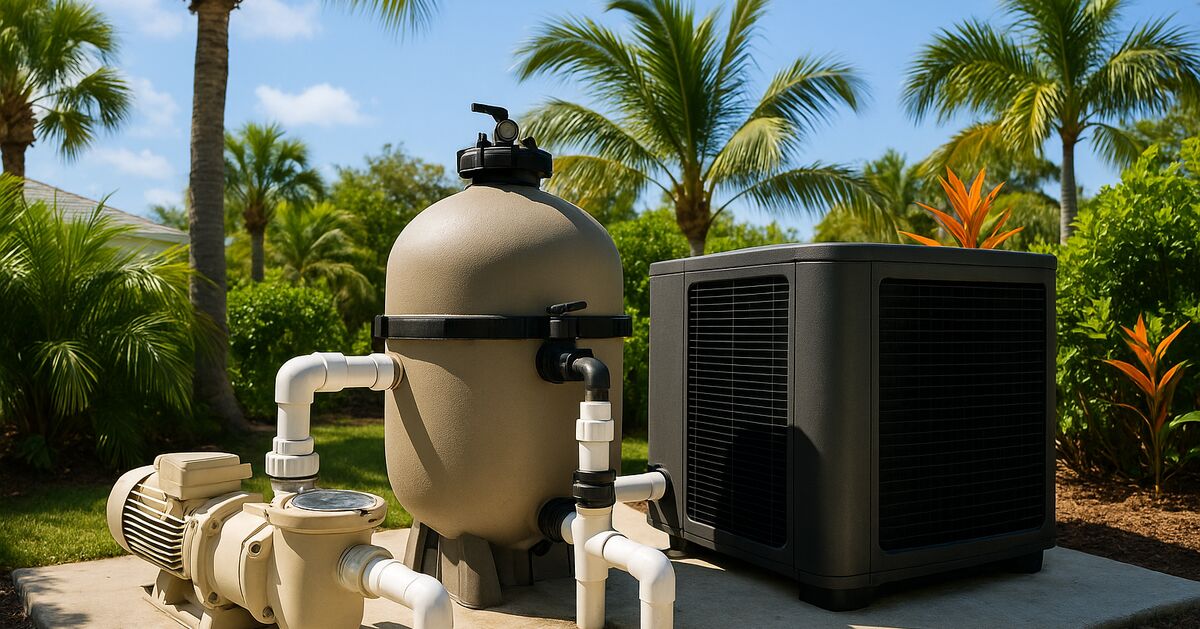
Coastal salt air, relentless Florida sun, and the kind of heavy-use summers that come with barrier-island living put your pool equipment on a shorter clock than most manufacturers print on the box. Knowing the realistic lifespan of each component, and spotting the warning signs before you have a full failure on your hands, is one of the best ways to protect both your pool and your wallet.
This guide walks through every major piece of equipment, gives you honest timelines for the Gulf Coast environment, explains the why behind accelerated wear, and tells you what to watch for so you can plan upgrades rather than scramble through emergency repairs.
Why coastal air shortens equipment life
Salt air is corrosive. That is not a scare tactic; it is simple electrochemistry. Sodium chloride particles suspended in the breeze settle on metal surfaces, circuit boards, and rubber seals. They attract moisture, which accelerates oxidation. On Longboat Key, Lido Key, Bird Key, and Siesta Key, homes sit within a few hundred feet of open water, and equipment pads are often exposed to afternoon sea breezes from the Gulf. That constant salt-and-moisture combination is the main reason pool equipment in our area ages faster than it does in an inland suburb.
Add Florida's UV index (consistently among the highest in the country), daily temperature swings between cool nights and 95-degree afternoons, and summer rainstorms that dump water on already-humid electrical enclosures, and you have a uniquely demanding environment for mechanical and electrical components.
There is no single fix that eliminates this wear entirely. But routine professional maintenance that includes inspecting equipment, rinsing salt deposits, and catching small problems early will meaningfully extend the life of every piece on your pad.
Pool pumps: realistic lifespan and what wears out first
Inland average: 10 to 12 years Gulf Coast realistic range: 7 to 10 years, sometimes less for single-speed models on exposed pads
The pump is the heart of your circulation system, and it takes the hardest beating from the coastal environment. The motor housing, typically painted steel or aluminum, shows rust and corrosion within a few seasons if it is not protected and rinsed regularly. Capacitors inside the motor are sensitive to heat and humidity. Shaft seals, which keep water out of the motor, degrade faster in salt-laden air.
Signs it is time to replace rather than repair:
- The motor hums but will not start (failed capacitor, potentially a motor that has been struggling for a season)
- You hear grinding, screeching, or rattling that a new impeller does not fix
- The motor is hot to the touch even at startup
- You are on your second or third repair in two years
- Your pump is a single-speed model over eight years old
On that last point: if your pump is a single-speed unit and showing any wear at all, replacement with a variable-speed pump is almost always the right call. Variable-speed models run quieter, use significantly less electricity, and the constant lower-RPM operation puts less mechanical stress on internal components. They also tend to have better weatherproofing on modern enclosures.
Pool filters: sand, cartridge, and DE
Sand filters: 7 to 10 years before the tank itself needs replacing; sand media every 5 to 7 years Cartridge filters: cartridges every 1 to 3 years; tank 10 to 15 years with care DE (diatomaceous earth) filters: grids every 5 to 8 years; tank similar to cartridge
The filter tank itself is usually fiberglass or reinforced plastic, which holds up reasonably well to salt air compared to metal components. What degrades faster on the coast are the internal components: o-rings, pressure gauges (which have metal internals and corrode), and the multiport valve on sand filters.
A common mistake we see on Anna Maria Island and Siesta Key properties is homeowners ignoring a rising PSI on the pressure gauge. If your filter is running 8 to 10 PSI above its clean baseline and a backwash or cartridge rinse does not bring it down, the media may be channeled or the filter undersized for the actual load. Neither problem fixes itself.
Signs the filter needs attention or replacement:
- Pressure stays high even right after cleaning
- Water clarity stays poor despite correct chemistry (the filter is not doing its job)
- Visible cracks in the tank or around the valve housing
- The multiport valve leaks back through the waste port when set to filter
Pool heaters: heat pumps vs. gas
Heat pump: 10 to 15 years inland; 8 to 12 years on the coast Gas heater: 8 to 12 years inland; 5 to 9 years on the coast
Heaters have the most metal exposure of any piece of equipment on the pad. Heat pump coils, copper headers, and burner assemblies in gas heaters are all vulnerable to salt corrosion. The good news: heat pumps are far more common in our area than gas, partly because they are more efficient in Florida's climate and partly because there is often no natural gas on the barrier islands. Electric heat pumps do not have burner assemblies to corrode, but their coil fins and cabinet metal still suffer from the salt environment.
We regularly see heat pump cabinets on Longboat Key and Lido Key properties that look significantly aged on the outside while the refrigeration components inside are still functional. The reverse also happens: cabinets that look fine but have corroded coil fins that restrict airflow and reduce efficiency by 20 to 30 percent.
Signs your heater needs attention:
- It runs but the water temperature gain is much lower than it used to be
- Error codes related to low refrigerant or high pressure (heat pumps)
- Visible corrosion on the coil fins (they look like a car radiator; bent or fused fins restrict airflow)
- A gas heater that lights but cycles off quickly, or will not maintain a set temperature
- Unusual smells, which with gas heaters always warrant an immediate professional inspection
Automation systems and controllers
Realistic lifespan: 7 to 12 years, but individual components (circuit boards, relays, display screens) may fail sooner
Automation systems have multiplied in popularity on high-end barrier-island homes, and they add tremendous convenience, allowing owners who split time between the island and a northern home to monitor their pool remotely. But the electronic brains of these systems are sensitive to humidity and salt contamination.
The most common failure we see is corroded terminal connections and relay boards inside the control enclosure. A properly sealed and regularly inspected enclosure survives much longer than one that was installed and then ignored. If your system is losing programming, showing intermittent failures, or displaying error codes you cannot clear, the control board is often the culprit.
If your automation system is more than eight years old and starting to act up, it is worth getting an honest assessment: sometimes a single board replacement restores years of life; other times the whole platform is outdated enough that upgrading to a current system (with better weatherproofing, app control, and energy monitoring) makes more financial sense.
Salt chlorine generators (saltwater systems)
Cell lifespan: 3 to 7 years Control board: 5 to 10 years
This is one of the areas where coastal homeowners sometimes feel a little cheated. A saltwater pool sounds low-maintenance, and in many ways it is, but the salt cell itself is a consumable. It is made of titanium plates coated with a ruthenium or iridium oxide coating that gradually erodes with each chlorine-generating cycle.
Inspecting the cell every three months, cleaning it with a dilute acid wash when calcium deposits form, and keeping salt levels in the correct range (generally 2,700 to 3,400 ppm, per your manufacturer's spec) will push cell life toward the longer end of that range. Letting salt levels run low stresses the cell; letting calcium build up unchecked and going too long between cleanings shortens it.
Signs the cell is nearing end of life:
- The system runs but free chlorine stays low even at maximum output
- The cell inspection shows heavily worn or pitted plates
- Error codes indicating low flow or low salt when both are actually correct (often a failing cell sending bad data)
Our frequently asked questions page covers salt system basics in more detail if you want to dig deeper before your next service visit.
Pool lights
LED lights: 15 to 25 years for the fixture; niches and conduit can be problematic sooner Older incandescent fixtures: 5 to 8 years
LED pool lights are now so efficient and long-lived that if you still have an incandescent fixture, replacement with LED is almost always worth doing. The lamp itself is rarely the problem after the LED switch; the more common issue is the niche (the housing embedded in the pool wall) cracking or allowing water intrusion into the conduit, which creates a potential safety hazard.
Any flickering, tripped GFCI breaker associated with the light, or water visible behind the lens is a reason to call a professional promptly. Pool lighting and electricity require careful handling.
Plumbing: PVC fittings, valves, and unions
PVC pipe: essentially indefinite lifespan indoors or underground; above-ground sections exposed to UV can become brittle in 10 to 15 years Valves and unions: 7 to 15 years depending on quality and UV exposure
Above-ground PVC that gets daily UV exposure on the Gulf Coast turns chalky, brittle, and eventually cracks. White PVC is particularly susceptible; gray or UV-stabilized fittings hold up better. The unions (threaded couplings that allow you to disconnect the pump or filter without cutting pipe) are a common failure point because they are subject to both UV and the mechanical stress of equipment removal and reinstallation.
If you see white, chalky PVC on your equipment pad, any union that feels gritty or difficult to turn, or any slow drip at a fitting, address it before it becomes a fast drip. Plumbing failures near the pump can allow the pump to run dry, which kills the motor in minutes.
How to plan for upgrades rather than emergencies
The most expensive way to replace pool equipment is as an emergency on a Friday afternoon before a holiday weekend. The most economical approach is tracking the age of each component, noting the early warning signs above, and replacing on a schedule you choose.
A few practical steps:
- Keep a simple equipment log. Note the installation date and model number of each piece. A photo of the label works fine.
- Schedule a full equipment inspection annually, separate from routine cleaning visits. A trained eye can spot early corrosion, seal degradation, and electrical issues before they become failures.
- Ask about bundling. If your pump is at eight years and your filter is at seven, replacing both at the same time often saves on labor versus doing them separately a year apart.
- Factor in energy savings. Old single-speed pumps and electric resistance heaters cost significantly more to run than their modern equivalents. The upgrade math often looks better once you account for the monthly energy difference.
Our team serves homeowners across the barrier islands and mainland, from Longboat Key and Siesta Key to Anna Maria Island and the broader Sarasota area. We see the full range of equipment ages and conditions, which means we can give you an honest read on what is worth repairing and what has run its course.
When to call a professional for an equipment assessment
Some signs are obvious: the pump will not start, the heater throws an error code, the filter is leaking. Others are subtler: water clarity that gets harder to maintain despite correct chemistry, energy bills that creep up without explanation, a pump that is running hotter than usual. Both categories deserve a professional look.
Reach out to us if you want an honest equipment assessment. We will tell you what is holding up well, what is worth a repair, and what is approaching the end of a useful service life, without pushing you toward unnecessary replacements. That is the kind of straightforward advice we would want if the pool were ours.
For a full picture of what a professional service program covers and how it protects your equipment investment over time, take a look at our complete list of services. Staying ahead of wear on the Gulf Coast is not complicated; it just takes consistency and the right set of eyes.