
Why pool water turns green so fast in summer
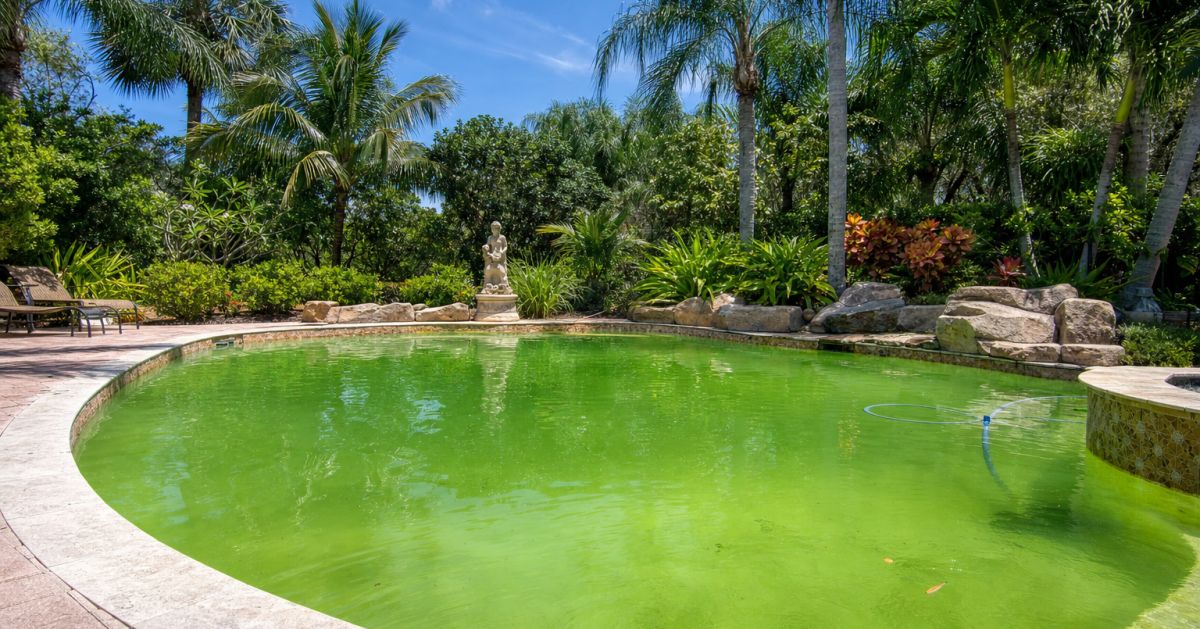
Green pool water is not just an eyesore. It is a sign that algae have taken over and that your swimmers are at risk of skin irritation, ear infections, and worse. In Sarasota and on the barrier islands, that takeover can happen in as little as 48 to 72 hours during July and August, which catches a lot of homeowners completely off guard.
Understanding why it happens so fast here is the first step to stopping it for good.
The science behind a summer algae bloom
Algae are single-celled plants. Like any plant, they need three things to thrive: sunlight, warmth, and nutrients. Sarasota's summer delivers all three in abundance.
Sunlight intensity. Southwest Florida sits at roughly 27 degrees north latitude. During June through September, the sun angle is high and the days are long, which means pool water receives an enormous dose of ultraviolet radiation. UV is the primary enemy of free chlorine - the sanitizer that actually kills algae and bacteria. The CDC's healthy swimming guidance notes that chlorine can be depleted very rapidly in direct sunlight, which is why outdoor pools require far more frequent monitoring than indoor ones.
Water temperature. Pool water on Siesta Key or Longboat Key can easily reach 88 to 92 degrees Fahrenheit by mid-afternoon in summer. Warm water dramatically accelerates algae reproduction rates. It also accelerates chlorine off-gassing, meaning your sanitizer burns off faster precisely when you need it most.
Nutrients in the water. Every time a swimmer enters the pool, they introduce body oils, sunscreen, sweat, and urine. Afternoon thunderstorms - a daily feature of Florida summers - wash pollen, fertilizer runoff, bird droppings, and airborne dust into the water. All of these are nutrients algae can feed on. On Anna Maria Island and Bird Key, where landscaping is lush and properties sit close to the water, wind-borne organic matter enters pools at a higher rate than you might expect.
Stabilizer imbalance. Cyanuric acid (CYA) is the chemical that protects chlorine from UV degradation. Too little and your chlorine evaporates within hours. Too much, however, and it "locks up" the chlorine so it cannot kill anything - a phenomenon pool professionals call chlorine lock. Many pools on Lido Key and St. Armands Key that go green repeatedly are found to have CYA levels above 80 parts per million (ppm), which renders even high chlorine readings nearly useless.
Why the barrier islands are especially vulnerable
If you live on Longboat Key, Siesta Key, or any of the other Gulf Coast barrier islands, your pool faces a few added stressors that inland Sarasota pools do not.
Salt air accelerates corrosion of pool equipment, including pump seals and filter components. A failing pump that runs fewer hours than it should means water sits still, circulation drops, and algae settle undisturbed. We cover the equipment side in depth in our post on how salt air and sand wear out pool equipment.
Sea breezes also carry fine organic particles directly into pool water. And many barrier island pools are surrounded by lush tropical landscaping, meaning leaves, palm debris, and flower petals fall in constantly. Each piece of organic material that dissolves in the water is free food for algae.
Finally, barrier island properties often sit vacant for weeks at a time during the off-season or during owner travel. A pool left unattended for even ten days in August without an automated dosing system or a professional visit is almost certain to turn green.
The five stages of a green pool
It helps to know what you are looking at so you can act at the right stage.
- Hazy water (early warning). The water appears slightly cloudy or dull. Chlorine is low but algae have not yet bloomed visibly. This stage is easy to correct with a shock treatment and filter run.
- Light green tint. Algae are actively reproducing. The pool may still be swimmable but should not be used. Act now and you can clear the water in one to two days.
- Bright green water. A full algae bloom. The water is opaque, the bottom may not be visible, and filtration is being overwhelmed. This takes two to four days of aggressive treatment to resolve.
- Dark green or teal water. A heavy, established bloom. Algae are coating surfaces. Expect three to five days of treatment, possible filter backwashing or cartridge cleaning multiple times, and significant chemical costs.
- Black-green or slimy water. Severe neglect. Black algae, the hardest variety to kill, may be establishing in grout lines. This is a multi-week recovery project and sometimes requires professional brushing with a steel brush and repeated superchlorination.
The lesson: the earlier you catch a bloom, the cheaper and faster the fix.
How to clear a green pool, step by step
This process applies whether you have a mild tint or a full bloom. Scale the chemical doses to the severity.
Step 1 - Test before you treat
Never dose a green pool without testing first. You need to know:
- Free chlorine (target 1 to 3 ppm for maintenance; you will raise this significantly during treatment)
- pH (target 7.4 to 7.6)
- Cyanuric acid / stabilizer (target 30 to 50 ppm for a chlorine pool)
- Total alkalinity (target 80 to 120 ppm)
- Calcium hardness (target 200 to 400 ppm)
A good test kit or a strip test from a pool supply store gives you a baseline. Many pool supply stores in Sarasota will test a water sample for free.
Step 2 - Adjust pH first
Chlorine is far less effective at high pH. If your pH is above 7.8, the percentage of "active" (hypochlorous acid) chlorine drops sharply, according to the Water Quality and Health Council's swimmer health guidelines. Add muriatic acid or dry acid to bring pH into the 7.2 to 7.4 range before shocking. This slightly lower range maximizes the killing power of the shock you are about to add.
Step 3 - Brush every surface thoroughly
Before adding chemicals, brush the walls, steps, benches, and floor. Algae cling to surfaces with a thin biofilm layer. Brushing breaks that layer open and exposes the algae cells to the sanitizer you are about to add. Use a nylon brush for plaster and fiberglass, and a stainless steel brush only on bare concrete pools. Do not skip this step - it makes a measurable difference in how quickly the treatment works.
Step 4 - Shock the pool aggressively
For a green pool, a maintenance dose of chlorine will not cut it. You need to superchlorinate, which means raising free chlorine to a "shock level" that overwhelms the algae load.
- Light green (stage 2): Raise free chlorine to 10 to 15 ppm.
- Bright green (stage 3): Raise free chlorine to 20 to 30 ppm.
- Dark green or worse (stages 4 and 5): Raise free chlorine to 30 ppm or higher, repeat as needed.
Use calcium hypochlorite (cal-hypo) granular shock, which is fast-acting and cost-effective. Dissolve it in a bucket of water first, then pour around the perimeter of the pool. Add shock at dusk or at night - sunlight will burn off a significant portion before it can do its work if you add it during the day.
If CYA is above 80 ppm, partial draining and refilling (dilution) may be necessary before shocking will help at all. This is a situation where a professional assessment pays for itself quickly.
Step 5 - Run the filter continuously
Run the pump and filter 24 hours a day until the water clears. For cartridge filter owners, check and rinse the cartridge every 12 to 24 hours during treatment - a clogged cartridge will cause the pump to work against back-pressure and reduce turnover dramatically. For sand filter owners, backwash when the pressure gauge rises 8 to 10 psi above its clean baseline.
Dead algae turn the water from green to cloudy white or gray. That is a good sign. It means the chlorine is winning. Keep filtering.
Step 6 - Add a clarifier or use an algaecide strategically
A clarifier helps the filter capture the tiny dead algae particles that cause cloudiness after treatment. Add a standard pool clarifier per the product directions once the water is turning from green to white-gray.
Algaecides (specifically polyquat 60) are non-foaming and can help as a follow-up treatment or as a preventive weekly dose. They are not a substitute for proper chlorine chemistry, but they provide a secondary layer of protection during peak summer months.
Step 7 - Retest and balance
Once the water is clear, retest everything and balance back to target ranges. Confirm that CYA is in the 30 to 50 ppm range. If it is low, add stabilizer (isocyanuric acid) to protect future chlorine from UV burn-off. If it is high, plan a partial drain.
Why the problem keeps coming back
A pool that goes green repeatedly is almost always telling you one of a few things:
- The pump is not running long enough. In summer, most Sarasota pools need 8 to 12 hours of pump run time per day to turn the water over sufficiently. Many homeowners set timers for 6 hours in winter and forget to adjust them in June.
- CYA has crept too high. Every time you use stabilized chlorine tablets (trichlor), you are adding a small dose of CYA. Over a swim season, it accumulates. If you use tabs exclusively, test CYA every month during summer.
- The filter needs service. A filter that has not been backwashed, cleaned, or inspected in months cannot do its job. Sand typically needs changing every 5 to 7 years; cartridges need replacing every 1 to 3 years depending on use.
- Visits between treatments are too far apart. In June through September, weekly chemical dosing that works fine in February is often not enough. Many homeowners on Siesta Key and Anna Maria Island move to twice-weekly service visits during peak summer to stay ahead of algae.
Our year-round pool maintenance schedule for barrier islands goes into detail on how to adjust your routine season by season.
What a professional service visit actually does
A trained technician does more than pour chemicals. During a typical visit, a professional will:
- Test water chemistry with a reliable kit and adjust all parameters, not just chlorine
- Inspect pump operation, filter pressure, and skimmer baskets
- Brush walls and steps
- Skim surface debris before it sinks and starts decomposing
- Note early signs of equipment wear or algae growth before they become expensive problems
For pools on the barrier islands especially, that set of eyes every week makes a large difference. If you are curious what routine service looks like for your area, our pool cleaning and maintenance services page explains the full scope of what we do, and you can explore coverage for specific communities including Longboat Key, Lido Key, Siesta Key, and Anna Maria Island.
The honest bottom line
Summer in Sarasota is genuinely hard on pool water. The combination of intense UV, warm temperatures, daily thunderstorms, and heavy bather loads creates conditions that algae are perfectly adapted to exploit. The chemistry is not complicated, but it demands consistency. A pool that is tested and balanced twice a week through the summer will almost never go green. A pool that goes two or three weeks without attention in August will almost certainly turn.
If your pool has already gone green, follow the step-by-step process above and be patient. The water will come back. If it keeps coming back, that is the signal to look harder at CYA accumulation, pump run time, and filter condition - or to call in a professional who can diagnose the underlying cause.
You can browse answers to common water chemistry questions on our FAQ page, or get in touch with us directly if you would like a professional assessment of your pool before the summer really heats up.