
How salt air and sand wear out pool equipment
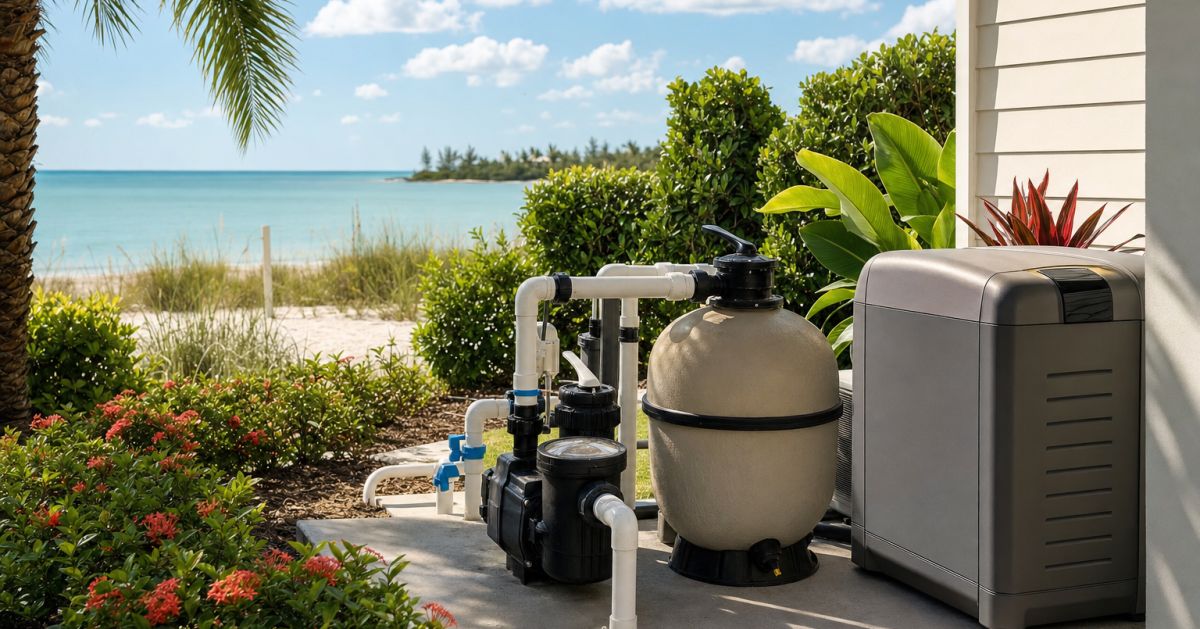
Salt air and windblown sand are two of the most relentless forces working against your pool equipment in the Sarasota area - and they never take a day off.
If you own a pool on Longboat Key, Siesta Key, Anna Maria Island, or anywhere else along this stretch of the Gulf Coast, your pump, heater, filter, and electrical components are exposed to a corrosive cocktail that simply doesn't exist in the same concentration twenty miles inland. Understanding exactly what's happening - and why - puts you in a position to slow the damage dramatically and avoid the kind of repair bills that catch owners off guard.
Why Gulf Coast Air Is Harder on Equipment Than You Think
The air along the Sarasota coastline carries a fine aerosol of sodium chloride and magnesium chloride droplets that drift inland from the Gulf. These particles are small enough to be nearly invisible, but they settle on every metal surface they touch. Once deposited, they attract moisture from the humid Florida air, and that combination - salt plus moisture - triggers electrochemical corrosion on ferrous and non-ferrous metals alike.
The corrosion process accelerates when temperatures climb, which in Sarasota means you're dealing with an aggressive environment for the better part of nine or ten months a year. Pool pump motors, electrical conduit, junction boxes, heater heat exchangers, and even the stainless-steel fasteners holding your equipment pad together are all vulnerable.
The U.S. Department of Energy notes that corrosion costs American industry and homeowners billions of dollars annually, and coastal environments are specifically identified as among the most damaging due to the persistent presence of chloride ions. That's not an abstract statistic when your pump motor seizes three years before it should.
What Salt Air Does to Specific Equipment
Pump Motors
Pool pump motors have vented housings that allow airflow for cooling. That same ventilation draws salt-laden air directly across the windings and capacitors inside. Over time, salt deposits on the windings create conductive pathways that cause electrical shorts. The capacitor - the component that helps the motor start - is particularly sensitive. A motor that labors to start, hums without turning over, or trips the breaker repeatedly is often showing early signs of salt-related internal corrosion.
Heaters
Gas and heat pump pool heaters take a double hit. The exterior cabinet, usually made of painted steel or aluminum, corrodes from the outside due to salt air. The interior heat exchanger, made of copper or cupronickel, is exposed to corrosive pool water on one side and combustion gases or refrigerant on the other. Salt air gets into the cabinet through ventilation gaps and attacks the burner tray, gas valves, and control boards. A heater that's throwing ignition error codes or running inefficiently may be dealing with corrosion on burner orifices or heat exchanger fins rather than a fundamental mechanical failure.
Electrical Components and Control Boards
Automation systems, timers, junction boxes, and breaker panels on or near the equipment pad are extremely vulnerable. Salt air creates a conductive film on circuit board traces, causing intermittent shorts, false readings, and eventually total failure of control boards that can cost several hundred dollars to replace. This is one of the main reasons electrical components near the coast fail years earlier than the manufacturer's rated lifespan.
Filter Tanks and Manifolds
Fiberglass filter tanks are relatively resistant to corrosion, but the metal band clamps, valve bodies, and pressure gauges attached to them are not. DE and sand filter multiport valves - often made of brass or chrome-plated zinc - corrode from the outside in areas of high salt exposure. The valve handle seizes, the O-rings degrade faster due to UV and salt exposure, and gauge faces fog or give inaccurate readings.
Pool Ladders, Rails, and Anchors
Stainless-steel ladders and handrails are specifically rated for saltwater environments, but even 316-grade stainless develops surface rust pitting in high-chloride air over time. The deck anchors embedded in your pool coping are even more vulnerable because they sit in a crevice environment (trapped moisture, restricted airflow) that accelerates crevice corrosion. A wobbly ladder is not just annoying - it's a safety concern.
Sand: The Grinding Force You're Probably Underestimating
Windblown sand from Gulf beaches is an abrasive that acts like fine-grit sandpaper when it's driven against equipment surfaces by the sea breeze. On barrier islands like Longboat Key and Lido Key, where nothing stands between your equipment pad and the Gulf for a significant portion of the year, this is a real and ongoing problem.
Sand settles into pump motor vents and bearings. It accumulates in the filter equipment cabinet and around valve seats. It gets into the pool itself, increasing the particulate load on your filter and shortening filter run times between backwashes. Sand also works its way under the pool cover and into the skimmer baskets, compounding the filtration burden.
Bearing wear from sand ingestion is subtle at first - a slight increase in motor noise is a common early sign - but it accelerates rapidly once the bearing surface is compromised. A motor that costs a few hundred dollars to replace when the bearings first show wear can destroy the entire pump volute if ignored, turning a moderate repair into a full equipment replacement.
Practical Steps to Slow the Damage
1. Keep the Equipment Area Clean
Rinse down your equipment pad with fresh water every two to three weeks - more often if you're on a barrier island or the wind has been particularly strong. This removes accumulated salt deposits before they can establish a persistent corrosive layer. Pay special attention to motor vents, cabinet louvers, and any exposed metal fasteners.
2. Apply Corrosion Inhibitors to Electrical Components
Dielectric grease on electrical connections, terminal blocks, and conduit entry points creates a moisture barrier that interrupts the electrochemical process. Products like CRC Marine or similar corrosion inhibitor sprays applied to the exterior of motor housings and junction box interiors are inexpensive and genuinely effective. Reapply every six months as part of routine maintenance.
3. Protect Your Motor
Consider a motor cover or equipment enclosure if your pad is in a particularly exposed location. These are available in vented designs that don't impair cooling but dramatically reduce direct salt air and sand exposure to the motor housing. For premium variable-speed motors, the investment in a cover pays for itself in extended motor life.
4. Inspect and Replace O-Rings on Schedule
Salt and UV exposure degrades rubber O-rings faster than the manufacturer's standard replacement interval assumes. In Sarasota's coastal conditions, inspect filter valve O-rings, pump lid O-rings, and union O-rings annually. Lubricate them with a silicone-based pool O-ring lubricant and replace them at the first sign of flattening or cracking. A five-dollar O-ring ignored long enough can allow an air leak that cavitates your pump.
5. Treat Stainless Steel Surfaces
A product like a lanolin-based corrosion inhibitor or even a light coat of petroleum jelly applied to ladder anchors and rail sockets reduces crevice corrosion significantly. Some pool owners on Anna Maria Island and Bird Key rinse their rails and anchors with fresh water weekly during the summer when salt air is heaviest - a simple habit that makes a real difference.
6. Keep Your Pool Chemistry Balanced
This one is easy to overlook in the context of external salt and sand damage, but pool water that's out of balance attacks your equipment from the inside at the same time salt air attacks it from the outside. Low pH (below 7.2) makes pool water aggressive toward copper heat exchangers and plumbing fittings. High calcium hardness causes scaling that reduces heater efficiency and can crack heat exchanger tubes. Per the Pool & Hot Tub Alliance's water balance guidelines, maintaining pH between 7.4 and 7.6, total alkalinity between 80 and 120 ppm, and calcium hardness between 200 and 400 ppm protects equipment from internal corrosion and scaling simultaneously.
7. Schedule Regular Professional Inspections
A trained technician can spot early corrosion on control board traces, the beginning of bearing wear in a motor, or a compromised heat exchanger fin before those issues become expensive failures. At a minimum, a full equipment inspection once a year - ideally before the heavy-use summer season - is worthwhile in any coastal Sarasota zip code.
What to Expect in Terms of Equipment Lifespan Locally
It's reasonable to expect that quality pool equipment installed in a coastal Gulf environment will have a shorter service life than the same equipment installed inland. Pump motors rated for ten to twelve years of service may realistically last seven to nine years on a barrier island without active protective measures, and closer to their rated life with consistent care. Heaters see similar compression of their service windows in salt air environments.
That's not a reason for pessimism - it's just a reason to be proactive rather than reactive. Owners on Siesta Key and St. Armands Key who rinse their equipment regularly, keep their chemistry balanced, and schedule annual inspections consistently report fewer emergency repair calls and lower overall maintenance costs than those who only address problems after they surface.
How a Local Service Pro Fits Into This
A pool service company that works specifically in the Sarasota coastal area understands these environmental realities in a way a generalist does not. Local technicians recognize the difference between normal corrosion and accelerated salt-air damage, know which equipment brands hold up better in coastal conditions, and can apply protective treatments as part of routine visits rather than waiting for a problem to declare itself.
If you're on Longboat Key, Lido Key, or Bird Key and you've noticed your equipment aging faster than expected, a conversation with a local pool professional is a logical first step. Our pool cleaning and maintenance services are designed with these exact conditions in mind - including routine equipment checks that catch corrosion damage early.
Owners across our service area - from Siesta Key to Anna Maria Island - deal with the same salt air and sand challenges. If you're not sure how your equipment is holding up, our FAQ page covers common questions about equipment lifespan and maintenance schedules, or you can get in touch with us directly for an assessment.
Salt air and sand are facts of life on the Gulf Coast, and they're part of what makes this area extraordinary to live in. With the right habits and the right help, they don't have to cut your pool equipment's life short.