
Why pool coping grout fails faster on Longboat Key - and which replacement materials hold up
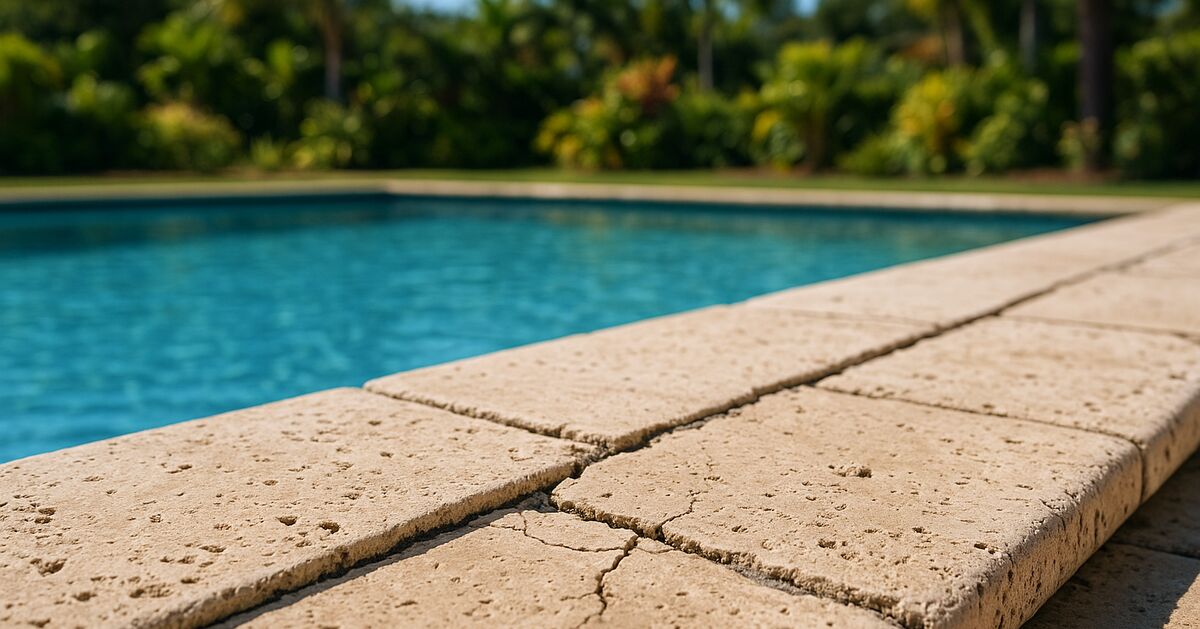
Salt is eating your pool coping grout right now, even if you can't see it yet.
Homeowners on Longboat Key, Lido Key, and Bird Key spend good money on beautiful travertine or natural stone coping, only to find cracked, hollow, or missing grout joints within a few years. Inland pools tend to show grout wear much later than barrier island pools, where salt exposure speeds up the failure timeline considerably. The question isn't whether it will happen - it's whether you understand why, so you can choose a repair that actually lasts.
What grout is actually doing at the pool's edge
Coping is the cap that runs along the top edge of your pool wall, bridging the pool shell and the surrounding deck. Grout fills the joints between individual coping pieces and, critically, between the coping and the pool deck itself.
That joint does several things at once. It keeps water from migrating behind the coping into the bond beam (the structural concrete ring at the top of the pool shell). It accommodates the slight movement between two different materials as they heat and cool. And it provides a finished, watertight edge that keeps debris from wedging underneath the stone.
When the grout fails, water gets behind the coping. Once water is behind the coping on a Florida barrier island, you have a problem that compounds quickly: the bond beam can saturate, the coping can lift, and during a hard rain or a splash-heavy afternoon of pool use, that water carries salt with it deep into the pool structure. If you've ever read about what shifting groundwater does to pool plumbing on Longboat Key, you already know that water infiltration in island pool structures is never a small issue.
The four forces working against your coping grout here
1. Salt air and salt spray
The Gulf of Mexico is roughly 100 to 200 feet from many Longboat Key and Lido Key pool decks. Salt air doesn't just corrode metal - it attacks cementitious materials too. Salt crystals are hygroscopic, meaning they absorb moisture from the air. When those crystals form inside the micropores of grout (a process called subflorescence), they expand as they dry and contract as they re-wet. That repeated cycling physically breaks apart the grout matrix from the inside out.
This is the same mechanism that causes efflorescence - the white, powdery residue you may have noticed blooming on your coping or pool tile. Per the Portland Cement Association's guidance on concrete durability, salt crystallization pressure is among the most damaging forces a cementitious product can face in a coastal environment.
2. Florida's thermal swing
People think of Florida as just "hot," but the daily and seasonal temperature swings are significant for building materials. Longboat Key pool decks can swing from cool winter mornings to very hot surface temperatures on summer afternoons, especially with dark stone or concrete coping. That's an 80-degree swing across a single day in extreme cases.
Grout and stone expand and contract at different rates. Conventional sanded portland cement grout is rigid. It does not flex. Every time the joint cycles through heat and cold, the grout is asked to do something it physically cannot do for long - and so it cracks.
3. UV degradation
UV radiation on the Gulf Coast is intense year-round. Conventional cementitious grout is not especially UV-stable. The binders that hold the grout together break down under prolonged solar exposure, leaving a chalky, porous surface that water and salt can penetrate far more easily.
4. Pool chemistry and splash-out
Chlorinated pool water splashing repeatedly onto coping joints accelerates the degradation of standard grout. High-pH water (common in Florida's hard water supply) can deposit calcium at the surface and deepen existing micro-cracks. Low-pH swings are even more aggressive, actually dissolving the calcium carbonate in the grout itself. For a deeper look at why waterline materials take such a beating, the post on the hidden cost of skipping waterline tile cleaning on a saltwater-exposed pool covers related chemistry in detail.
Common failure patterns to look for
Knowing what to look for helps you catch grout failure before water has time to migrate. Here are the patterns that come up again and again on barrier island pools:
- Hollow-sounding joints. Tap the coping stone with a rubber mallet. A solid "thunk" is good. A hollow "click" means the coping has debonded from the substrate - grout failure has already allowed water behind the stone.
- Hairline surface cracks. These start small and are easy to dismiss. On the coast, they are never cosmetic. They are entry points for salt water.
- Joint crumbling at the pool edge. The joint between the coping underside and the pool tile is frequently the first to go because it sits at the waterline and is directly exposed to splash chemistry.
- White powder or staining along joints. As noted above, that's efflorescence - evidence that water is moving through the grout and depositing minerals on its way out. Our post on pool tile and waterline stains: what each color is telling you explains this mineral migration in detail.
- Lifted or rocking coping pieces. This is a late-stage failure. The bond beneath has been compromised and water infiltration is ongoing.
Why the original grout was never the right choice for this environment
The hard truth is that many builders on Longboat Key, Siesta Key, and Anna Maria Island use standard sanded or unsanded cement grout at the coping joints because it is inexpensive and familiar. It works fine for interior tile. At the pool's exterior edge on a coastal barrier island, it is the wrong product for the environment.
This is not a criticism of any one builder. For decades, the industry treated pool coping grout the same way interior tile setters did. Only as polymer-modified and epoxy-based alternatives matured did it become practical to specify a product that could survive coastal exposure, UV, and thermal cycling simultaneously.
If your coping is several years old or your pool predates the wider availability of coastal-rated grout products, it may well have been set with conventional grout regardless of the coping stone's quality. The stone may look perfect while the joints are already failing.
Replacement materials that actually hold up
Here is where the investment is worth making. When you are re-grouting coping on a Longboat Key pool, you have several options - and choosing the right one from the start saves money over the long run.
Polymer-modified sanded grout
This is the minimum upgrade from standard cement grout. Polymer latex additives are blended into the mix, giving the cured product some flexibility and better resistance to chemical attack. It is still a cementitious product, so it will eventually degrade in a salt-air environment, but it lasts considerably longer than unmodified grout. It is widely available, relatively affordable, and appropriate for joints up to about 1/2 inch wide.
Best for: Owners on a moderate budget who need a meaningful improvement over standard grout without a full specialty-product installation.
Epoxy grout
Two-part epoxy grout is not a cementitious product at all. It is a resin-and-hardener system that cures into a dense, nearly non-porous surface. Salt, chlorine, UV, and thermal cycling all have far less effect on properly installed epoxy grout than on any cement-based alternative. Industry guidance generally recommends epoxy grout for pools, chemical-exposure environments, and areas subject to thermal cycling - which is exactly what barrier island coping faces.
The downsides are real: epoxy grout is more expensive than polymer-modified products, it is unforgiving to install (the working time is short and temperature-sensitive, which matters on a hot Florida pool deck), and it requires an experienced installer. Done right, it is the longest-lasting option available.
Best for: Travertine, marble, or high-end stone coping where you want the joint material to match the lifespan of the stone itself. Particularly well-suited to Longboat Key and Bird Key pools with premium finishes.
Urethane grout (single-component)
Urethane grouts are a newer category that sits between polymer-modified cement and full epoxy in both cost and performance. They are pre-mixed, stain-resistant, highly flexible, and more UV-stable than cement-based products. Several major manufacturers have introduced urethane grout lines specifically marketed for exterior and pool applications. Because they flex rather than crack, they handle thermal cycling especially well.
Best for: Owners who want better-than-epoxy flexibility for joints that move, without the installation complexity of two-part epoxy systems.
Backer rod plus polyurethane sealant for the expansion joint
This is not a grout at all, but it is often the correct answer for the joint between coping and deck - the one that builders most frequently fill with grout and that fails first. That joint is a true expansion joint, designed to absorb movement between two separate concrete structures. Per the American Concrete Institute (ACI 224R guide on cracking in concrete structures), expansion joints should never be filled with a rigid material.
The correct repair is to remove all old grout from that joint, install a closed-cell foam backer rod to the proper depth, and seal over it with a polyurethane or polysulfide sealant color-matched to the coping. This joint will flex without cracking, and it should be inspected periodically and refreshed as needed depending on exposure.
What a proper re-grouting job involves
If a contractor is quoting you coping grout repair and proposing to simply press new grout over the old failed material, that is not a repair - it is a delay. Proper re-grouting involves:
- Full removal of all failed grout with an oscillating tool or grout saw, without damaging the coping faces.
- Cleaning the joint of salt deposits, biofilm, and any loose substrate with an appropriate cleaner.
- Allowing the joint to dry fully (which in Florida's humidity may require a sunny afternoon or two).
- Applying the chosen grout or sealant product in the correct conditions - epoxy grout in particular should be installed out of direct sun and avoided during the hottest part of the day.
- Curing protection and post-installation sealing where the product specifies it.
A square-footage estimate without a site visit is a sign to be cautious. The scope of barrier-island coping work varies enormously depending on how deeply the failure has progressed and whether the substrate itself needs repair before re-grouting makes sense.
Our team provides pool cleaning and maintenance across the barrier islands, and coping inspection is part of how we catch these failures early, before water has had months to work behind the stone.
How often should you inspect and reseal?
On Longboat Key, Lido Key, and Siesta Key, a practical schedule is:
- Annually: Visual inspection of all coping joints, including the expansion joint between coping and deck. Look for hairline cracks, hollowing, efflorescence, and any movement in the coping pieces.
- Every two to four years: Professional assessment of the expansion joint sealant and re-application if the sealant has cracked or pulled away from one or both sides.
- After any significant storm: Salt-laden storm surge and wind-driven rain can force water into joints that were borderline. Check after hurricane-season events in particular.
Homeowners on Anna Maria Island should be especially attentive given the combination of Gulf and bay exposure that many properties face. Our Anna Maria Island pool maintenance page covers the specific challenges of that environment in more detail.
When it's more than a grout problem
If your coping is rocking, if you can see daylight under a piece when you press down on it, or if there is visible cracking in the bond beam itself, re-grouting alone will not fix the underlying issue. Lifted coping needs to be pulled, the substrate assessed, and the coping re-set with an appropriate thin-set mortar before any joint material is applied.
This is also the point at which it is worth getting a professional set of eyes on the rest of the pool structure. Failed coping can allow sustained water infiltration into the bond beam, which in a high-water-table environment like Longboat Key or Lido Key has consequences beyond cosmetics. The Longboat Key pool maintenance page explains how we approach whole-pool assessments, not just individual repairs.
The short version
Standard cement grout was never well suited to coastal Florida coping, and the salt air, UV, and thermal cycling on Longboat Key can accelerate its failure faster than expected. When it's time to replace it, polymer-modified grout is the minimum upgrade, epoxy or urethane grout is the right choice for premium stone, and the deck-to-coping expansion joint should always be sealed with a flexible sealant over a backer rod - never filled with rigid grout.
If you are not sure what condition your coping joints are in, that is a good reason to get in touch for an assessment before the next rainy season begins. Catching this early is the difference between a afternoon of grout work and a full coping re-set.
Sources & further reading
- Concrete Durability: Salt Crystallization and Subflorescence (Portland Cement Association)
- ACI 224R Guide to Cracking in Concrete Structures - Expansion and Control Joints (American Concrete Institute (ACI))
- Florida Building Code - Swimming Pools and Bathing Places (Florida Department of Business and Professional Regulation)
- EPA Guide to Managing Pool Water Chemistry and Material Degradation (U.S. Environmental Protection Agency)
Claim-by-claim audit (6 checked)
- “Inland pools tend to show grout wear much later than barrier island pools, where salt exposure speeds up the failure timeline considerably.” (rewritten to what the article can stand behind)
- “Longboat Key pool decks can swing from cool winter mornings to very hot surface temperatures on summer afternoons, especially with dark stone or concrete coping.” (rewritten to what the article can stand behind)
- “Industry guidance generally recommends epoxy grout for pools, chemical-exposure environments, and areas subject to thermal cycling - which is exactly what barrier island coping fac…” (rewritten to what the article can stand behind)
- “If your coping is several years old or your pool predates the wider availability of coastal-rated grout products, it may well have been set with conventional grout regardless of th…” (rewritten to what the article can stand behind)
- “epoxy grout in particular should be installed out of direct sun and avoided during the hottest part of the day.” (rewritten to what the article can stand behind)
- “This joint will flex without cracking, and it should be inspected periodically and refreshed as needed depending on exposure.” (rewritten to what the article can stand behind)