
Why Salt Air Off the Gulf Wears Out Pool Equipment Faster
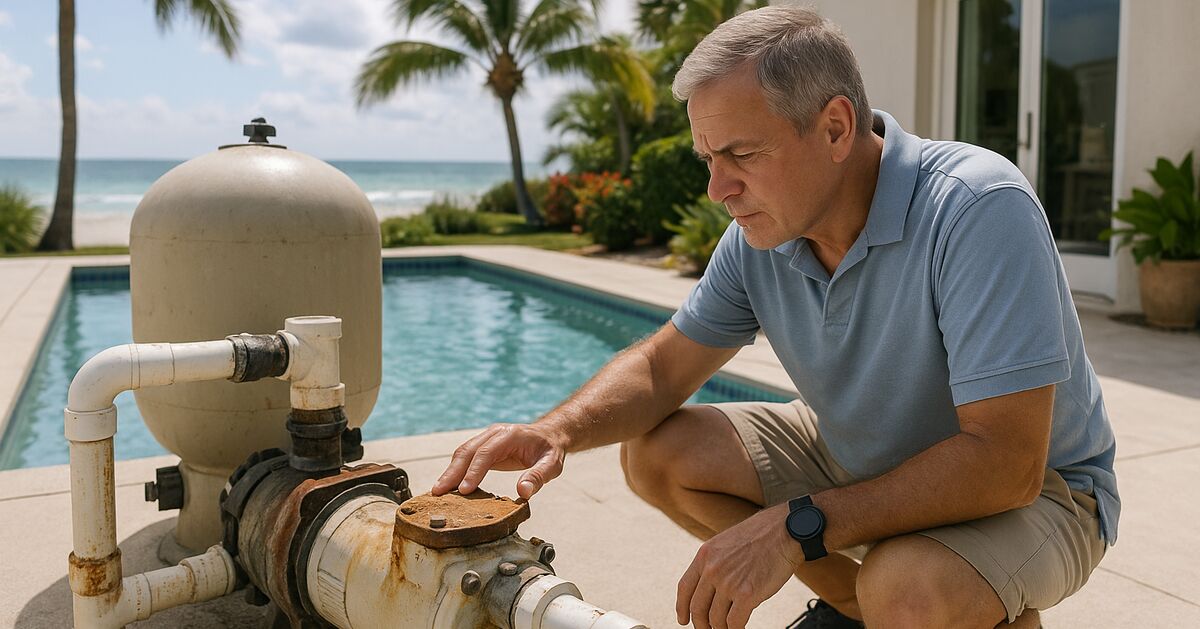
Salt air is one of those things you stop noticing after a few weeks on Longboat Key. It's just part of the deal - the breeze off the Gulf, the smell of the water, the way everything feels slightly damp even on a sunny afternoon. What you do eventually notice, sometimes painfully, is what that air does to your pool equipment over time.
Pump motors that seize up years ahead of schedule. Control panels with corroded terminals. Heat pump cabinets that look fine on the outside but are dissolving internally. Filter canisters with fittings so oxidized they snap when a technician tries to turn them. These are not flukes. They are what happens when pool equipment sits in a coastal atmosphere day after day, and understanding the mechanism makes it much easier to catch the damage early.
Why Coastal Air Corrodes Equipment So Much Faster
You don't have to be right on the water's edge for this to matter. On a barrier island like Longboat Key, salt-laden moisture is essentially everywhere. Wind picks up sea spray, and that fine aerosol carries sodium chloride and other minerals far inland - or in this case, far across the island. Even properties that face the bay rather than the Gulf are exposed, because the prevailing onshore wind carries the aerosol from both directions depending on the time of day.
The science is straightforward. Salt is hygroscopic, meaning it attracts and holds moisture. When salt particles settle on metal surfaces - motor housings, electrical terminals, copper wiring, steel brackets, brass fittings - they create a thin, persistent film of conductive moisture. That moisture accelerates electrochemical corrosion dramatically compared to what the same metal would experience in a drier, inland environment. Steel rusts faster. Aluminum oxidizes faster. Copper develops a greenish patina that signals the metal is being consumed. Brass fittings, extremely common in pool plumbing, are especially vulnerable to a process called dezincification, where the zinc component of the alloy leaches out, leaving a porous, weakened copper structure that eventually crumbles.
On the inland side of the Sarasota metro, a well-maintained pool pump might reasonably last ten or more years. On Longboat Key, Lido Key, Bird Key, or Siesta Key, five to seven years is a more realistic expectation for the same pump if it isn't inspected and protected regularly. That gap represents real money, and the difference is almost entirely explained by salt air exposure.
The Equipment Most at Risk
Not every component corrodes at the same rate. Knowing which parts are most vulnerable helps you focus your attention.
Pump motors. The electric motor driving your pool pump has metal housings, windings, and bearings. Moisture intrusion through corroded seals eventually reaches the windings and causes insulation breakdown. The first sign is often intermittent starting failures or a motor that runs hot and trips the thermal overload breaker. By the time a motor fails completely, internal corrosion has usually been building for a year or two.
Electrical panels and timer boxes. These are arguably the most sensitive components on a coastal property. Control panels contain circuit boards, relays, and wiring terminals that are extremely intolerant of salt moisture. Corrosion on a terminal connection increases electrical resistance, which generates heat, which accelerates corrosion further - a self-reinforcing cycle. Panels that look intact externally often have green or white corrosion buildup on internal terminals that is invisible until you open the enclosure.
Heat pumps. If your pool uses a heat pump, the cabinet houses a refrigerant coil, a compressor, and a fan motor, all of which are exposed to ambient air. The aluminum fins on the evaporator coil are highly susceptible to pitting from salt. A corroded coil loses efficiency before it fails outright, so your electricity bill quietly climbs while the unit works harder to reach the same water temperature.
Copper plumbing and brass fittings. Many older pools on Longboat Key and across Anna Maria Island still have copper plumbing or at least brass union fittings and valves. These develop green patina and pitting that can eventually lead to pinhole leaks. Even PVC plumbing is not immune, because the metal fittings and clamps connecting PVC runs will corrode and can cause joint failures.
Filter housings and multiport valves. Cartridge and D.E. filter tanks are typically plastic, which resists corrosion, but the metal hardware - bolts, banding, valve handles, pressure gauge fittings - corrodes readily. A seized multiport valve handle is a classic Longboat Key pool problem. Forcing a corroded valve handle is one of the more common ways homeowners accidentally crack a filter body, turning a minor maintenance item into an expensive repair.
How to Catch It Early: The Inspection Habits That Save Money
Early detection is everything with corrosion. Metal that has started to oxidize but hasn't yet failed can often be cleaned, treated, and extended in life significantly. Metal that has corroded through to structural failure has to be replaced. Here's what to look for and how often.
Monthly visual walk-around. Once a month, spend five minutes walking around your equipment pad and looking at everything with fresh eyes. You're looking for white or green powder on metal surfaces (oxidation and salt deposits), rust streaks running down from fasteners, any sign of moisture staining around electrical enclosures, and corrosion at pipe fittings and unions. If you see it, flag it for your service tech at the next visit.
Open the electrical panel seasonally. At least twice a year, open your timer or control panel and look at the terminal connections and wiring. Green buildup on copper terminals is a clear warning sign. Do not touch live terminals, but you can look. If you see significant corrosion, that's a job for a pool professional or a licensed electrician, not a DIY cleaning.
Check the motor vents. Pool pump motors have ventilation slots that allow airflow to cool the motor. Peer into these vents with a flashlight. If you can see rust or corrosion on internal surfaces, moisture is getting in and the motor casing or shaft seals may need attention.
Listen to your equipment. A motor that rattles, grinds, or hums differently than usual may have bearing corrosion. A heat pump that cycles on and off unusually quickly may have a fouled coil. A filter that needs to be backwashed more frequently than before may have a partially blocked multiport valve due to corrosion buildup in the valve body. Your equipment tells you things if you pay attention.
Have a pro inspect annually. A trained eye catches things a homeowner's walk-around will miss. Our pool cleaning and maintenance in Longboat Key includes routine equipment checks precisely because coastal exposure makes periodic professional assessment genuinely worthwhile, not just a sales pitch.
Protective Measures Worth Taking
Catching problems early is one half of the equation. The other half is slowing the corrosion process down in the first place.
Dielectric grease on electrical terminals. Any time a qualified technician opens an electrical connection at your pool equipment, applying a thin coat of dielectric grease to terminals before closing the connection back up creates a moisture barrier that dramatically slows terminal corrosion. It's a small step that extends the life of electrical components significantly on barrier islands.
Anti-corrosion spray on motor housings. Products like CRC 6-56 (a marine-grade corrosion inhibitor) applied to external motor housings and metal equipment surfaces help displace moisture and create a protective film. This is standard practice on boat equipment throughout the Sarasota and Manatee County area and transfers well to pool equipment.
Shade and ventilation. Equipment pads that sit in direct afternoon sun and trap heat accelerate corrosion because the expansion and contraction cycles stress metal surfaces and joints repeatedly. A simple shade structure or equipment enclosure that allows ventilation but blocks direct sun and rain splash can noticeably extend equipment life. Make sure any enclosure doesn't restrict airflow around the motor or heat pump.
Rinse the equipment pad after storms. After heavy rain or a tropical weather event, rinsing the equipment pad and surrounding area with fresh water dilutes and removes salt deposits that rainfall carried down from exposed surfaces. It takes two minutes with a garden hose and makes a difference over time. If you want a full checklist for post-storm pool care, our post on what to check on your pool after a Longboat Key storm covers this in detail.
Keep pool chemistry balanced. This one surprises people, but pool water that is out of balance, particularly water that is too acidic, actually accelerates corrosion on metal pool components that come in contact with the water, including pump impellers, heater heat exchangers, and metal ladder hardware. Our guide on balancing pool chemistry in Florida heat explains why Florida's climate makes this especially tricky and what to watch for.
Saltwater Pools and an Extra Wrinkle
If you have a saltwater pool, you have one additional layer of corrosion risk: the salt cell itself generates a slightly corrosive chlorinated environment around the cell housing and plumbing nearby. Saltwater pools are wonderful in many ways, and for a full comparison of the tradeoffs, our post on saltwater vs. traditional chlorine for Sarasota island pools is worth reading. The practical takeaway for equipment longevity is that salt cell housings and the plumbing immediately around them deserve close inspection every few months, and the cell itself should be cleaned on schedule to prevent calcium and corrosion buildup that shortens cell life.
What This Looks Like Across Our Service Area
While Longboat Key gets a lot of attention on this topic because of its narrow barrier island geography and consistent Gulf exposure, the same dynamics apply across the coastal communities we serve. Pools on Lido Key and Bird Key sit in essentially identical salt-air environments. Properties on Siesta Key see similar equipment wear patterns. Even pools further from the immediate waterfront in Sarasota neighborhoods that are open to Gulf breezes show accelerated equipment corrosion compared to inland areas.
The common thread is proximity to salt water and the prevailing southwest winds that push marine air across all of these communities year-round. Seasonal visitors who leave their homes unoccupied for months at a time and let pool equipment sit idle often return to find corrosion damage that accelerated during their absence, because no one was checking. Regular professional service is particularly valuable for those properties.
When to Call a Professional
If you're not sure whether what you're seeing on your equipment is normal weathering or something that needs attention, err on the side of getting a professional opinion. Corrosion that looks minor visually can be much further progressed than it appears, especially on electrical components. A small service call to have a technician look at a suspicious motor or panel is far less expensive than an emergency repair when equipment fails mid-summer.
Our full list of services covers what's included in a standard maintenance visit and what we check on the equipment side. You can also browse our frequently asked questions for more information on service schedules and what to expect. If you're ready to set up regular service or just want someone to take a look at your equipment, the easiest step is to get in touch with us directly.
Salt air is the price of admission for living on the Gulf Coast. Knowing how it works and what to watch for means you pay that price in small, manageable increments rather than one large, unpleasant repair bill.