
Cloudy pool water on the barrier islands: causes and fixes
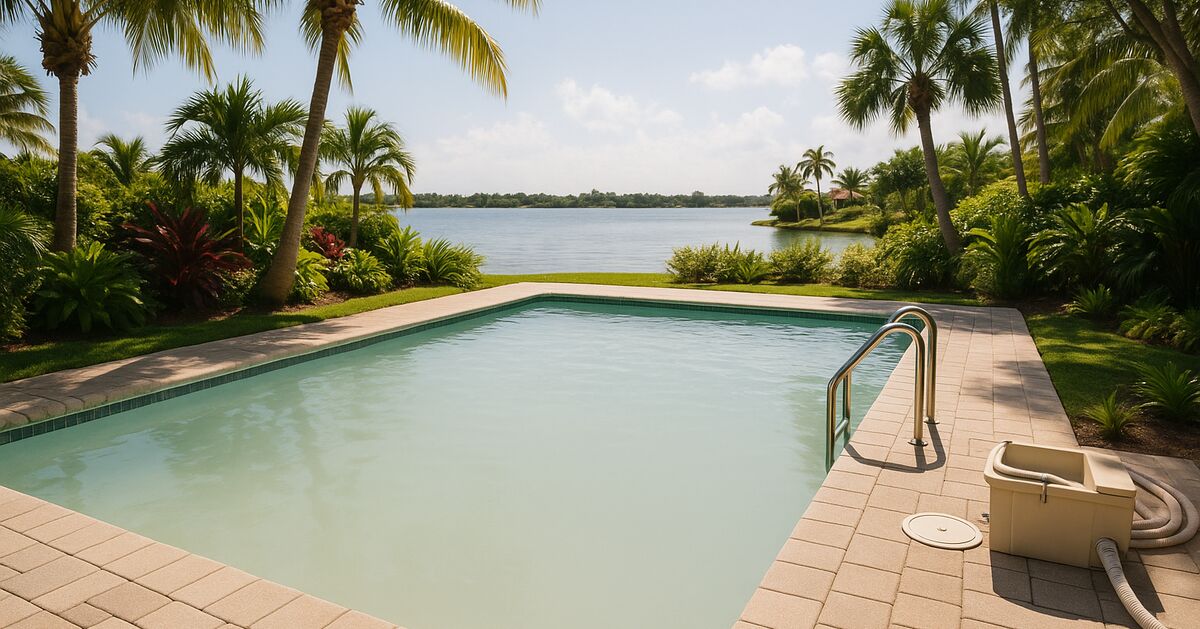
Cloudy pool water has a way of turning a perfectly good afternoon into a frustrating guessing game. One day your pool is sparkling clear, and the next it looks like watered-down milk. If you own a pool on Longboat Key, Siesta Key, Anna Maria Island, or any of the surrounding barrier islands, you are not imagining things: the local environment genuinely makes this problem more common and more stubborn than it is inland. Understanding exactly why cloudiness happens is the fastest path to fixing it and keeping it from coming back.
What cloudiness actually means
Water turns cloudy because tiny suspended particles are scattering the light passing through it. Those particles can be almost anything: dead algae cells, calcium deposits, body oils, sunscreen residue, fine debris carried in by the Gulf breeze, or the microscopic byproducts of an overwhelmed sanitizer system. The water is not necessarily unsafe to swim in at the very first sign of haze, but cloudiness is always a warning that something is out of balance. Left alone, it gets worse quickly, especially in Florida's heat.
The goal of any fix is not just to make the water look clear again. It is to address whatever allowed those particles to accumulate in the first place. Otherwise, the cloudiness comes back within days.
The barrier-island conditions that work against you
Homeowners in Sarasota, on Bird Key, or on Lido Key face a combination of factors that inland pools rarely deal with all at once.
High bather load and heavy sunscreen use. Barrier-island pools often see a lot of use, especially in winter and spring when owners and guests are visiting from colder climates. Sunscreen, body oils, and cosmetics break down chlorine and add organic load to the water faster than many people expect.
Intense UV radiation. The sun along the Gulf Coast is relentless from spring through fall. UV destroys free chlorine at the surface very quickly, which is one reason that pools without a stabilizer (cyanuric acid) at the right level can go from balanced to dangerously under-sanitized in a single sunny day.
Windblown debris and salt spray. The Gulf breeze deposits fine particulates into the water constantly. Sand, pollen, and salt spray all contribute to the suspended-particle load your filter has to process. Pools on the west-facing side of Longboat Key or on the open Gulf side of Anna Maria Island tend to collect debris faster than sheltered pools.
Our rainy season. From roughly June through September, afternoon thunderstorms can dump enormous amounts of rain into a pool in a very short time. Rain dilutes your chemicals, drops the pH, and introduces organic matter. If you want to understand just how dramatically rain can destabilize pool chemistry, our post on why rainy season is the hardest time to keep your Gulf-coast pool algae-free goes into this in detail.
The five most common causes of cloudy water here
1. Low or zero free chlorine
This is the single most common cause, and it is almost always fixable quickly once you identify it. When free chlorine drops below 1 ppm, bacteria and organic matter multiply. Your chlorine gets consumed fighting the contamination, and cloudy water follows. In summer, this can happen in 24 to 48 hours if something disrupts your dosing schedule, a chlorinator runs out, or a heavy rainstorm dilutes the water.
The fix: shock the pool with a chlorine-based shock product, brush the walls and floor to circulate any settled particles, and run the pump continuously until the water clears. If the cloudiness clears but returns within a few days, you have a recurring chemistry problem, not a one-time event.
2. pH and alkalinity out of range
Chlorine does not work well outside a narrow pH window. At a pH above 7.8, chlorine becomes far less effective even if the reading looks fine on paper. High pH also causes calcium to fall out of solution, which creates that white, milky haze that many homeowners mistake for algae.
Alkalinity matters because it stabilizes pH. On the barrier islands, the fill water from many municipal sources already comes in with elevated alkalinity, so the balance can drift high without any obvious cause. Testing pH and total alkalinity every week is the minimum standard here, not a luxury.
The fix: use a pH decreaser (muriatic acid or dry acid) to bring pH down to the 7.4 to 7.6 range, and adjust alkalinity to 80 to 120 ppm. Allow the circulation system to mix the chemicals fully before retesting.
3. Calcium hardness problems
Saltwater pools and traditional chlorine pools both have to manage calcium hardness, though the issues can look a little different. Very high calcium (above 400 ppm) causes calcium carbonate to precipitate out of solution, giving the water a chalky, white cloudiness. Very low calcium causes the water to become aggressive and start pulling calcium from grout and plaster, which also produces suspended particles.
On St. Armands Key and Lido Key, where many pools are older and have a lot of plaster surface, calcium management is especially important. If you have a saltwater pool, our guide to saltwater pool maintenance for island homeowners covers calcium balance in that specific context.
The fix: if hardness is high, dilution (partially draining and refilling with softer water) is often the only real solution. If it is low, a calcium hardness increaser brings it back into the 200 to 400 ppm range.
4. Filter problems
Your filter is doing the actual physical work of removing the fine particles that cause cloudiness. If the filter is dirty, channeled (water is bypassing the media), undersized for the volume of the pool, or simply at the end of its useful life, it cannot keep up.
Sand filters need backwashing when the pressure gauge rises 8 to 10 psi above the clean starting pressure. Cartridge filters need to be removed, rinsed with a garden hose, and inspected regularly. DE (diatomaceous earth) filters need to be charged with fresh DE after each backwash. Skipping any of these steps means the filter is circulating water without actually cleaning it.
Run time also matters. Many homeowners set their pumps to run 6 or 8 hours a day to save electricity. In Florida summer, that is often not enough. Running the pump at least 10 to 12 hours during peak season ensures that all the water turns over through the filter at least once or twice a day.
The fix: clean or backwash the filter, check the pressure gauge and look for physical damage to the cartridge or grids, and increase run time if cloudiness persists after chemistry is corrected.
5. Dead algae after a treatment
This one catches a lot of homeowners off guard. You treat a green pool with a large shock dose, the algae dies, and then the water turns a murky gray or white instead of clearing up. The algae is dead, but the dead cells are now suspended in the water. This is normal and temporary, but it requires aggressive filtration to resolve.
The fix: run the pump continuously, vacuum to waste if possible to remove the dead material directly without sending it back through the filter, and clean the filter repeatedly until the water clears. For more on the full process of recovering a neglected pool, our algae prevention rainy-season action plan includes the post-treatment steps in detail.
When a clarifier or flocculant actually helps
Pool clarifiers are chemical coagulants. They cause tiny suspended particles to clump together into larger particles that the filter can catch more easily. A clarifier is a useful tool, but it is not a root cause fix. Think of it as a way to accelerate the clearing process once your chemistry is balanced and your filter is clean. Using a clarifier on a pool with unbalanced chemistry is like sweeping dust under a rug.
A flocculant works differently. It causes particles to clump into heavy masses that sink to the bottom, where you can vacuum them out directly (to waste, not through the filter). Flocculant is powerful but requires the pump to be off for 24 to 48 hours while the material settles, which is inconvenient for an active pool. It is most useful for severely cloudy water that a filter alone cannot clear in a reasonable time.
What to check first, in order
If you are standing in front of a cloudy pool and wondering where to start, work through this sequence:
- Test free chlorine, pH, total alkalinity, and calcium hardness before touching anything else
- Correct any chemistry that is out of range, starting with pH and then free chlorine
- Check filter pressure and clean or backwash the filter if pressure is elevated
- Increase pump run time to at least 12 hours
- Brush the pool walls, floor, and steps to suspend settled particles back into the water column
- Add a clarifier if chemistry is now correct and the filter is clean but cloudiness persists
- Retest every 24 hours and adjust as needed
Most cases of cloudy water resolve within 24 to 72 hours when the right sequence is followed. If you are past 72 hours with correct chemistry and a clean filter, the problem is either a persistent organic load (very heavy bather use, a wildlife issue, or a leaking DE filter putting powder back into the water) or something mechanical that warrants a closer look.
When to call a professional
Some situations genuinely need an experienced eye. If your water has been cloudy for more than a week, if your chemistry readings are all over the place and you cannot get them stable, or if you have already treated for algae and the water still will not clear, it is time to bring someone in. Our pool cleaning and maintenance services include a full water analysis and filter inspection, and we can usually diagnose the root cause in a single visit.
Homeowners on Longboat Key can learn more about what regular service looks like for their specific environment on our Longboat Key pool service page. If you are on Siesta Key, our Siesta Key pool service page covers the particulars for that area, and homeowners on Anna Maria Island can find local information on our Anna Maria Island pool service page.
Preventing cloudiness before it starts
The best approach is consistent, proactive maintenance rather than reactive treatment. On the barrier islands, that means:
- Testing chemistry at least once a week, twice a week in summer
- Keeping cyanuric acid (stabilizer) between 30 and 50 ppm so chlorine is not burned off by UV in hours
- Cleaning the filter on a regular schedule rather than waiting for pressure to spike
- Rinsing off before swimming to reduce the sunscreen and oil load on the water
- Checking your chlorinator or salt cell output monthly to confirm it is producing at the right level
- Scheduling a professional service visit after any significant storm or heavy pool party
Cloudiness is one of those problems that feels sudden but is almost always the result of several small things drifting in the wrong direction at the same time. Catching any one of them early keeps the others from compounding.
If you have questions about your specific pool or want to set up a regular maintenance schedule, get in touch with our team. We service pools throughout Longboat Key, Lido Key, Bird Key, St. Armands Key, Siesta Key, Sarasota, Anna Maria Island, and The Village, and we are happy to take a look at what is going on before a minor haze turns into a major headache.