
Reading your equipment pad for salt-air corrosion
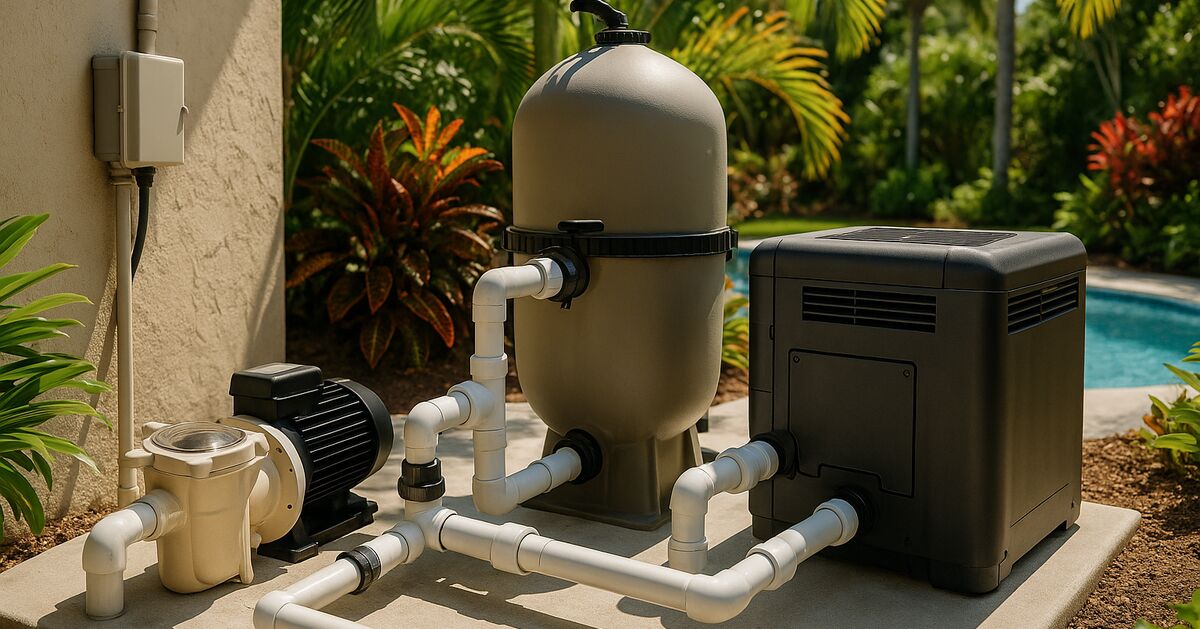
Rust-colored streaks on your pump housing, a faint green bloom on your electrical conduit, a timer dial that feels stiff and gritty - these are not cosmetic quirks. They are your equipment pad sending you a message, and the message is "fix this before it gets expensive."
Living on or near the Gulf is one of the genuine pleasures of owning a home in Sarasota County, but the salt-laden air that drifts off the water is relentless on pool equipment. The closer you are to the shoreline - on Longboat Key, Lido Key, Bird Key, or Siesta Key - the faster that chemistry works. Salt particles are hygroscopic, meaning they attract and hold moisture. When that moisture settles on metal components, electrical connections, and painted surfaces, oxidation accelerates in ways that simply do not happen inland. A quarterly visual walk-around of your equipment pad costs you nothing but ten minutes of your time. Knowing exactly what to look for is the difference between a small adjustment and a full equipment replacement.
Start with the big picture: what a healthy pad looks like
Before you can spot problems, it helps to know what "good" looks like. A well-maintained equipment pad should have:
- Equipment surfaces that are roughly the same color as when they were installed (faded is normal, flaking is not)
- Rigid PVC or CPVC plumbing with no white chalky mineral deposits around joints
- Conduit and wiring that runs neatly and is fully enclosed with no exposed wire
- Fasteners (bolts, screws, clamps) that are silver or stainless, not orange-brown
- No standing water or perpetually damp concrete under the pad
If you cannot remember what the equipment looked like new, a good photo log taken today becomes your baseline for every inspection going forward. This is a habit worth starting immediately.
The pump motor: your first and most important stop
The pump motor is often one of the first components to show salt-air damage because it runs hot, cycles on and off repeatedly, and has exposed metal surfaces in contact with moist, salty air during every rest cycle. Here is what to look for:
Exterior housing and end caps. On a typical single or variable-speed pump, the motor housing is a combination of plastic and cast metal end caps. Look closely at the end caps and the seam where they meet the motor body. Orange or reddish-brown staining here indicates iron oxide forming on internal components that has wept outward. This is not surface rust on a coating - it means corrosion is occurring inside the motor.
Vents and cooling fins. Motors are cooled by air drawn through vents along the housing. Press your finger gently near the vent louvers and check for a crust of white or light-tan mineral deposit mixed with rust. Blocked vents cause the motor to run hotter, which accelerates winding failure. Per the U.S. Department of Energy's guidance on motor efficiency, heat is the primary driver of premature motor winding degradation.
Shaft seal area. Where the motor shaft passes into the wet end of the pump, there is a mechanical seal. A slight mineral crust around this junction is normal. Active dripping or a rust stain running down the pump body toward the concrete pad is not - it usually means the seal is beginning to fail and water is wicking back along the shaft into the motor bearing.
Terminal box. If your pump has an accessible terminal or connection box, open the cover and look for green or white corrosion on the wire lugs and terminal block. Green corrosion on copper conductors means the insulation is no longer protecting the connection adequately. This is also a fire and shock hazard, not just an equipment concern.
Our team covers this in more depth when we discuss pool cleaning and maintenance services, because motor inspections are built into every professional visit for exactly this reason.
The filter tank and multiport valve
Fiberglass filter tanks are largely corrosion-resistant, but the hardware around them is not.
Clamp band and locking ring. The stainless steel clamp band that holds the filter lid in place is under constant tension and is often partially wet. Inspect the clamp's buckle mechanism and the band itself for pitting or rust spotting. A clamp that has corroded significantly can fail under the pressure spike that occurs when the pump starts, which is a safety risk as much as a maintenance issue.
Multiport valve handle and body. On sand and DE filters, the multiport valve handle is usually plastic over a brass or stainless body. Watch for hairline cracks in the plastic where it has been stressed by someone forcing the handle while the pump was running (a common mistake that comes up again and again in owner forums). Also look at where the valve body threads into or seats against the tank - mineral crusting here can make future disassembly very difficult and can crack the tank collar.
Pressure gauge. This is a small item that can be easily overlooked. The gauge threads into the filter tank with a brass fitting. If you see green patina around that fitting, the threads are corroding. More practically, coastal pool gauges can read inaccurately after a few years because the internal Bourdon tube, a thin coiled metal tube, can corrode from the inside out due to process water chemistry. A gauge that reads zero when the pump is running, or one that never moves off a fixed reading, needs replacement. You cannot assess filter condition without a working pressure gauge.
Electrical components: where the real risk lives
Salt-air corrosion on electrical components is the area where a visual inspection most directly prevents a dangerous and expensive failure.
Timer and control panel. Older mechanical timers have metal housings and exposed trippers (the small metal tabs on the dial that trigger on and off cycles). These trippers corrode and can seize to the dial, causing the timer to stop advancing. The result is a pump that runs continuously - or not at all. Open the timer panel door and look at the trippers. They should be bright metal. Orange-tipped or crumbling trippers need replacement.
Modern digital and variable-speed controllers have circuit boards inside that are sensitive to humidity and salt. If your control panel fogs up on the inside of its cover, or if you see white mineral haze on the interior surfaces, the enclosure seal has failed. This is a concern worth raising with a technician before the board corrodes through.
Conduit and wire entries. Wherever conduit enters a piece of equipment or a junction box, there should be a watertight connector (often called a conduit hub or rain-tight fitting). Run your finger around each one. If the fitting is loose, cracked, or missing entirely, the conduit is acting as a funnel that channels salt-air humidity directly to the wiring inside. The National Electrical Code (NFPA 70) and Florida Building Code both require listed fittings at these penetrations for good reason.
Ground wire and bonding connections. Pool equipment is required to be bonded together with a bare copper conductor. Look for this wire running between the pump, filter, heater, and any metal handrails. Where it connects to the equipment with a lug or clamp, check for green copper oxide or white mineral buildup that could be increasing resistance in the bond. We have a more detailed discussion of what the code requires for waterfront properties and pool bonding, which is worth reading if you are near the water on Bird Key, St. Armands Key, or anywhere along the Longboat Key bayfront.
The heater: highest failure risk per square foot
If you have a gas or heat pump pool heater, it deserves its own focused inspection. Heaters have the largest concentration of metal components in the smallest space, and the heat cycling they go through creates expansion and contraction that accelerates corrosion at joints and seams.
Heat exchanger fins. On a heat pump, the evaporator coil faces outward and acts almost like a fin-tube radiator. These aluminum fins corrode in salt air and can close together, reducing airflow and efficiency. Run a flashlight beam across the fins from the side - they should be uniformly spaced. Clumped or missing fins indicate corrosion damage.
Cabinet panels and fasteners. Sheet metal cabinet panels on gas heaters are typically powder-coated steel. Bubbling or flaking paint on the panels means the steel beneath is actively rusting. This is cosmetic at first but eventually allows moisture into the combustion chamber area. Check every visible screw and panel fastener. A rusted screw that shears off during service can turn a simple repair into an hours-long job.
Vent collar and draft hood (gas heaters only). The collar where the flue exits the heater should be firmly seated and sealed. Salt air entering through a loose vent collar will corrode the heat exchanger from the outside in. Manufacturer documentation for major brands like Pentair, Hayward, and Raypak generally recommends annual inspection of vent connections for this reason.
Plumbing connections and valves
PVC itself does not corrode, but the hardware connecting it does, and the PVC can degrade in its own way.
Unions. Unions are the threaded fittings that allow equipment to be disconnected for service. The plastic bodies are durable, but the o-rings inside them dry out and crack, especially when exposed to ozone from salt chlorine generators or UV from direct sun. Grip each union nut and try to turn it by hand. It should not be frozen. If it is, a technician will need penetrating lubricant or a strap wrench - and if the union shatters, you have an unexpected pipe repair.
Ball valves. Look at the handle position on your return and suction side ball valves. They should be pointing parallel to the pipe (open) when the system is running. A valve handle that is seized and will not move freely is a valve that will fail at the worst moment - typically when you need to isolate a piece of equipment quickly.
Check valves. Check valves prevent backflow from the pool into the equipment when the pump shuts off. The most common failure is a cracked body from UV degradation. Hold a flashlight at an angle to the check valve body and look for hairline cracks running along the seam. A failed check valve can allow water hammer on startup, which stresses unions and pipe joints throughout the pad.
What to do when you find something
A few practical guidelines:
- Surface corrosion on a metal housing that has not yet penetrated into function: clean with a wire brush, treat with a rust converter or corrosion inhibitor rated for outdoor/marine use, and monitor on your next inspection.
- Corroded electrical connections: this is a licensed electrician or pool technician job. Do not clean and re-land corroded wire connections yourself unless you are qualified to do so safely.
- A failed pressure gauge, leaking union, or seized valve: these are straightforward repairs that your pool service professional can handle during a regular visit.
- A pump motor showing internal rust or winding heat damage: budget for replacement rather than repair. On a motor more than five years old in a coastal environment like Longboat Key pool cleaning and maintenance, the labor cost to rebuild often approaches replacement cost.
- Anything involving the heater's gas train, vent, or combustion components: always a licensed professional - no exceptions.
For owners across Anna Maria Island, Siesta Key, and Sarasota, the corrosion timeline is similar because the salt air envelope extends well inland from the Gulf. You do not need to be oceanfront for this to apply to your equipment.
Building this into a routine
The right cadence for an equipment pad inspection is once a month during high-use season (typically April through October in Sarasota County) and once before closing out for any extended absence. If you use a pool service for regular maintenance, ask that they include a brief equipment pad notation in their visit report so you have a written record over time.
You can also review our frequently asked questions for guidance on what to expect from a professional service visit and how to communicate concerns to your technician. If you would rather have trained eyes on your pad before your next repair bill arrives, get in touch with us directly and we can schedule an inspection visit.
Salt air is patient. It works on your equipment every single day, all year long, whether the pool is being used or not. The good news is that most corrosion damage is gradual, detectable, and stoppable - if you know what to look for and you look before the failure happens.
Sources & further reading
- Motor efficiency and heat as a driver of winding degradation (U.S. Department of Energy)
- NFPA 70: National Electrical Code - wiring methods and pool equipment (National Fire Protection Association)
- Florida Building Code - Residential Pool and Spa chapter (Florida Department of Business and Professional Regulation)
Claim-by-claim audit (8 checked)
- “Blocked vents cause the motor to run hotter, which accelerates winding failure. Per the U.S. Department of Energy's guidance on motor efficiency, heat is the primary driver of prem…” (cited → energy.gov)
- “The National Electrical Code (NFPA 70) and Florida Building Code both require listed fittings at these penetrations for good reason.” (cited → nfpa.org)
- “Green corrosion on copper conductors means the insulation is no longer protecting the connection adequately.” (reasoning shown in the article)
- “This is also a fire and shock hazard, not just an equipment concern.” (reasoning shown in the article)
- “A clamp that has corroded significantly can fail under the pressure spike that occurs when the pump starts, which is a safety risk as much as a maintenance issue.” (reasoning shown in the article)
- “More practically, coastal pool gauges can read inaccurately after a few years because the internal Bourdon tube, a thin coiled metal tube, can corrode from the inside out due to pr…” (rewritten to what the article can stand behind)
- “Manufacturer documentation for major brands like Pentair, Hayward, and Raypak generally recommends annual inspection of vent connections for this reason.” (rewritten to what the article can stand behind)
- “On a motor more than five years old in a coastal environment, the labor cost to rebuild can be close to the cost of replacement.” (rewritten to what the article can stand behind)